
(A)FE and Skills as Place-Based Green Changemakers, A Personal Reflection of the Green Mindset Collective

I’ve been working in AFE (intentionally remembering ‘adult) and Skills on a climate action programme for two years now. Green Changemakers is a systems-change green mindset programme that develops a ‘second operating system’ in organisations, to drive momentum for transformation.
The programme itself has been a joy…but getting people to understand what it is and why we need it has been like pushing a boulder up a hill. We are not great at shifting systems in FE because the day job (the ‘first operating system’) is so prescriptive and exhausting, not our fault, by the way, but it still gets in the way of radical change. And if we are to lead the ‘green revolution’, radical change is what we need.
The Tipping Point
At the recent Green Mindset Collective, organised by FE News and supported by ETF, EAUC, Edge Foundation and City and Guilds, I finally felt that tipping point. And when I say ‘felt’, I mean really felt it, experienced an affective and even visceral moment where everyone there was ready and hungry for change.
I loved sharing a platform with Palvinder Singh and Oliver Newton – bright minds sparking off one another and expertly facilitated by Vikki Smith, who brought plenty of sparks of her own. I’ve written before about the powerful changemaking force of potentia and I was bursting with it when I hopped off that stage (not realising at the time we were sitting over a glass bottomed window 23 floors up!).
Where the Brilliance Happens
This is the third Collective and the first with a Green Mindset focus. The reason I get involved is because Collectives are so refreshing, not the usual tired format for education events, but a thought provoking morning followed by dedicated and generous facilitated thinking time – Collective Intelligence sessions. This is where the brilliance happens, where people are able to make connections with their own work and each other and where good intentions shift to sustainable change.
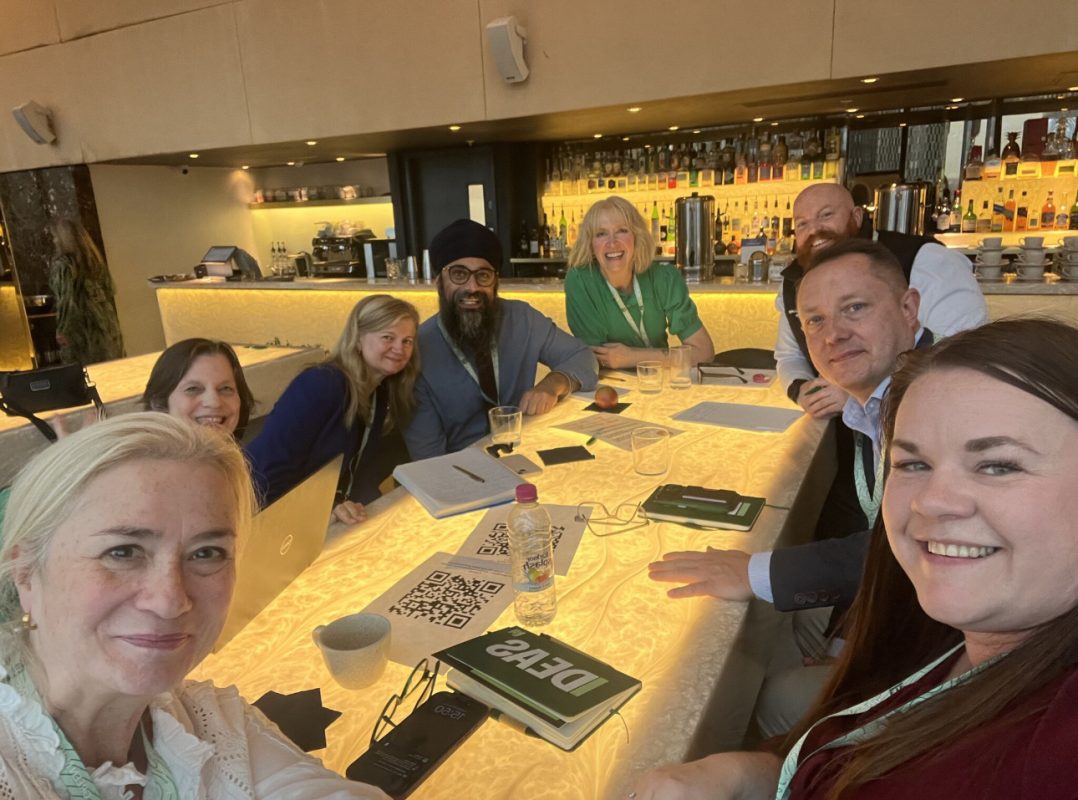
On 10th December, Vikki and Charlotte Bonner will publish a report from the Green Mindset Collective, which will shift the dial (Jacqui Smith, Minister of State for Skills has already said she’s looking forward to reading it, hugely appreciated but we know the real change will come from us). This will cover the whole event and all four Collective Intelligence sessions (also facilitated by Paul Smith from ETF, Sorah Gluck from Edge and Toby Shergold from Energy and Utility Skills). In what follows, I’d like to share some thinking from the Collective Intelligence Skills session I facilitated in a Thinking Environment – AFE and Skills as Place-Based Changemakers.
The 3% Who Influence the 85%
Pally and I had talked from the stage about Helen Bevan’s NHS Horizons work and the statistic that 3% of the workforce can influence 85% of their colleagues. We operationalise this through the Green Changemakers programme at Kirklees College and it proved to be a real conversation starter in our session (and throughout the whole event).
The opportunity to collaborate rather than compete is on offer to us. Leading anti-competitively and with equality is the way forward for (A)FE and Skills, working with the whole community and not just the ‘usual suspects’. Collaboration is itself a ‘green skill’ and is for the wider good.
The 3% (local leaders and influencers) are passionate and hopeful and they need time, agency and space to articulate their thinking. Leadership is in the values of organic (not forced) collaboration and community and in framing the challenge punchily so that parameters are clear.
Green Confetti and the Art of What’s Possible
So much brilliant ‘green confetti’ (do/try/change One Thing) already exists and needs to be not only visible and showcased, but brought into a coherent encounter with the first operating system. The work will be messy and doesn’t need to be perfect – it’s the art of what’s possible. Green skills/climate action/ESD should be empowered/embodied (beyond embedded) in curriculums and also across the wider estate – all areas of operations.
Local political relationships can be challenging but meeting face-to-face with combined authorities as well as community partners is necessary to drive change, including High Schools where the ‘green baton’ is dropped across the educational lifecycle. There is momentum in the world, FE and Skills can draw energy from this and resist being super-localised, to find its own momentum. People don’t know where to start but this work has already begun and we are beautifully placed to instil curiosity.
Momentum doesn’t have to be pace and speed. Change happens as a consequence of small, slow, patient actions taken by people with the courage to think differently, who are enabled to take risks, innovate, fail and learn. Understanding this reduces overwhelm.
Old Containers and Evidence-Based Traps
We went onto explore what’s currently getting in the way of this, not least the language we use which traps new thinking in old containers. What holds us back, too, is our ‘evidence-based’ culture. Sometimes, this is appropriate, but how can we do anything new if we rely on evidence from what’s already happened? We can’t start with all the answers, because nobody has faced this before. And we have a focus on ‘sustainability training’, when it needs to be on innovation.
The first operating system is focused on the day-job, which dominates and exhausts so that developing a green mindset is seen as a ‘nice to have’, rather than an overarching imperative. The lack of policy drivers underpins this and good intentions sometimes lead to unintended consequences and tick box approaches. Leaders’ mindset needs to shift – their role is creating opportunities for the 3% and using their power to shift systems when necessary. The urgency of the situation is more important than the money this may cost.
Brave and Expansive
That’s just a quick run-through of two hours of focused collaborative thinking, never mind countless inspiring exchanges which were happening throughout the day and to which this short article cannot do justice. Huge kudos to everyone there who to a person were willing to have brave and expansive conversations.
By Dr Lou Mycroft, Green ChangeMaker
Responses