
The Role of Further Education and Skills in a Sustainable Future


It’s clear that the UK faces urgent environmental and social challenges that demand real change in how people live, work and learn. Of course, the Government has committed to meeting these challenges, for example, with its ambitions to decarbonise the UK’s electricity system by 2030, secure the highest sustained growth in the G7, and break the link between a child’s background and their future success.
At the heart of these missions lies the development of a skilled and adaptable workforce. The further education (FE) and skills sector occupies a pivotal position: no sector in the tertiary world has such reach into every community and employer and is uniquely capable of operationalising sustainability policy at scale, embedding it not only in curriculum and training but in institutional culture and practice (Smith and Rowland 2024).
Continuous Learning and Workforce Culture
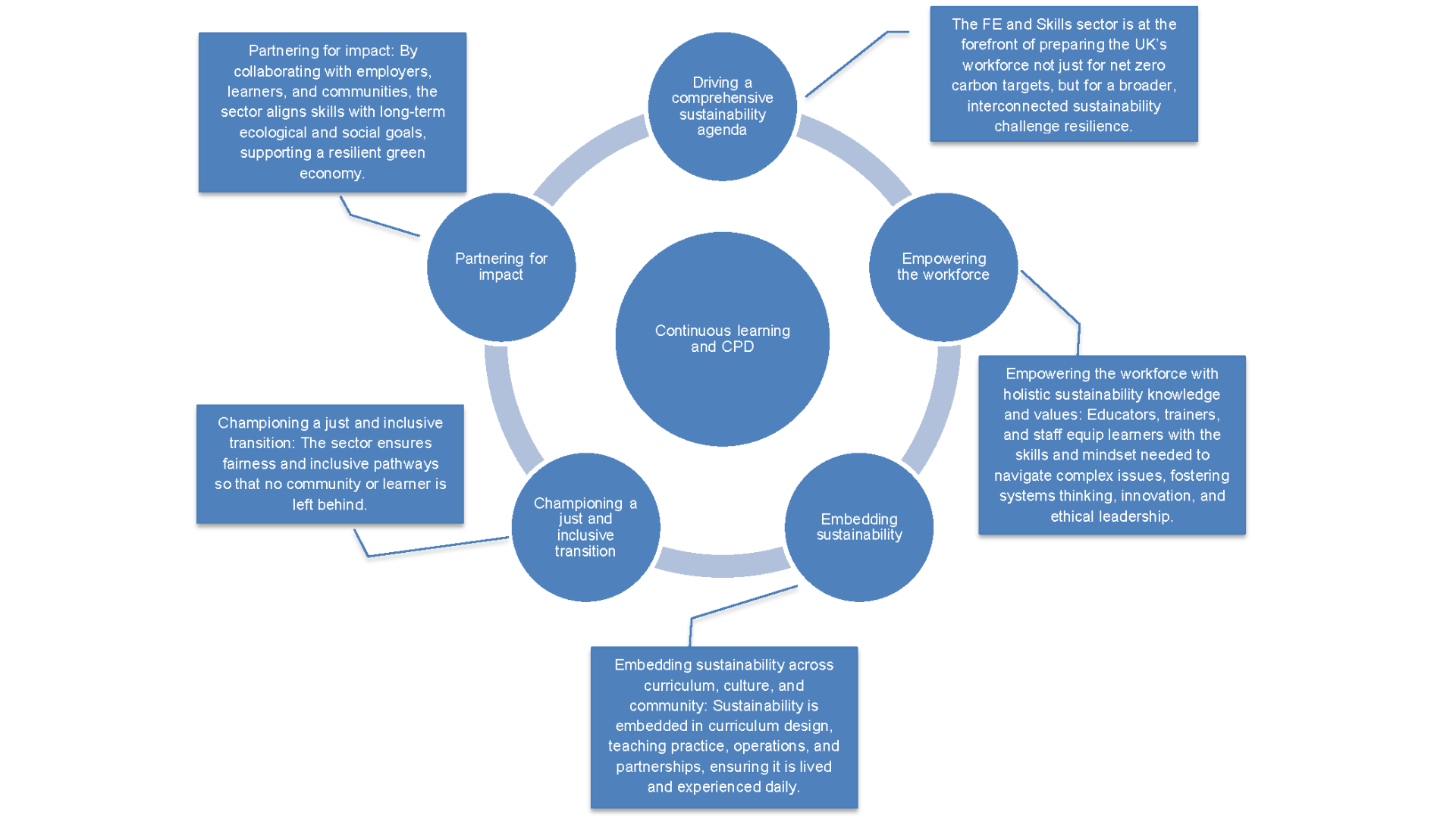
To keep pace with accelerating change, ongoing development must be a permanent feature of how everyone in FE and skills operates. Continuous learning and upskilling through continuous professional development (CPD) ensures that educators, trainers, support staff, and learners remain equipped to meet emerging challenges and seize new opportunities (DfE, 2022). Staff will remain capable of delivering updated curricula and supporting learners to meet emerging challenges (DfE, 2022).
Driving the Sustainability Agenda
Because FE is uniquely positioned as a convener of employers, civic institutions, and learners, it is central to equipping the workforce for the sustainability transition. Importantly, this will look different across the country: in some regions, local economies are heavily shaped by manufacturing, logistics, or energy-intensive industries, while in others, health, retail, or service sectors dominate. FE providers are therefore not simply delivering generic green skills, but are adapting provision to reflect local employment structures and regional priorities (Green Jobs Taskforce, 2021). In doing so, they help ensure that sustainability strategies are rooted in the economic realities of place and community: partnerships must be essentially place-based. Colleges and training providers are already working with combined authorities, local enterprise partnerships, and employers to ensure skills responses are tailored to regional transitions. Such collaboration ensures that sustainability strategies are not only reactive but genuinely transformative, embedding resilience and inclusivity into local workforce ecosystems.
Living Sustainability Daily
Embedding sustainability in FE requires whole-institution approaches that cut across curriculum, pedagogy, estate management, and community partnerships. Rather than being confined to discrete projects, sustainability becomes part of the culture and daily practice of providers. This is increasingly evident in how colleges redesign curricula to embed climate literacy, manage estates to reduce waste and emissions, and build partnerships that strengthen community resilience. While the concept of living laboratories has often been associated with higher education institutions (Christou et al., 2024), FE providers are adapting these principles in pragmatic ways suited to their local contexts. Examples include learners leading biodiversity audits of college grounds, trialling low-waste catering options, and contributing to retrofit projects that support local housing and construction needs (CCC, 2023). Through such initiatives, sustainability is normalised as a lived experience rather than remaining a distant policy ambition.
These dimensions of sustainability can be understood as interdependent pillars that together underpin the FE and skills sector’s role in the green transition. The framework below captures this holistic approach, emphasising the centrality of continuous professional development as the core route to achieving systemic impact.
Equity: A Just and Inclusive Transition
The impacts of the transition will not necessarily be experienced evenly, however: for example, regions whose economies are more dependent on carbon-intensive industries face greater disruption than those with more diversified or low-carbon employment bases. The FE and skills sector has a pivotal role in providing reskilling pathways for workers in affected industries, as well as tailored programmes for groups and communities most vulnerable to climate impacts (Green Jobs Taskforce, 2021). A sustainable, just transition will only be truly realised if prosperity and resilience are distributed fairly, ensuring that no community is left behind.
Beyond Net Zero
The sustainability agenda now extends beyond carbon reduction to encompass nature, resilience, and legal requirements to publicly report on sustainability-related activities and impact (DfE, 2022; ISSB, 2023). For the FE and skills sector, this broadening of scope widens opportunities to contribute across curriculum design, community engagement, and institutional operations. However, technical skills alone cannot deliver change at the pace required. The sector must foster a cultural shift towards green mindsets; this is the ethos will that normalise sustainable decisions and behaviours and is at the very core of the Green Mindset Collective, 2025. Embedding such values within the education system ensures that learners enter the workforce not only technically competent but also culturally aligned with the demands of a sustainable society.
Closing Thoughts
The UK’s sustainability transition will not be achieved by policy statements or investment strategies in isolation. Its success depends on people: the educators, learners, and communities who enact change in practice. The FE and skills sector is one of the principal delivery mechanisms for this mission.
To realise its potential, the FE and skills sector requires sustained investment, policy stability, and national recognition of its central role in delivering the UK’s sustainability transition. By embedding lifelong learning, amplifying sustainability in ETF’s professional standards, and cultivating green mindsets, the sector will equip the UK to deliver climate, biodiversity, and inclusion objectives in tandem.
This mission must be underpinned by a professional infrastructure that enables educators and leaders to act with confidence and coherence. ETF, as the professional body for FE and skills, plays a convening role and is working with FE News and EAUC to bring the sector together for the Green Mindset Collective 2025. This is part of ETF’s commitment to ensuring the workforce is equipped to meet the challenges of a sustainable future, by ensuring sustainability is embedded within the Professional Standards and recognising contributions through the education for sustainable development (ESD) specialist status, ETF ensures that educators and leaders are equipped to drive change with coherence and credibility.
By Dr Vikki Smith, Executive Director, Education and Standards, Education Training Foundation
References
- Climate Change Committee (CCC) (2023), A Net Zero Workforce. London: CCC
- Christou et al (2024), Fostering a Whole-Institution Approach to Sustainability through Systems Thinking: An Analysis of the State-of-the-Art in Sustainability Integration in Higher Education Institutions. Sustainability, 16(6): 2508.
- Department for Education (DfE) (2022), Sustainability and Climate Change: A Strategy for the Education and Children’s Services Systems. London: DfE
- Fehlner, W (2019), Educating for Sustainability: The Crucial Role of the Tertiary Sector. Journal of Sustainable Development, 12(2): 18-28.
- Green Jobs Taskforce (2021), Report to Government, Industry and the Skills Sector. London: HM Government
- International Sustainability Standards Board (ISSB) (2023), IFRS Sustainability Disclosure Standards. London: IFRS Foundation
- Office for National Statistics (ONS) (2025), Estimates of green jobs, UK: July 2025. Newport: ONS
- Skidmore, C (2023) Mission Zero: Independent Review of Net Zero. London: HM Government
- Smith and Rowland (2024), Bridging the gap between policy and pedagogy building a stronger FE and Skills system Report
- United Nations (2015), Transforming our world: the 2030 Agenda for Sustainable Development. New York: United Nations
Responses