
We Must Succeed at Tackling Youth and Disabled Unemployment Gaps


The outlook after the Spring Forecast and the latest labour market statistics continues to be gloomy. The number of UK job vacancies has dropped to the lowest level in five years, and this is compounded by the rate of unemployment hitting 5.2% for the first time since the start of the pandemic. Yet with the focus on the weak broader economic picture, we cannot lose sight that for young and disabled workers this represents only the deepening of an ongoing crisis. The FE and Skills sector are critically positioned to address this crisis, and learning from those facing the biggest barriers to work could shed light on wider workforce woes.
One in eight young people are not earning or learning
The UK labour market has become an increasingly challenging place for a generation of young people who face a range of distinct health, social, and economic issues. This is evidenced by the number of young people not in employment, education, or training (NEET) being persistently high over the last two years, rising to 957,000. Whilst the overall number of NEET young people remains stubbornly close to one million, the challenge has evolved with a slight rise in the number of young people actively looking for work.
Figure 1. Unemployment and economic inactivity among young people aged 16-24
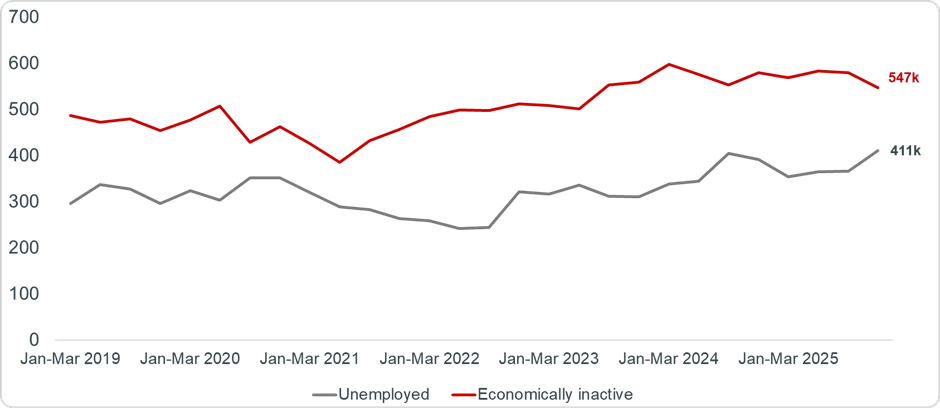
Source: ONS data, young people not in education, employment, or training (NEET), UK: February 2026
The most recent ONS data release showed that the number of NEET young people who are economically inactive decreased by 34,000 on the quarter, whilst simultaneously the number of unemployed young people has risen by 45,000. Counterintuitively, whilst this may suggest more young people are moving closer to entering employment, this will only happen if the right jobs are available.
Disabled people are twice as likely to be unemployed, despite many wanting to work
The UK labour market is particularly challenging for young people and disabled people, who have seen a much larger surge in unemployment. Disabled people continue to face persistent inequalities in the labour market and are twice as likely to be unemployed than non-disabled workers. The weakening labour market means it is harder for disabled people to get in and stay in work than it was a year ago, with a 9.2% unemployment rate, the highest since 2018. The number of disabled people classified as economically inactive (meaning they are not working or looking for work) has also increased sharply after the pandemic, from 2.1 million to 2.8 million people between 2020-2025, three times the rate of non-disabled people.
For those who are young and disabled, the barriers to access work are multiplied. Between 2005 and 2025, the proportion of NEET young people who are inactive due to sickness or disability doubled for young men and tripled for young women. In 2024/2025 45.8% of NEET young people were classed as disabled, with disabled young people three times as likely to be NEET (29.7%) compared to non-disabled young people (8.7%).
With unemployment across the labour market rising and vacancies declining, there is a serious risk that more young people and disabled people will slip into long-term worklessness without further Government intervention.
The UK Government has set ambitious targets to ‘Get Britain Working’, but quick fixes risk misdiagnosing the actual challenge
The Get Britain Working white paper, published in November 2024, sets out a long-term ambition to achieve an 80% employment rate, moving two million more people into work.
Addressing the youth and disability employment gaps are key to meeting this goal. Annual Population survey data from 2024/2025 suggests around 908,000 disabled people who are economically inactive want a job.
Yet there is a risk, as we highlighted in a previous FE News article, that the UK Government tries to push young and disabled people into the workforce through cuts to Universal Credit by making it untenable to be out of work. This may force young and disabled people into work that damages their health and leaves them trapped in a ‘low pay/no pay’ cycle between repeated spells of unemployment and jobs that are low paid and unstable.
In 2025, the UK Government was forced to step down from attempts to remove the health component of Universal Credit for those aged under 22, and wider cuts to Personal Independence Payments (PIP) through restriction on eligibility (both of these payments are available to people in work). The Timms review into the PIP system is now underway with a report due in autumn 2026.
Job quality, support and design hold the keys to unlocking greater participation
Work Foundation research has highlighted that employment gaps for young and disabled workers reflect structural barriers of poor job design and low availability of good quality jobs. For example, findings from the Inclusive Remote and Hybrid Working Study, which surveyed 1,221 disabled people who work remotely or in a hybrid way, suggest that working remotely was positively associated with physical and mental health. Nearly nine in ten participants (85%) said that having access to remote/hybrid working would be essential or very important when looking for work. Another UK-wide survey of 3,796 working people in 2025 found that workers in poor health were twice as likely to say their job negatively affects their physical health and 1.5 times more likely to say it harms their mental health. Two in five young workers (43%) in the survey expressed worry their declining health could push them out of work in future.
In addition, we know that young and disabled workers are more likely to experience severely insecure work than other groups. For disabled people, this is often because secure roles do not have the flexibility or adequate workplace adjustments that they need, which forces them to trade security for flexibility. For young people, they are much more likely to be on zero-hour contracts, creating a ‘trap’ of health-damaging jobs with little progression and a lack of certainty over hours, pay, and conditions. Longitudinal analysis of Understanding Society data from 2017-2021 showed that 28.2% of insecure workers aged 16-24 remained stuck in insecure work four years on, meaning low quality jobs are not just ‘stepping stones’ to better employment.
Finally, a recent event held by the Work Foundation on rising NEET levels uncovered the importance of addressing “challenging transitions” that young people make through education and employment. Susannah Hardyman, Chief Executive of Impetus, stated that “for every step up the qualification ladder, a young person’s likelihood of becoming NEET falls. That means we need a joined-up approach, starting in schools, not just interventions once young people reach the labour market.”
Further Education and Skills organisations will be vital in shaping new ‘pathways’ to good work
The Further Education and Skills leaders have a clear role to play in making these small local experiments work and scale. By providing alternative pathways, flexible qualifications and tailored support, FE colleges and skills providers are often more likely to encounter young or disabled people struggling to access work. Speakers at our recent event also highlighted the importance of tackling the NEET challenge at source, during statutory education, and in situating interventions within trusted community connections and spaces. This makes FE and skills providers natural partners to participate and share learnings from the early stages’ trailblazers and Youth Guarantee schemes. The wider industry must also take an active role in identifying ways that the sector can adopt ‘what works’ from these smaller local experiments across the whole country.
Finally, it is important to hold the Government to account in delivering its promises. Given a weakening labour market, there is a risk that proposed reforms to employment rights are watered down, or Ministers returns to punitive cuts to welfare with the view that “any job is better than no job”. Experienced FE and Skills practitioners must highlight the importance of addressing barriers such as insecure work, exclusionary job design and greater support during transitions through education and work for young and disabled people. Tackling these three barriers can, if identified correctly, support greater agency for all workers in finding sustained employment that supports a healthy working life.
By Jess Redmond (Policy Advisor) and Emelia Williams (Research and Policy Analyst), Work Foundation at Lancaster University
Responses