
Post 16 Skills White Paper? Back to the Future – Part 1

GCSE resit policy, qualification reform and why are young people (pre16 and post 16) disengaging from our education and skills system and becoming NEET?
Don’t look back in anger, I hear you say …
Last week, on my research day, I took the opportunity to listen live to a webinar presentation and research informed panel discussion on NEET. The research into the data was thorough and considered but, and it is a big but, part way through the panel discussion I was roaring, like a Riot Woman (thank you Sally Wainwright) at my screen, so much so I posted my question in the wrong place so it was never asked. Lesson learned, sometimes best to take a deep breath and think carefully about how to respond, with careful consideration, to something that is so misunderstood.
The panel discussion (and the research) focused only on 16- to 24-year-olds and there was no consideration of pre-16 and the impact of the secondary school GCSE curriculum, with its wholly academic focus, on disengagement from education. One speaker, though stating his lack of knowledge of education research, highlighted his support for GCSE resits, stating that there were now more students achieving “good” GCSEs post 16, the passport to future opportunity. This completely missing the reality of the high percentage of students who fail to gain a higher grade, some resitting year after year without achieving this “passport to success”. He also stated that there weren’t well recognised viable alternatives and if we created a new qualification no one (employers, universities etc.) would know or understand, it would have no value.
To clarify, for those who don’t know, Functional Skills English and Maths qualifications have been around for 15 years. However, it is clear we, as educationalists, have failed either to communicate what they are, and what they could be if delivered by skilled teachers, or to make clear how they can be used to build the skills young people need for success. There is some outstanding practice in how Functional Skills are being used to underpin high-quality ESOL/EAL programmes, for both young people and adults, with rigorous and robust internal verification and creative curriculum design, but the perceived low value of these qualifications is still a barrier to progression into further and higher-level learning.
Functional skills for raising attainment in English and Maths
In 2010, when working in the 14-19 Team in our local authority, I was asked to host a learning visit for senior colleagues from DfE, QCDA and Ofqual, to find out more about how we were using Functional Skills to raise attainment in English and maths across Manchester.
On getting in the taxi from Piccadilly Station, and giving the address, the driver had asked “Is this right? Are you sure you want to go to Harpurhey? No one ever asks me to take them there?”
On 19th May 2010 a group of articulate and confident young people (then in yr 10) from Harpurhey, Manchester presented on their direct experience of this new qualification to Kathleen Tattersall the Chair of Ofqual and Chief Regulator. They explained how they had studied Functional Skills to develop the underpinning English Language skills in preparation for GCSE. A few weeks later Kathleen Tattersall resigned, due to a disagreement with the Secretary of State for Education. I do wonder if the visit to Harpurhey, and the presentation from those amazing young people, was the final straw for Kathleen Tattersall.
“It has been a pleasure to be part of building this organisation. Nonetheless, it is clear that the new Government is bringing a fresh perspective to public policy, in education as in other areas.
“In that context, I have come to the conclusion that it is in the best interests both of Government and of the education sector for Ofqual to have a new Chair. I have therefore decided to step down with immediate effect.” Letter of resignation from Chair of Ofqual to the Secretary of State for Education (July 2010).
On Gove’s initial plan (to scrap GCSE and replace them with a new end exam assessed EBacc qualification), she said
“No one who is responsible for the education of young people should be proud to introduce a system which will result in a greater number of students leaving school with no qualifications. Education is about encouraging success and the raising of aspirations, not the writing off of a generation, which is what this new, untried, untested policy, based on prejudice and untruths, will bring about.”
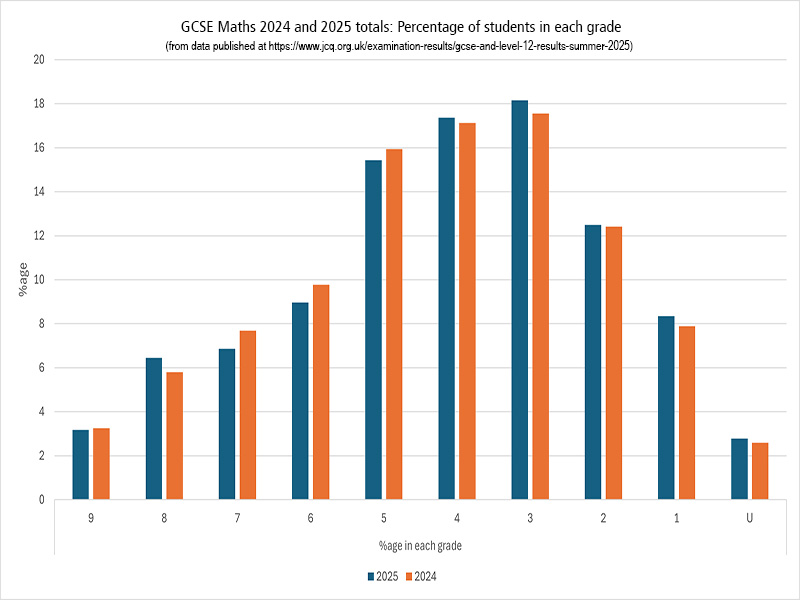
So the GCSE remained, though wrapped in the EBacc and with performance measures focused on high grade achievement. This continued focus on achieving “good” grades at GCSE has completely undermined the value of the GCSE qualification at lower grades, these having no value and with students seen as failures. Creating an elitist and demoralising education system by default. Instead of resitting the EBacc post 16 (Gove’s suggestion for those who failed to achieve the new EBacc) thousands of students, those who are not NEET, are resitting or working towards a higher grade GCSE in English and/or maths. Though recent adjustments are now allowing students to take “alternatives”, the aim is still towards attaining a “good” GCSE grade. The norm referenced assessment model of GCSE, that maintains the bell curve of graded achievement, is designed to demonstrate achievement of students in comparison to their peers. Put bluntly on the bell curve of grade distribution, not everyone can be above average, the qualification is designed to be selective, a gateway to success for some, not all.
Functional Skills for English and maths qualifications were designed with a different focus, to develop and then evidence the skills students have achieved against a competency framework, a “what I can do” model. This qualification allows students to have their achievements (skills, knowledge and application of those) recognised and valued against clear criteria, not in comparison to their peers. Functional Skills are levelled to enable progression, for example from L1 to L2 and if achieved against the stated criteria achievement rates are high, without any statistical adjustment for norm referenced grading. The challenge in this type of competency-based model however is to ensure rigour and robust assessment, particularly as there is significant pressure on both teachers and curriculum leaders to hit target KPIs on achievement. Internal and external verification needs to be robustly implemented to ensure standards are met, but can the education provider, under pressure to achieve those KPIs, be trusted to mark and robustly verify their own (or their students’) work and are externally set and marked examinations really the answer?
In 2003 Kathleen Tattersall shared her own perspective on externally set and marked examinations:
“The equation of reliable assessment with externally set and marked examinations is neither helpful nor based on reality. It devalues the skills which external assessment cannot accommodate; it places pressure on students. Most of all it undermines teachers’ confidence and commitment.
“We need to challenge society’s double standards of faith in external markers – the majority of whom are classroom teachers – and lack of trust in teachers’ judgments of their students’ attainment. Investment in teacher training in assessment skills and professional development would raise the status of teachers and enable the range of skills which students need for the 21st century to be recognised.”
“Given the major changes which have taken place in the qualifications system and within subjects, direct comparisons are difficult, but all the evidence I have seen over the years convinces me that we demand more of students now than was the case in the past. We ought to give them credit rather than undermine their achievements as some do every year when results are published.
The past was not a golden age of perfection. Those who believe it was should take note of this extract from the chief examiner’s report on the first A-level English Literature examination of 1951:
“Until candidates can write legibly, in clear, correct English, with some care for punctuation, sentence structure and paragraphs, their views on Hamlet or anything else will command little attention… We do not ask for enchantments of style, but we do ask for correctness.” Kathleen Tattersall (The Guardian 30th September 2003)
The English teacher from Harpurhey, made full use of the competency model in Function Skills English to develop the underpinning skills for success, in both English GCSE and across other subjects.
Gold standard qualifications for all
Now we have a more nuanced approach to GCSE resits, but as we look to realise the wider ambitions for qualification and curriculum reform it is clear we need high quality gold standard qualifications for all, not just for some.
- Qualifications that enable excellence, recognising and valuing the skills young people have gained.
- Qualifications with appropriate assessment methodologies, enabling young people and adults to demonstrate their ability to apply their skills and knowledge in context of their future career aspirations.
- Qualifications that enable and support innovative teaching and curriculum design to engage, challenge, encourage success, raise aspirations and support progression.
In 2025 young people are voting with their feet. Even with Raising Participation Age as a statutory requirement, an increasing number of young people are (NEET) disengaged, disenfranchised and disadvantaged. We have increasing numbers with mental health challenges and we have a system where high stakes externally set and timed exams are the accepted norm. Why?
Looking forward we have so much to build on.
- Vocational qualifications (L2 and L3) that are destination-led and with assessment methods that are appropriate and robust.
- Increasing recognition of L3 vocational qualifications as entry into higher education
- Increasingly skilled teachers and curriculum leaders, working collaboratively with employers and maximising on best practice.
Building on these foundations, we now have the opportunity to purposely design our education and skills system to be gold standard, inclusive and relevant to this complex and rapidly changing world.
Thank you to all the skilled English and maths teachers and curriculum leaders whose best practice has informed this article. Through LinkedIn I contacted Reece(one of those young people who presented to Ofqual) and asked him about his experience and how this has impacted on him and his peers.
“When remembering my lessons with Michelle, I remember them with huge fondness and definitely consider Miss Rathor as having a huge impact on my school life and education, and only for the better! I know that a lot of my ex-classmates would agree and have only positive things to say about Michelle and her classes.
The lessons I learnt from Michelle have carried me through life both professionally and personally.” Reece McDonagh (Lead Model Booker – Boohoo, Manchester)
Posthumously, thank you too to Kathleen Tattersall for having the courage to say no, for listening to our young people and for staying true to your own moral compass. And on the questions raised on leadership in FE is this what is needed from us all? Difficult when conditions of funding drive us to do something that just isn’t right but let’s not pretend it is ok, it isn’t, we must do better.
“Education is about encouraging success and the raising of aspirations, not the writing off of a generation”
By Gill Scott, Director and Senior Consultant at Gill Scott Consultancy Ltd
Responses