
GCSE Level 1 and 2 Results 2025 | Sector Reaction

More than 5.6 million GCSE results have been issued to students in England today, along with more than 368,000 results for level 1 and 2 vocational and technical qualifications taken alongside them.
These results enable young people to progress to further study or an apprenticeship. Well done to all students receiving their results today, and to all the teachers and others who have supported them every step of the way.
This year’s picture is one of stability, with outcomes showing only minimal variation from previous years. This falls within the boundaries of natural year-on-year fluctuations. According to JCQ in 2025 there were just over 1.1 million candidates. This is 29,885 more than last year and the number of entries was 6,160,034.
English GCSE Results
866,023 students sat English Language in 2025, compared to 845,834 in 2024, but with very similar results with 15.6% achieving 7 / A grades in 2025 compared to 15.7% in 2024 and 60.2% achieving 4/C grades in 2025 compared to 61.9% in 2024. So very similar grade percentages. The male the female data was 12% of males achieving 7/A grades in English Language, compared to 19.5% of females achieving 7/A grades in English Language. This is very similar split to 2024 when this 11.5% of males and 20.1% of females received a 7 grade.
Maths GCSE Results
893,198 students sat GCSE Maths in 2025, compared to 878,165 students in 2024. 16.6% of students received a 7/A grade, and 58.3% of students received a 4/C grade. The male and female awarded grades was pretty similar with 18.1% of males and 15.2% of females awarded a 7/A grade, compared to 2024 when this was 18% for males and 15.8% for females. Grade 4/C in Maths is also very similar with 59.8% of males and 56.8% of females. This is again, very similar split to 2024 when 60.2% of males and 58.9% of females were awarded grade 4/C in Maths in 2024.
Drop in Computing GCSEs: Just 20,708 female students studied Computing GCSE in 2025
There was also a drop in Computing GCSEs in 2025, which is surprising with the rise in AI and the acceleration of the fourth industrial revolution. Just 91,619 students sat GCSE Computing in 2025, this is a drop from 95,841 in 2024. Alarmingly, just 20,708 female students studied Computing GCSE in 2025. If there were 1.1 Million students, the number of female students who studied Computing GCSE was just 1.88% in the overall student cohort!
Here are some key facts and figures from today’s GCSE and level 1 and 2 results:
- Overall GCSE results are similar to 2024. Outcomes at grade 7 and above are 21.8% compared with 21.6% in 2024, and outcomes at grade 4 and above are 67.1% compared with 67.4% in 2024.
- 5,661,970 GCSE results were issued in 133 different qualifications.
- There were more entries from post-16 students this summer for GCSE English language and maths. However, within both the 16-year-old and post-16 groups, results are stable.
- Fewer students sat GCSE biology, chemistry and physics but there was an increase in entries for combined science. There was also a decline in entries for history compared with 2024, but a small increase in geography.
- Overall, 4.1% (14,920) of the 368,065 vocational and technical qualification grades issued are at the top grade available. Of those, 355,590 were Technical Awards and 12,475 were Technical Certificates.
- The most widely taken vocational and technical subjects were Technical Awards in Leisure, Travel and Tourism; and Health, Public Services and Care.
- The geographical region with the highest percentage of GCSE grade 7s and above was London, and the north-east had the fewest.
- Boys’ results improved slightly while girls’ results fell marginally.
Post-16 GCSE candidates
Where there is a more notable change is the 14% increase in post-16-year-olds getting GCSE results today. This is due to the greater number of post-16 students taking English language and maths resits.
The higher number of resit candidates is reflected in the changes to English and maths results at and around grade 4 for all candidates combined, compared to last year. In fact, performance within the 16-year-old age group and within the 17+ age group is broadly similar year on year.
What are the trends behind the results?
Stable levels of performance
Stability is the watchword with the 2025 GCSE results.
The national picture at grade 4 shows just a 0.3 percentage point reduction from 2024, and just a 0.1 percentage point increase compared to 2019 (see Figure 1).
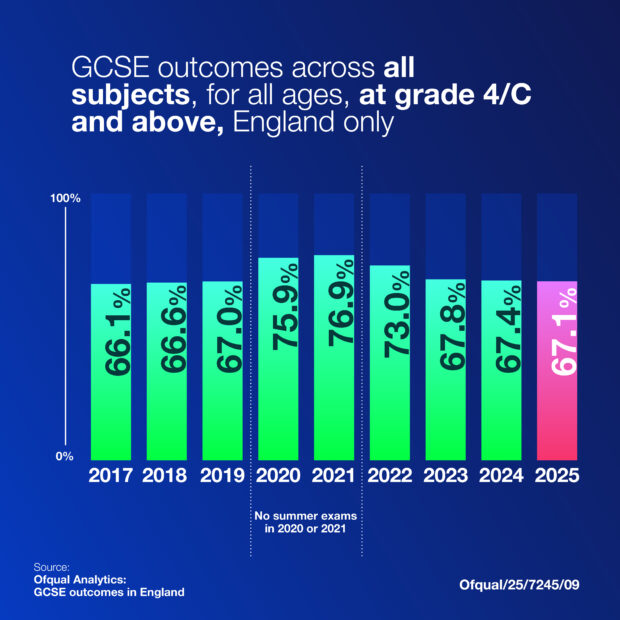
Figure 1: GCSE outcomes across all subjects, for all ages, at grade 4/C and above, England only
While grades overall are stable, there are still small variations reflecting differences in student performance. However, the standard of work that students must achieve to gain a grade is held consistent year on year, and these results maintain that standard.
The 2025 National Reference Test results, also published today, demonstrate the continuing stability of English language and maths performance outcomes for 16-year-olds.
Girls and boys
The gap between boys’ and girls’ GCSE attainment has narrowed, due to a combination of boys performing marginally better and girls performing marginally less well than in 2024. These are, again, only small changes.
Regional disparities
As in any year and at any level of qualification, today’s results reflect the regional disparities that exist across England. Within that wider picture, though, it is worth noting that the gap between London and the rest of the country has narrowed slightly at GCSE grade 4.
Vocational and technical results
This is just the second year of Tech Award results since these qualifications were strengthened by changes to their design and structure. Tech Awards are typically the size of a GCSE and cover subjects such as sport, hospitality and catering, and health and social care.
As normal, the Joint Council for Qualifications (JCQ) has published results in England, overall and by subject. These results are also shown in our interactive charts.
Today is the culmination of a lot of hard work, not just by the students involved but also their teachers and those who have supported them along the way. Congratulations to you all.
Sector Reaction
Education Secretary, Bridget Phillipson, said:
“Huge congratulations to everyone receiving their results today – you should be incredibly proud of what you’ve achieved. To the brilliant teachers, school and college staff, and parents who have been there every step of the way, thank you for your unwavering support.
“These young people moved from primary to secondary school right in the midst of the pandemic, showing remarkable resilience despite the disruption to those crucial years of education. Their options now are better than ever, whether it’s A levels, T Levels, or an apprenticeship.
“While it’s a moment to celebrate, today’s results will expose the inequalities that are entrenched in our education system. Too many young people continue to have their life chances defined by their background and where they live, and while we are beginning to see promising signs in critical areas like attendance and teacher recruitment, I am absolutely determined to deliver on our Plan for Change and truly break the link between background and success once and for all.”
The Welsh Cabinet Secretary for Education Lynne Neagle said:
“Congratulations and well done to everyone who has received their results today.
“I hope you got the grades you wanted and whether you decide to carry on with education, choose vocational training or employment there are many options available. For those seeking guidance on their next steps, support remains available through your school or college and the Young Person’s Guarantee, which provides a range of options.
“I wish you Pob lwc, and best wishes for the future.
“We have seen some strong results at our top grades and across a range of subjects including Maths and English. A positive indication that we are moving in the right direction with attainment in our schools.
“I also want to pay tribute to our teachers and education workforce whose support and hard work has helped our learners thrive.”
Jill Duffy, Chair of JCQ Board of Directors and Chief Executive of OCR, said:
“Looking at these results, it is hard not to be impressed by students’ breadth of skills
and knowledge.
What I find most exciting about results day is seeing the diverse range of qualifications achieved, from maths to art to hospitality – and what that means to hundreds of
thousands of young people. The subjects may be very different, but every single qualification issued today is a passport to future success and opportunities.
These students have shown resilience and determination throughout their school years; they now have the chance to thrive in their next endeavours, whether that is in education, training or apprenticeships. Congratulations to you all on what you have achieved today.”
Margaret Farragher, JCQ’s Chief Executive, said:
“Well done to students across the UK who are today receiving their results. Marking their achievements in GCSE and vocational and technical qualifications is an important moment for them and those who have supported them throughout their education. We wish them every success as they build on these results.
As ever these results are enabled by the dedication of every leader, teacher, exams officer and all staff in schools and colleges who supported these students. On behalf of JCQ and our members, I thank them for their continued hard work.”
Catherine Sezen, Director of Education Policy, Association of Colleges said:
“Congratulations to all the students receiving their GCSE results today, and to the teachers and support staff who have supported them every step of the way. For those who did not get the grades they hoped for, help is at hand; schools and colleges are ready to guide you towards the next step that suits your goals and strengths.
“We also want to celebrate the determination of the 30,000 16 to 18-year-old students who have achieved a grade 4 or above in English and or maths. Their persistence is a real achievement. But we must also reflect on the experience of over 130,000 students who did not reach that benchmark. Across the country, educators are working hard to improve outcomes, yet many are left asking what more can be done.
“After a decade of the condition of funding policy, it is time to rethink how we support young people to build essential English and maths skills. Through the Curriculum and Assessment Review, AoC is calling for a more flexible, evidence-based approach, one that empowers colleges to meet learners’ needs without relying on repeated resits that can undermine confidence and motivation.”
Daniel Kebede, general secretary of the National Education Union, said:
“Congratulations to every young person receiving results today. This cohort began secondary school as the pandemic hit—facing unprecedented disruption and a government that failed to invest in recovery. Their achievements are amazing, our teachers and support staff the under-celebrated backbone.
“It is sadly all too clear from entries in GCSE subjects that the curriculum is continuing to narrow. Young people are being denied the fully-rounded education experience they deserve. The arts, PE and many other subjects are sidelined by the EBacc and the restrictive conditions it puts on schools.
“The assessment regime for GCSEs is outdated. Regurgitating information on a single day is becoming less and less relevant.
“The measurement of skills or knowledge should be tailored to the needs of a subject, not the one-size-fits-all of exams. A six-week window of stress is unnecessary and fails to prepare students for the world they are about to enter. Broader, mixed methods of assessment would help cultivate skills more effectively and allow all students the chance to show what they can do.
“We need to see an end to both EBacc and Progress 8. A major improvement in school funding would ensure young people can access a wider range of subjects.
“The government’s ongoing Curriculum and Assessment Review is a generational opportunity to address these concerns. The time to do so is now.”
Jon Andrews, EPI’s Head of Analysis and Director for School System and Performance, said:
“Today is, of course, a day to celebrate the achievements of thousands of young people as they collect their results in Level 2 qualifications.
“As expected, the overall grade distribution for this year is similar to what we have seen in each of the last two years. But what is notable is that, while girls continue to outperform boys, the gap continues to close. Our previous analysis showed that girls’ outcomes were particularly affected by the pandemic, and there are worrying trends around girls’ wellbeing.
“As we look ahead, there are three significant developments over the next academic year that will prove crucial for schools and young people in England: the outcome of the Curriculum and Assessment Review; a new Ofsted inspection framework alongside the DfE’s consultation on school accountability; and the long-overdue cross-government child poverty strategy.
“This year’s results continue to show disparities in outcomes. The evidence is clear: disadvantage continues to drive attainment gaps, and while schools step in to deal with the effects, these challenges cannot be solved by schools or the Department for Education alone.”
Heather Smith, Vice President UK&I at Okta said:
“It’s fantastic to see so many students celebrating their hard-earned results, but if they weren’t what you hoped for, don’t panic, grades are just one part of the bigger picture. In my own career journey so far, I can say that I gained the most experience after I entered the business world – from developing sales acumen, understanding a corporate sales environment to navigating the professional world and connecting with people from all walks of life. Focus on discovering what you enjoy and what motivates you. When you find work that excites you, success has a way of following
“The real opportunity for young people is to focus on the skills that AI can’t easily replicate such as creativity and problem solving. Get comfortable working alongside technology and keep an eye on emerging fields – you could end up leading in a job that doesn’t even exist yet. Instead of worrying about AI replacing you, think about how you can use it to make an impact.
“There’s no shortage of talent among girls – it’s the culture around STEM that needs to evolve. If we want more girls to enter and thrive in these fields, we must make STEM not just accessible, but genuinely welcoming. As an industry, we should be making STEM career paths visible, relatable, and rooted in real-world impact. And let’s not underestimate the power of addressing unconscious bias, both in classrooms and workplaces. When girls see that STEM is a place where they can lead and make a difference, the numbers will follow.”
James Toop, CEO of Teach First said:
“Great teaching transforms lives and today’s GCSE results show the extraordinary dedication of teachers across the country. But we know too many young people from disadvantaged backgrounds will be denied outcomes that reflect their potential simply because of where they grow up. Their talent is no less, but too often their results fall short because of an unfair lack of access to great teaching. Only with targeted investment to get teachers into these communities can we ensure results day reflects the potential of every child.”
Nick Harrison, CEO of the Sutton Trust, said:
“Pupils receiving their results today should be proud of their achievements, especially considering the disrupted start to their secondary education due to the pandemic school closures.
“Today’s results show that regional differences in attainment remain stubbornly entrenched, with London continuing to streak ahead in terms of top grades. These regional gaps have widened significantly since 2019 and show no signs of improving.
“While it’s encouraging to see the gap between pupils in state and private schools getting top grades has narrowed slightly, this needs to be taken with a pinch of salt. This gap had already widened last year, and remains no better than in 2019.”
“If the Government is serious about breaking down barriers to opportunity, it needs a laser focus on closing the attainment gap and tackling regional inequalities. Funding should be rebalanced back towards the most deprived areas, and underlying issues of child poverty and huge gaps in opportunity across the country must be addressed.”
Angela Joyce, Chief Executive Officer at Capital City College, said:
“Today is a milestone for thousands of young people across the country. GCSE Results Day is a reminder of the incredible potential in the next generation, and a testament to their hard work, determination and resilience.
“For those who might not have achieved the marks they were hoping for, remember that these results don’t define who you are, nor do they define your future. Everyone is an individual and there are many pathways available.
“Congratulations to all students receiving their GCSE results today. Your journey is just beginning. Keep going.”
Philip Blaker, Chief Executive at Qualifications Wales said:
“Well done to all of you receiving results. Today marks an important milestone in your lives, after years of hard work.
Your results can help you to take your next step, whether that be getting a job, starting an apprenticeship or training, or continuing your studies at school or college.
I hope you got the grades that you wanted. If not, don’t worry. There’s lots of information and support available to you. Your school or college can help you with advice and guidance, and there’s information on the Qualifications Wales website with links to organisations that can provide further support.”
“A huge thank you to everyone who has supported learners completing qualifications this summer, especially to teachers, lecturers and other staff at centres for their work throughout the year.”
Pepe Di’Iasio, General Secretary of the Association of School and College Leaders, said:
“Congratulations to students and their teachers on this year’s results in GCSEs and vocational and technical qualifications. This is the culmination of a huge amount of hard work.
“These students experienced a great deal of disruption earlier in their time at school as a result of the Covid-19 pandemic. Schools strained every sinew to support those who have needed additional help to catch up and to tackle the lingering impact of the pandemic on attendance rates. However, it has not been easy, and the previous government did not put enough investment or focus into educational recovery.
“Disadvantaged students were often those most severely affected by the disruption of Covid and that has made it even more difficult to close gaps in educational attainment caused by socioeconomic factors. Those gaps are reflected in regional disparities evident once again in this year’s results. We simply must do more to invest – educationally, economically, and socially – in communities suffering from generational disadvantage.
“Once again we see that the majority of students who retake GCSE English and maths in post-16 education under a government policy of mandatory resits continue to fall short of a Grade 4 standard pass. It is utterly demoralising for these young people and there has to be a better way of supporting literacy and numeracy. We urge the curriculum and assessment review to grasp this nettle.
“We continue to see entries fall in certain GCSE subjects, highlighting the need to rebalance the curriculum. The previous government’s focus on a core set of traditional academic subjects in school performance tables has served to increasingly squeeze out other subjects. The number of entries to design and technology has fallen again and has now decreased by nearly 200,000 in England since 2010. Drama and media studies are also down on top of steep declines over the past 15 years. We hope that the curriculum and assessment review will bring forward recommendations on how creative arts and technology subjects can be better recognised and supported in the future. They are both culturally important and vital components of the country’s economy.
“French and German continue to be a source of concern with entries declining in both subjects. The rising popularity of Spanish is great to see, but we cannot escape the fact that over the past 20 years or so there has been a massive decline in language take-up overall.
“It is imperative that we find ways of promoting a love of languages or we will become an increasingly monolingual society with consequent implications for our ability to trade and travel abroad.”
Paul Whiteman, general secretary of school leaders’ union NAHT, said:
“Congratulations to all students receiving their GCSE and VTQ level 1 and 2 results today. These grades will be the culmination of years of hard work by both pupils and teachers, and they should all be very proud of their achievements.”
“The regional gaps in attainment persist. The differences between London and the West Midlands and Yorks/Humber at C/4 are particularly significant – although this gap has reduced it is because of a dip in the London grades rather than an improvement in other regions.
“The reasons for this continued regional disparity need to be properly understood if they are to be tackled. This could range from differences in the impact of Covid and the cost-of-living crisis, to specific areas of poverty, and varying investment into education, health, social care and other support services and infrastructure in the London and the South compared to the North.
“We also need to see similar data collected for VTQs in order to build a complete picture of the situation, as these qualifications are equally important in supporting young people to take their next steps.”
“The data released today is yet more evidence that the current GCSE resit policy is not fit for purpose, with less than 20% of 17–19-year-old students achieving a grade 4 in English, and a little over 15% of students achieving a grade 4 in maths.
“NAHT has long called for reform of the current policy that forces students into repeated resits, which is demotivating and ineffective. What is needed are more appropriate and engaging alternatives to GCSEs in English and maths at KS4. Post-16 students who need to continue the subjects must be allowed to study for qualifications that suit their needs and ambitions, rather than defaulting to GCSE resits. Gaining the numeracy and literacy skills they need is what’s important, not what the qualification is called.
“In general, we need to see changes to improve students’ experiences of maths and English at key stage 4 and beyond, prioritising the literacy and numeracy skills needed for everyday life and not just academic progression. The curriculum needs to be engaging and motivational; the excessive content in GCSE maths and English should be cut and the exams shortened and simplified.”
“Over 360000 VTQ results were received today which shows just how important these qualifications are alongside the GCSE offer for students.
“GCSEs alone don’t meet the needs of all learners. The volume of content, the reliance on final exams, and the average of 30+ hours of exams per student at the end of key stage 4 are all excessive and unnecessary.
“We must move away from an almost exclusive reliance on fully linear, terminal exams, and instead allow modular assessments and reintroduce more non-exam assessment and project-based assessments, in order to complement exams and better assess what students know and can do.
“We need to value a broad mix of qualifications, including vocational options and restore some meaningful subject choice for students at key stage 4 to reduce the negative impact that limiting qualification options can have. EBacc must be scrapped and Progress 8 reformed to enable that to happen.
“There is a lot to be improved at key stage 4 and we hope that the recommendations of the Curriculum and Assessment review reflect the urgent need for change.”
“Providing students with a digital record of their exam results seems an entirely sensible development and if it goes well with GCSE results this year, development to include post 16 qualifications in the future could make this a really useful tool, not only for moving education provider, but for applications for training and employment too.
“It’s important to remember this app is not designed to replace the experience of students going into school to collect their results where they have access to the support of their teachers and friends.
“It will be interesting to see the how the app performs on today, hear the feedback from those who took part this year, and consider its potential expansion.”
“There is extra pressure on secondary and sixth form admissions at the moment, due to a pupil population bulge at that age. Some sixth form colleges may be over-subscribed, especially in certain areas of the country – for example in areas with large amounts of new house building. This means competition for places for some students could be high.
“However, there are a very wide range of post-16 options for young people – attending a sixth form college to do A Levels is not the only next route. Colleges can often be more flexible in response to the applications they get, and are able to offer a huge range of academic and vocational courses. Young people should be confident they will find a course that’s right for them, and that will allow them to take their next steps in education or training.”
Jeanette Wheeler, Chief People Officer at HR, payroll and finance provider, MHR:
“Today marks two milestones for young people: GCSE results day, and new ONS figures showing a rise in the number of 16- to 24-year-olds not in education, employment or training (NEET). Between April and June 2025, an estimated 948,000 young people were classed as NEET – 12.8% of this age group, up from 923,000 earlier in the year.
“Alongside these figures, much has been said about how AI is reshaping entry-level opportunities. The latest NEET rise is a stark reminder the onus is on business leaders to widen, not narrow, employment routes for young people. The skills needed to enter the workplace are evolving rapidly, but let’s not forget the students receiving their results today will be the ones leading the charge in shaping how businesses adopt and use AI in the years to come.
“Against this backdrop, ambition risks being stifled before many young people have even had a chance to open their results envelopes. Employers cannot afford to alienate younger generations from the workplace. They must now design entry-level positions that channel strengths and curiosity around AI from the start, or we can only expect to see NEET levels continue to rise over the coming months and years.”
Responding to the publication of today’s results, Professor Ulrike Tillmann, Chair of the Royal Society’s Education Committee said:
“Congratulations to all students receiving their GCSE, BTEC Tech Awards and other Level 2 results today.
“It is concerning that the number of students resitting maths GCSE has increased by over 10%. The trend has continued that only 15% of 17-19-year-olds resitting GCSE Maths achieve the grade 4 required for further study or training. History shows that two thirds of GCSE resit students do not achieve the required grade by age 19, and we cannot let this pattern continue.
“Repeated resits create huge pressures on teachers, schools and colleges, not to mention the emotional strain on students forced to retake an exam that does not serve them. We must question whether the maths content these students are studying meets their needs.
“A GCSE course modelled on current level 3 Core Maths qualifications, including real world contexts and problem-solving, would be far more useful in providing students with the data and analytical skills needed for future employment. It is imperative that the Curriculum and Assessment Review addresses the policy around compulsory resits as a priority.
“While the increase of young people taking a dedicated statistics qualification is a positive step, this represents a very small number of GCSE students. Since statistics and data play an increasingly important role in all our lives, we advocate their incorporation into maths courses at all ages.
“Computing is another area that needs a serious system upgrade. While only two thirds of schools offer computing at GCSE, it seems the content does not appeal to students, with overall entries down, especially among girls. AI and digital technologies are advancing at a faster rate than the curriculum can keep up with. If the UK is to meet skills demanded for an AI future, the government must ensure maths and computing courses provide the appropriate content and digital skills. The Royal Society will be publishing our recommendations for computing education later in the autumn setting out strategies to widen access to the subject.
“It is interesting to see the continued fall in students taking Triple Science (Biology, Chemistry, Physics), with a corresponding increase in Combined Science (worth two GCSEs). Data from the Royal Society’s Science Education Tracker (2023) shows that students who take Combined Science are less likely to pursue science post-16 than those taking Triple Science. They are also less likely to be taught by specialist teachers and spend less time doing hands-on practical science. We need a single pathway for science at GCSE that gives all students the same opportunity to experience an excellent science education.”
Today students across England, Northern Ireland and Wales are receiving their GCSE exam results. This follows the Scottish National 5s, earlier this month.
Beth Elgood, Director of Communications at EngineeringUK, comments:
“Most of the students receiving their GCSE results today started secondary school in autumn 2020, so much of their early secondary education was disrupted by the covid pandemic. Huge congratulations to all of them on their results.
“GCSEs in Science, Maths, Engineering and Technology (STEM) subjects are a key milestone on the journey towards a career in engineering and technology.
“Science and maths, like English, are core (compulsory) subjects at GCSE. Maths entries are up slightly compared to last year (+1.7%), although we believe this is mostly due to re-sits, while statistics has seen a significant increase in popularity (+9.5%). It’s interesting to see combined science is up slightly (+0.9%), however biology, chemistry and physics are all down (-6%).
“We are concerned to see design and technology (D&T) continue its long-term decline, despite a small uptick last year. In fact, D&T Entries have fallen to below half of what they were in 2016. Computing has also dipped slightly (-4.4%), but this comes after a rise of 5.8% last year. So overall computing entries remain above pre-2024 levels.
“With the engineering and technology sector growing rapidly and offering countless opportunities to make a meaningful impact, there’s never been a better time to pursue a career in this field. It’s important young people studying for GCSEs in STEM subjects can develop a broad range of skills to enable future study and pathways into careers in engineering and technology.
“We encourage students to explore the variety of options available to them for their next steps – from A levels to T Levels and other Vocational and Technical Qualifications. Whether students are passionate about tackling climate change or driving digital innovation, STEM subjects open the door to rewarding and diverse career options.”
Mayor of Greater Manchester Andy Burnham said: “What we’re building here thanks to our brilliant schools and colleges is an education system that offers true parity between academic and technical routes.
“All young people should be able to fulfil their potential, whatever path they choose after their GCSEs. And they should have the same chance to thrive and build a great career they right here in Greater Manchester.
“We look forward to seeing the full data from last week’s T Level results, but early results seem to suggest that, once again, Greater Manchester’s T Level students have beaten the national average.
“This shows the quality of education that our schools and colleges are providing. It also proves that when we invest in technical education, young people rise to the challenge.
“I want to congratulate everyone getting their GCSE results today. Whatever path you choose next, the future is bright for you here in Greater Manchester.”
Anna Dawe, Chair of GM Colleges, said: “Technical education students across the GM Colleges have excelled in their advanced technical qualifications.
“T Level results across Greater Manchester outperformed national averages in both overall pass rate and high grades, meaning that students have secured first choice destinations.
“Many are progressing to university, and we are seeing significant increases in those securing degree apprenticeships.
“For young people receiving their GCSE results today, this demonstrates that technical education is a fantastic option, opening doors to university, apprenticeships, and exciting careers in growing sectors.”
David Lakin, IET Head of Learning Services and Education said:
“We’d like to congratulate all students receiving their GCSE results today, many of whom were in Year 6 when the first Covid lockdown was introduced in March 2020, and they began secondary school in “bubbles”.
“It’s concerning to see a drop in STEM gateway subjects, particularly among girls at this stage. While gender parity is emerging in Biology, Chemistry and Physics, stark gaps remain in Computing, Construction, Design & Technology, Digital Technology and Engineering.
“Most STEM subjects saw slight gains in performance, but Maths has dipped. We must ensure this doesn’t discourage students. There are many different routes into a career in engineering so no matter what results students receive today, there are lots of options to suit them.
“With 124,000 engineers needed annually*, and nearly half of employers telling us that education isn’t preparing young people for real-world roles**, low uptake in STEM threatens the start of the talent pipeline.
“At a time when government ambitions in defence, AI, science, and energy are growing, we risk falling short without enough engineers and technologists. The opportunity is still there, whether through A Levels, college or vocational routes, we must inspire and support young people to pursue STEM. It is practical, impactful and essential to society’s future.”
On gender gaps, Christopher Knibb, Governance and External Engagement IET Director and Director of WISE added:
“The gender gap in STEM gateway subjects remains a major challenge. To inspire the next generation of women engineers, we must start early – showing primary school children the exciting range of careers in engineering and technology.
“Visibility matters, and real-life role models play a crucial role. Initiatives like our Young Woman Engineer of the Year Awards and WISE’s My Skills My Life platform are helping to showcase the diversity of talent and opportunity in the sector. But progress requires consistent action from educators, employers, and government – because without diversity, we risk losing the innovation and collaboration needed to tackle society’s biggest challenges.”
Responses