
Greater Manchester’s universities and industry partners are powering national progress

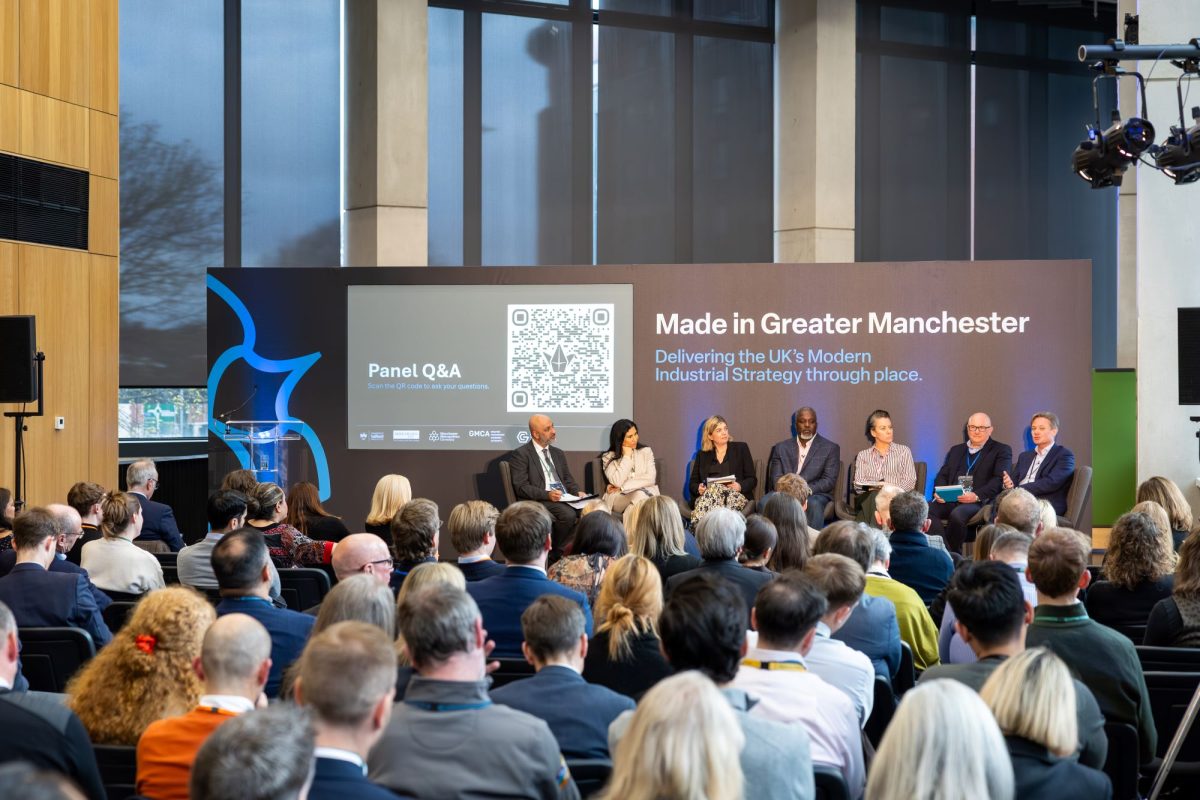
Regional leaders showcase how collaboration is accelerating the UK’s industrial strategy at ‘Made in Greater Manchester’ event.
Leaders from industry, government, academia and civic organisations gathered last week (Wednesday 25 March 2026) to demonstrate how Greater Manchester is strengthening its position as one of the UK’s most dynamic centres of innovation and economic growth.
Hosted by Manchester Metropolitan University, in partnership with Greater Manchester Combined Authority (GMCA), The Growth Company, University of Manchester, and University of Salford, the flagship Made in Greater Manchester event demonstrated how coordinated regional action is accelerating delivery of the Government’s Modern Industrial Strategy.
Recent national data shows that Greater Manchester is the UK’s fastest growing city region, with productivity growth outpacing national averages for more than a decade.
The city region has long been recognised as a testbed for the future UK economy, bringing together universities, business and civic partners to tackle national challenges at regional scale.
That collaborative model now supports Greater Manchester’s approach to good growth, as it leads the UK’s ambitions in five ‘frontier’ sectors – advanced materials and manufacturing; creative industries; digital, cyber and AI; health innovation and life sciences; and low carbon.
These are aligned to five of the sectors identified as having the greatest potential for growth in the Modern Industrial Strategy.
Professor Steve Rothberg, Provost and Deputy Vice-Chancellor at Manchester Met, said: “With universities acting as powerful anchor institutions for growth, there has never been a more important time to connect, collaborate and drive collective impact.
“Here in Greater Manchester, we have a long tradition of being at the forefront of innovation. This event was a fantastic opportunity for organisations across the city-region to come together and re-emphasise this commitment while exploring future ways to deliver for the UK.”
Speakers at the event outlined how universities, industry and civic partners are aligning investment, skills pipelines, research strengths and business support to accelerate the industrial strategy in real time.
By uniting academic expertise, cutting edge R&D facilities, industry ambitions and civic leadership, Greater Manchester is building the environment required for long term national competitiveness.
At the event, Jo Ahmed MBE, Practice Senior Partner at Deloitte, said: “What we do brilliantly in this city region is that we come together across the public and private sectors and academia to deliver impact and, importantly, to deliver action.
“When I speak to national and international colleagues, they all want to know what it is we are doing in Greater Manchester to create the growth we are seeing here. My answer is that it’s a blend of the spirit this place, it’s how we connect, how we collaborate, and how we support each other for collective long term growth and opportunity.
“I am truly optimistic about the future opportunities that can be delivered through a continued place-based approach to deliver the Modern Industrial Strategy and Greater Manchester Sector Development Plans, and to continue that collaboration between sectors to benefit the broadest possible cross section of businesses and the communities around us.”
Professor Simon Green, Pro Vice-Chancellor for Research and Knowledge Exchange at the University of Salford, said: “Bringing organisations from across the region together, the event provided a real opportunity to celebrate what has already been achieved as a collective and to explore new possibilities for how we can continue to deliver progress.
“Greater Manchester has long been shaped by a deep-rooted culture of innovation and in an era where innovation drives economic growth, it has never been more vital for universities to collaborate with partners in this way to shape a more prosperous and sustainable future for all.”
Responses