
An Introduction to Innovation Ecosystems: What FE providers need to know

In today’s rapidly evolving world, innovation isn’t just the domain of major corporations or tech giants, it’s a critical driver of progress for every sector, including education and skills development. Whether you’re preparing students for emerging industries or equipping them with the skills to drive change, understanding how innovation ecosystems work is key.
The UK’s Industrial Strategy places a strong emphasis on skills development, particularly within the Further Education (FE) sector, to support growth in key sectors. It focuses on aligning the skills system with the needs of high-growth industries and promoting skills excellence.
This article introduces the concept of innovation ecosystems, interconnected networks where educators, businesses, researchers, investors, and policymakers collaborate to accelerate ideas, build skills, and create future-ready communities.
For colleges, training providers, and education leaders, tapping into these ecosystems offers the chance to:
- Contribute directly to regional and national innovation agendas
- Develop innovation-focused curricula
- Support student employability and entrepreneurship
- Contribute directly to regional and national innovation agendas
What is an Innovation Ecosystem?
In biology, ecosystems consist of interconnected organisms, each playing a vital role in the survival and growth of the entire system. Organisms like producers, consumers, and decomposers, all contribute to the balance and sustainability of their environment.
Similarly, an innovation ecosystem is a network where the five stakeholder types, research institutions, entrepreneurs, corporations, investors, and governments, fulfil similar roles. They collaborate and interact contributing valuable resources, expertise, and perspectives to drive the generation and scaling of ideas, solve complex challenges, and create meaningful impact.
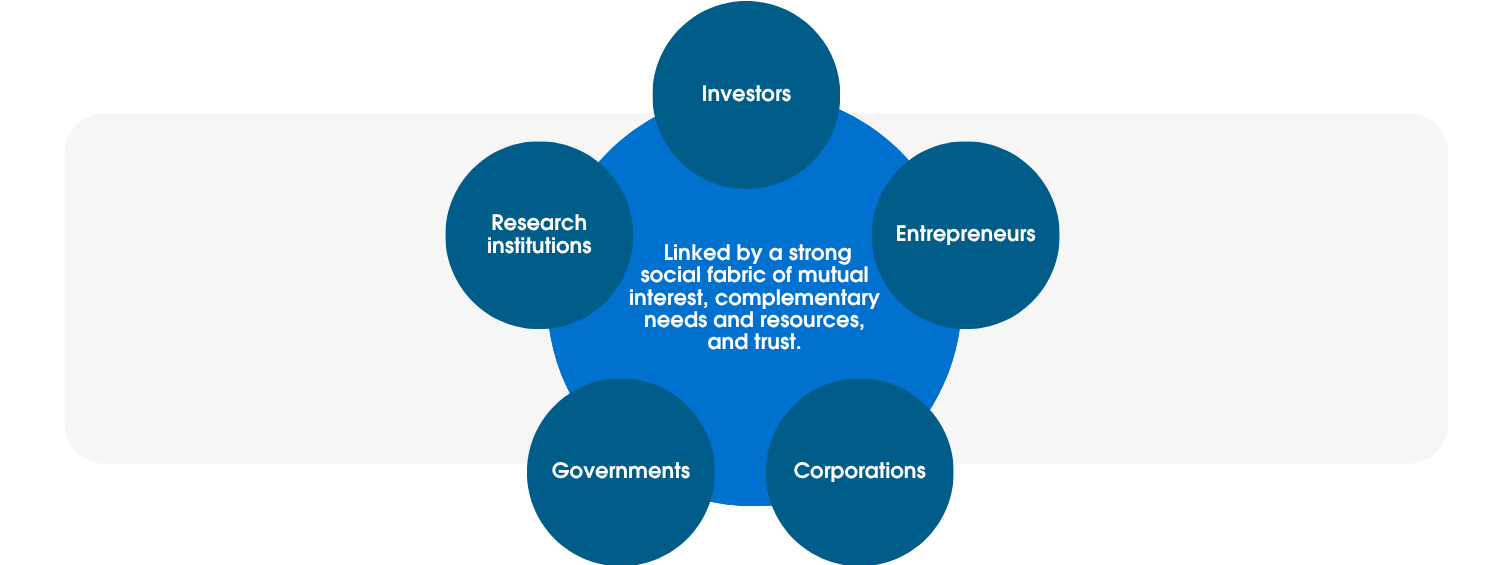
Just as organisms in a natural ecosystem depend on each other to survive and thrive, the success of an innovation ecosystem relies on the cooperation of these five groups. These players are bound by a strong social fabric of mutual interest, complementary needs, and trust.
Working in silos is inefficient, much like in nature, these groups need to combine their strengths and resources for the ecosystem to flourish. When they align their efforts toward shared goals, they accelerate the pace, impact, and longevity of innovation.
Why Innovation Ecosystems matter
The impact of these ecosystems is profound:
- For businesses, they provide access to fresh ideas, top talent, and strategic partnerships that accelerate growth and innovation.
- For cities and regions, these ecosystems drive competitiveness, attract investment, and create jobs, fuelling long-term economic growth.
- For society, they serve as powerful engines for tackling global challenges, from advancing climate solutions to revolutionising healthcare and enhancing quality of life.
Some of the world’s most successful innovation ecosystems include:
- Silicon Valley – the ultimate tech hub, home to giants like Apple, Google and Meta supported by top institutions like Stanford and UC Berkeley.
- Boston-Cambridge – a global leader in biotech and life sciences, driven by cutting-edge research from MIT and Harvard.
- Shenzhen, China – a powerhouse for hardware, manufacturing and deep tech, fuelled by a robust supply chain and major companies like Huawei.
Communities for Innovation
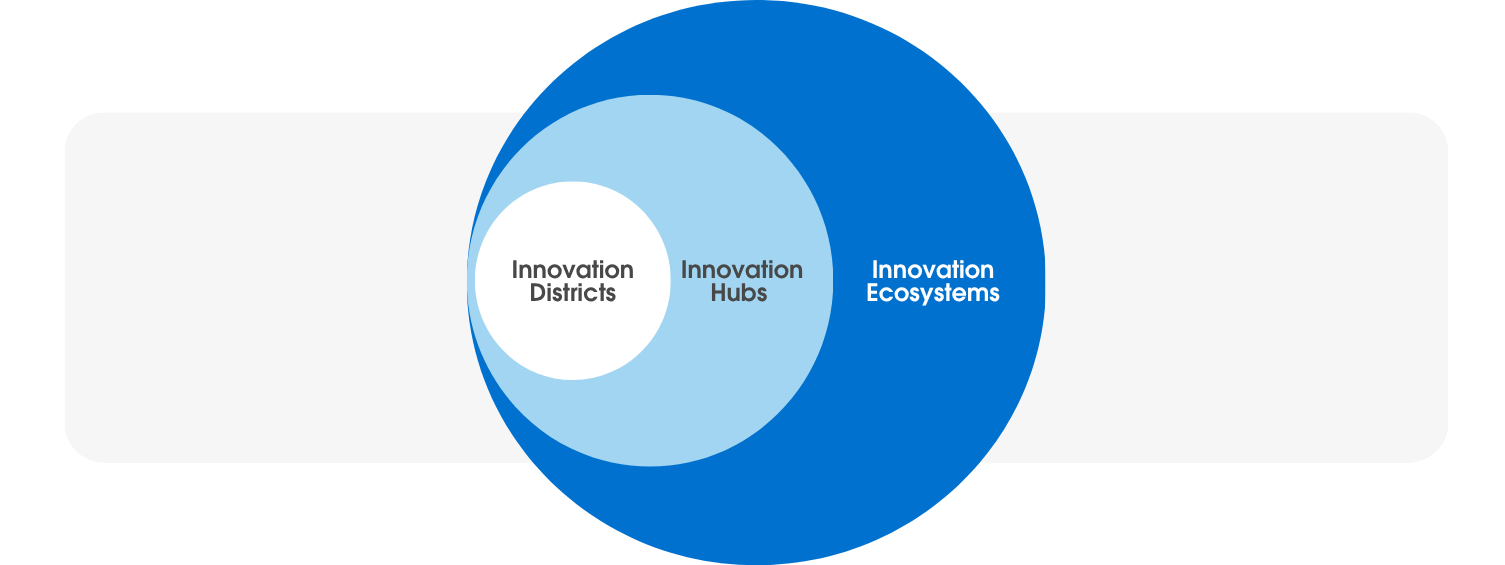
Communities for innovation are geographic areas where key stakeholders work together. Innovation ecosystems, hubs, and districts are common terms used to describe these communities. Although they vary in size and scope, they all combine economic, physical, and networking assets to create innovative environments that accelerate the development of new ideas, businesses, and technologies.
Innovation Districts
Innovation Districts are the smallest in size defined as “geographic areas where leading-edge anchor organisations and companies cluster and connect with start-ups, business incubators and accelerators. They are physically compact, transit-accessible, and feature mixed-use spaces for work, living, and retail.” As an example, White City Innovation District, in London is home to Imperial College’s research campus, life sciences startups, and corporate R&D centres in London.
Innovation Hubs
Innovation Hubs sit between innovation districts and ecosystems. They often cover multiple neighbourhoods or larger parts of a city and are defined as cities or metropolitan areas that can lead global innovation. These hubs leverage local advantages in science and technology to spur innovation. Innovation Hubs encompass districts like White City, Knowledge Quarter, and Tech City in London.
Innovation Ecosystems
Innovation Ecosystems are the largest and most flexible, linking smaller hubs and districts across broader regions or cities. They facilitate continuous collaboration across a wide range of sectors. UK Golden Triangle (London, Oxford, Cambridge) – connects London’s hubs with Oxford’s and Cambridge’s science and tech clusters.
Innovation Assets
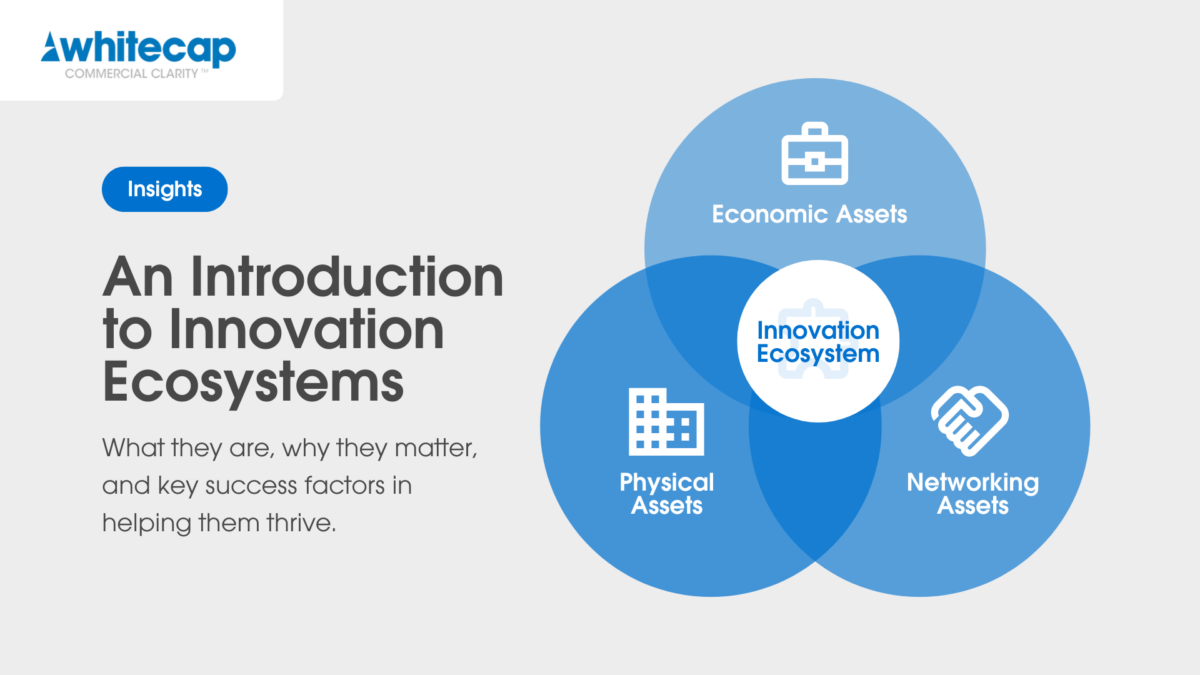
Creating an innovation ecosystem requires three innovation assets: economic, physical, and networking. Each plays a vital role in building a dynamic environment that nurtures innovation.
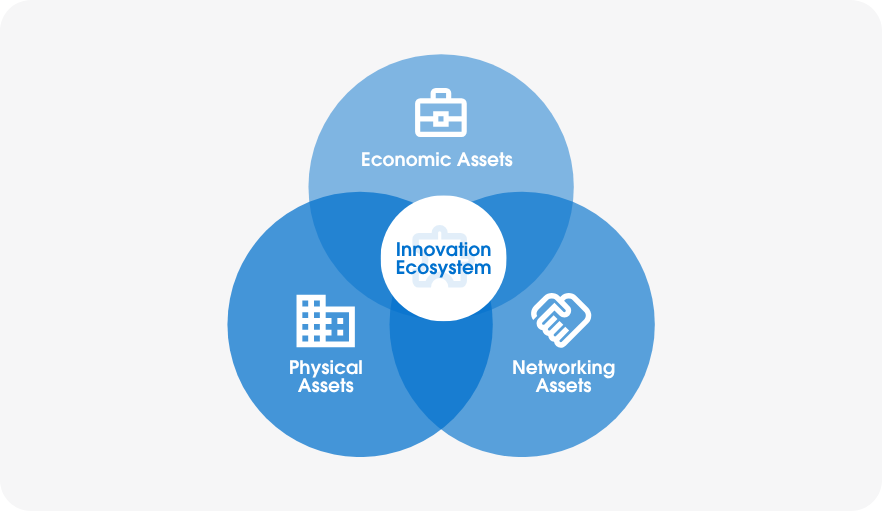
Economic Assets
Economic Assets are the firms, institutions, and other organisations that drive, cultivate, or support an innovation-rich environment. These include innovation drivers like research institutions, universities, established companies, and start-ups that create new technologies, products, and services. Innovation cultivators such as incubators, accelerators, and venture capital firms who guide and fund emerging ideas, while neighbourhood amenities, including local cafés, shops, and service providers, help create a community that connects and sustains ecosystem members.
Physical Assets
Physical Assets are the infrastructure that fosters connectivity and innovation. These include private spaces such as offices and co-working areas to public spaces like parks and plaza and includes the connectivity infrastructure that links ecosystem members including public transport and broadband. The aim is to connect and create environments that foster collaboration between members.
Networking Assets
Networking Assets represent the connections between individuals and organisations within the ecosystem. These can either be strong ties that provide established, high-trust relationships that support deep collaboration and joint problem-solving whilst weak ties are newer connections but introduce fresh ideas, insights, and contacts.
The Six Key Success Factors
Thriving innovation ecosystems emerge by connecting smaller innovation districts within a region. These ecosystems consistently demonstrate six key success factors (KSFs) which form the foundation for a prosperous environment.

Case Study: Boston – Cambridge Innovation Ecosystem
The Boston-Cambridge Innovation Ecosystem is an exemplar of how all KSFs combine together to succeed.
The region stands as one of the world’s premier innovation ecosystems, celebrated for its academic excellence, industries, and entrepreneurial spirit. Over the last 30 years, its success has been shaped by visionary leadership, public and private investments, and cross-sector collaboration.
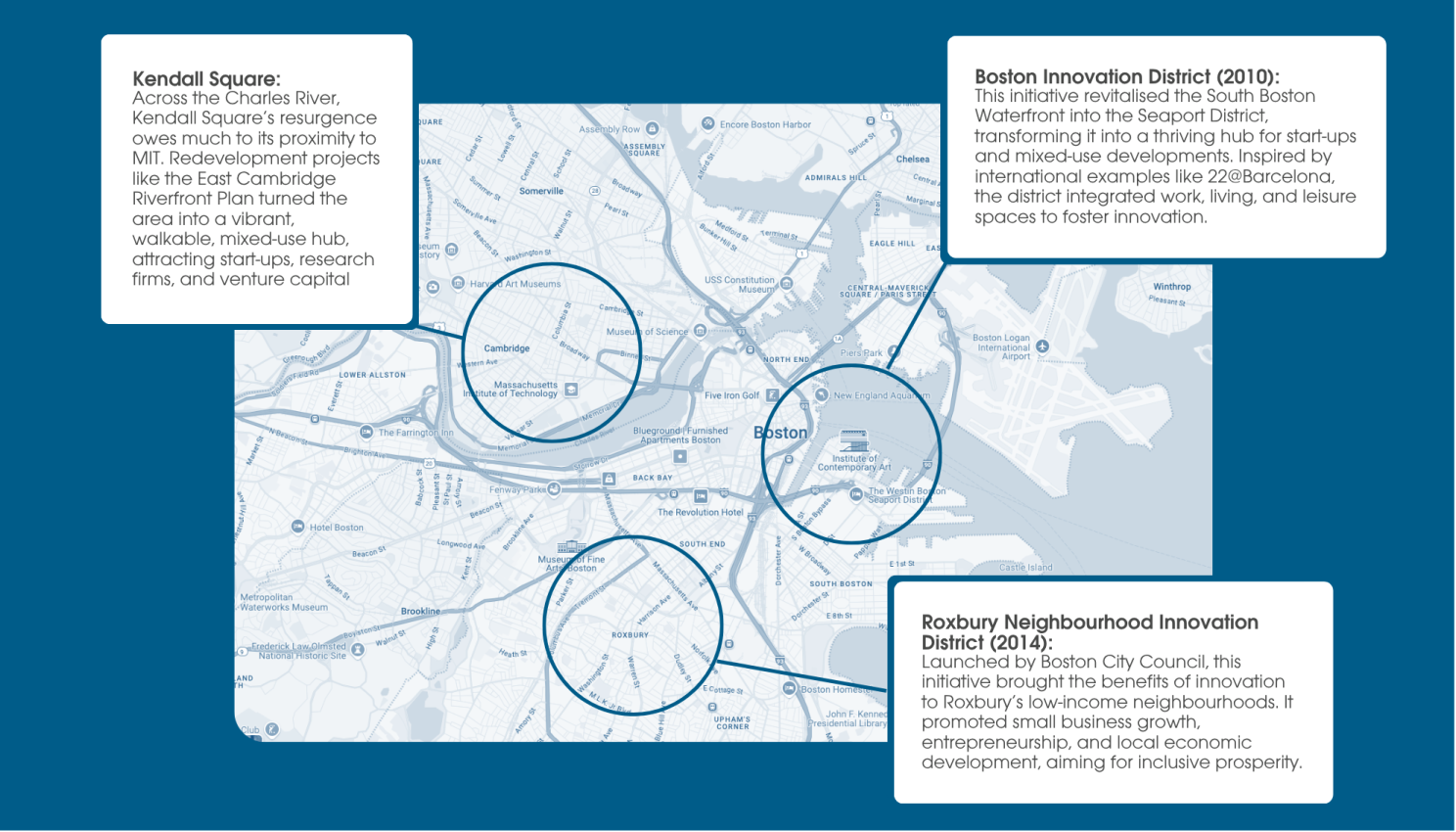
At the core of this ecosystem is a cluster of world-renowned universities, including MIT, Harvard, Boston University, and Northeastern University. These institutions not only produce highly skilled talent but also anchor pivotal research initiatives and foster partnerships with industries.
Targeted investments have spurred growth across key sectors like life sciences, high technology, education, and financial services. This has led to the formation of dense innovation clusters that have defined the region as a global hub of innovation.
In 2004, spearheaded by the Boston Planning and Development Agency (BPDA), the LifeTech Boston policy was pivotal in strengthening Boston’s life sciences and high-tech sectors. It attracted global companies and laid the foundation for Boston’s first innovation district.
Next in the series: Aspiration and Bold Vision
Our next blog will explore the key forces behind the world’s most successful innovation ecosystems, aspiration and bold vision.
- Blog 1: An Introduction to Innovation Ecosystems
- Blog 2: Aspiration and Bold Vision
- Blog 3: Clusters and Partner Strategy
- Blog 4: Capital and Funding
- Blog 5: Talent and Community Building
- Blog 6: Real Estate, Infrastructure and Place Making
- Blog 7: Diversity, Equality and Inclusion
At Whitecap Consulting, we support organisations in building and enhancing innovation ecosystems. In addition to working directly with clients, we conduct research and analysis to inform strategic decision-making and thought leadership. If you need support with a project or are looking to develop an innovation ecosystem, get in touch.
Responses