
AUCSO Launches Practical Framework to Support Universities in Preparing for Martyn’s Law

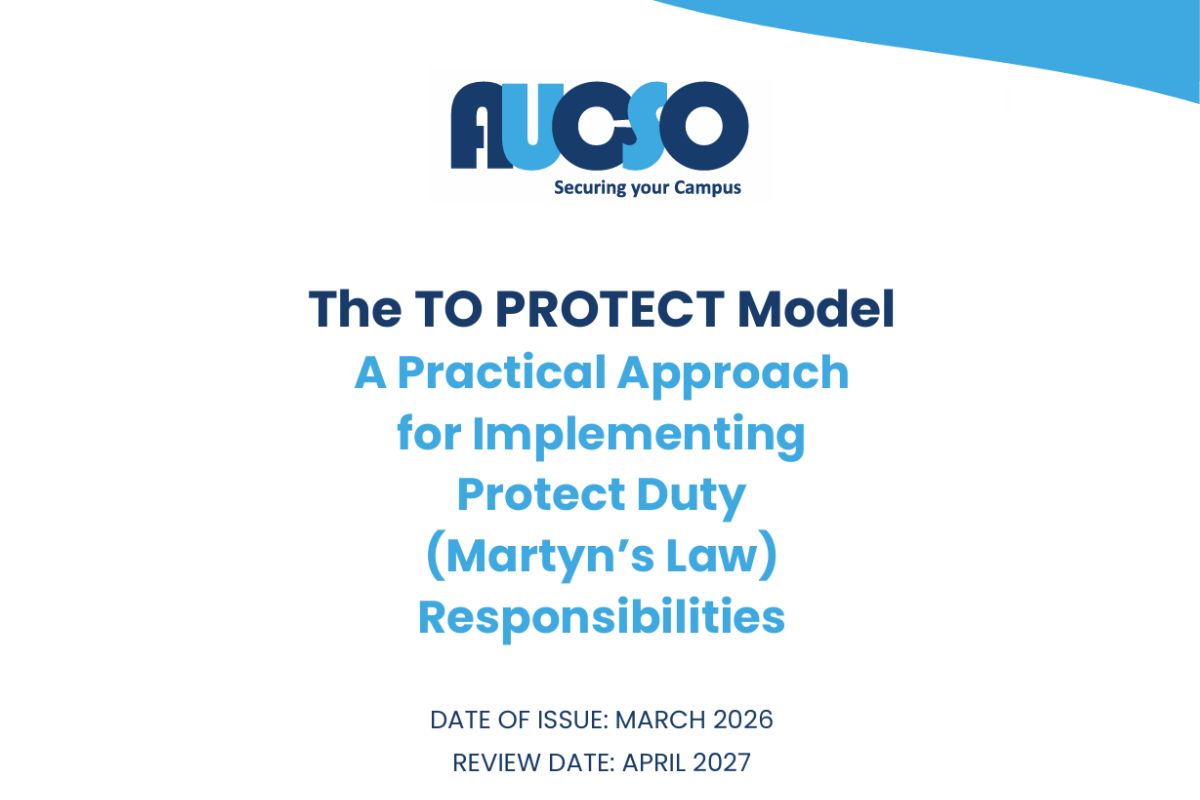
The Association of University Chief Security Officers (AUCSO) has today announced the publication of a new sector-led framework designed to support Higher Education institutions in preparing for the requirements of the Terrorism (Protection of Premises) Act 2025, widely known as Martyn’s Law.
Developed by AUCSO members Oliver Curran BSc (Hons), University College London, and Dale Murphy MSc, CSyP, University of Hertfordshire – with input and consultation from
AUCSO’s CONTEST Special Interest Group, the TO PROTECT Model: A Practical Approach for Implementing Protect Duty (Martyn’s Law) Responsibilities provides a practical, structured approach to implementing Protect Duty responsibilities within the complex, open and highly accessible environments that define modern university and college campuses.
The framework translates the legislative intent of Martyn’s Law into a clear, operational model built around nine core pillars, including governance, risk assessment, protective security measures, training, emergency preparedness, and partnership coordination.
The Higher & Further Education sector faces a unique challenge in balancing openness and accessibility with robust protective security. With large populations, diverse estates, and frequent public-facing activity, many institutions are expected to fall within the enhanced duty tier of the legislation.
The TO PROTECT Model: A Practical Approach for Implementing Protect Duty (Martyn’s Law) Responsibilities has been developed to help institutions respond to this challenge in a proportionate, practical and structured way – supporting both compliance and the development of a strong, embedded security culture across the university community.
A sector-led response to emerging regulation
The publication of the framework comes ahead of formal statutory guidance from Government, positioning AUCSO and its members at the forefront of sector readiness.
The document is designed as a living framework, enabling institutions to begin early planning, strengthen organisational awareness, and develop capability in advance of full regulatory implementation.
At its core, the TO PROTECT Model: A Practical Approach for Implementing Protect Duty (Martyn’s Law) Responsibilities recognises that effective protective security in Higher Education cannot sit in isolation. Instead, it must be embedded across governance structures, operational planning, and institutional culture.
The framework supports universities in:
• Understanding evolving threat landscapes
• Conducting structured Risk Assessments for Security and Vulnerability (RASV) and Terrorism Vulnerability Risk Assessments (TVRA)
• Implementing proportionate and layered security measures
• Strengthening staff awareness, training and preparedness
• Enhancing coordination with partners and emergency services
• Demonstrating compliance and assurance to regulators
The development and publication of the framework is also closely aligned with the intent behind Martyn’s Law, which seeks to ensure that organisations take appropriate, proportionate steps to protect the public from terrorist threats.
AUCSO continues to engage with key stakeholders across the sector, including those closely connected to the development and advocacy of the legislation, such as Figen Murray OBE, AUCSO patron, whose work has been instrumental in driving awareness and change.
Geoff Brown, Chair of AUCSO, said:
“Universities are among the most open and complex environments in the UK, and that openness is fundamental to who we are as a sector. However, it also brings responsibility.
“The introduction of Martyn’s Law represents a significant step forward in strengthening public safety, and it is vital that Higher Education institutions are equipped to respond in a structured, proportionate and practical way.
“The TO PROTECT Model is a sector-led framework, developed by practitioners for practitioners. It provides a clear, operational approach that universities can begin using now to build readiness, strengthen resilience, and embed protective security into the fabric of their organisations.
“As a community, we have an opportunity not just to comply with legislation, but to lead in how it is implemented, and this framework is an important step in that journey.”
Julie Barker, Chief Operating Officer at AUCSO, added:
“This framework represents a significant member benefit for the sector, developed to provide practical, actionable support at a critical time.
“In my recent discussions with partner associations across the Higher Education landscape, there has been a clear and very positive response. There is a strong appetite for shared approaches and practical guidance, and a real willingness to support and endorse initiatives that help the sector prepare effectively for Martyn’s Law.
“We look forward to continuing that collaboration as the framework is adopted more widely across the sector.”
Responses