
Validated Insights Report: Institutions Must Update Curriculum in Light of Demand for AI Fluency

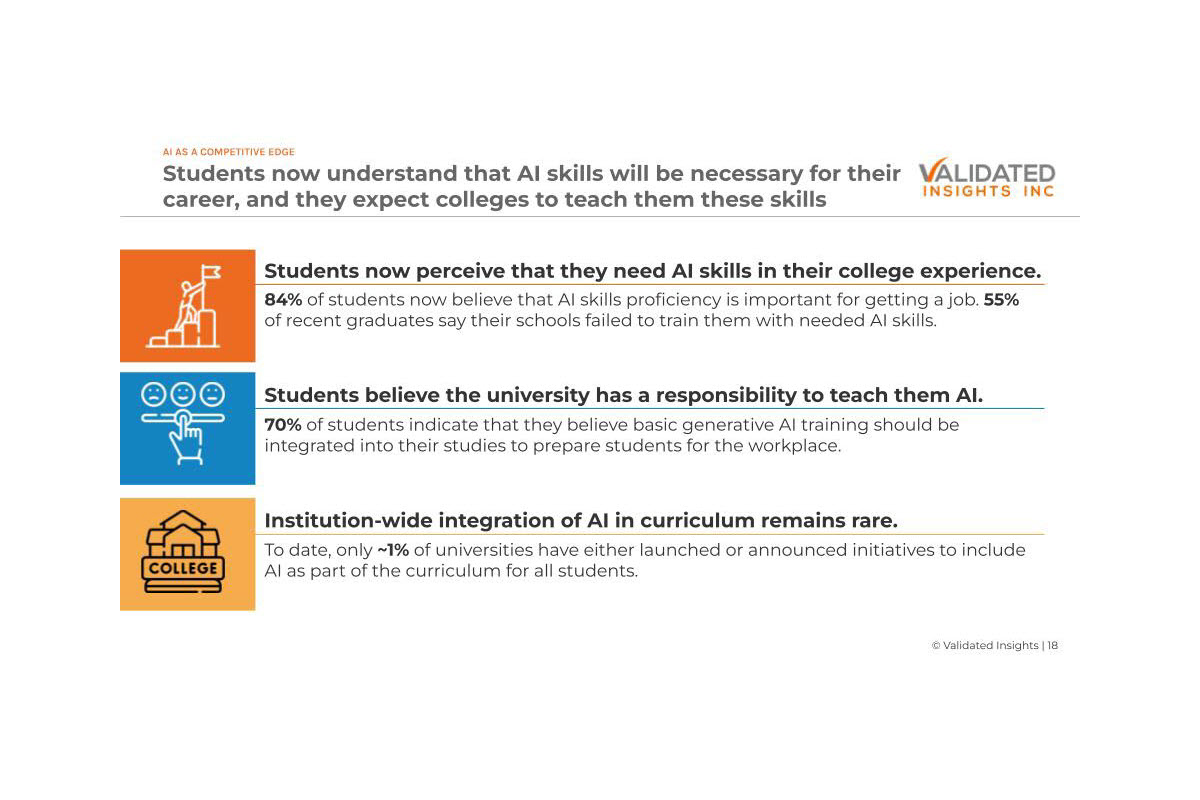
Newest report from Validated Insights shows significant missed opportunity, mismatch between teaching AI literacy and market demands
According to the newly released report from higher education marketing and research firm Validated Insights (VI), only about 1% of American higher education institutions have included AI literacy as an institution-wide instructional priority, despite evidence that workplace demand for AI literacy is already substantial and growing rapidly.
VI describes the disconnect between workforce and teaching as a “missed opportunity,” and recommends that education providers adjust quickly, adding AI literacy to their curricula not just here and there, but broadly across the entire institution. “Moving to an institution-wide approach to teaching AI literacy will serve students, graduates, and education providers immediately and throughout the next decade,” the report says.
AI Skills in the Workforce
The report is a comprehensive compilation of existing research and data related to demand for AI skills in the workforce and teaching AI skills and literacy. The report states:
“Rapid increases in enterprise adoption and personal utilization have spurred rapid growth in the percentage of jobs requiring AI skills. Industry sources indicate that demand for AI services and solutions will grow 5X faster than the aggregate U.S. economy through 2031, further driving growth. As it stands, almost one in twenty job postings for college graduates require AI skills, and 33% of the college educated workforce is already using AI.”
Additional findings in the report include:
- 88% of employees expect to utilize AI in their work by 2028.
- AI utilization and the demand for AI fluency is highest in occupations that require a college degree.
There is already a significant wage premium for positions that require or use AI literacy skills, finding that demand for AI skills is growing faster than supply of AI talent and that employers are willing to pay a premium for workers who can utilize AI.
“Every single metric shows increasing demand for AI skills in the workforce,” said Brady Colby, Head of Market Research at Validated Insights. “These data are the closest thing to inevitability that we see in research. AI skills are on their way to being a requirement for nearly all mid-level and high-level careers, and those who have them will be hired faster and earn more.”
Gap in Teaching AI Skills
The ascension of demand for AI skills will drive the market for AI education, predicting double-digit AI education market growth and an overall market size over $4.4 billion.
The report stated:
- The rapid growth in the size of the AI market is projected to drive even faster growth in the market for AI education.
Despite market demands and opportunities in a growing, lucrative market, just 1% of institutions have announced or launched plans to incorporate AI into all programs.
“Programs and some sectors have been faster and more responsive in meeting the need for AI skills,” Colby said. “But this only shows what’s possible and highlights the pretty weak movement to school-wide, universal AI literacy. At just one percent, higher education providers are, by and large, not even in the game yet, and students are noticing.”
Several schools were highlighted in the report as leaders in making AI literacy a part of their institutional approach:
- The University of Southern California
- The University of Florida
- The Ohio State University
- Purdue University
- University of San Francisco
- Creighton University
- Lehigh University
- University of North Carolina, Charlotte
- Stevens Institute of Technology
- DeVry University
- University of Phoenix
“The labor market needs these skills and students want them. It’s past time for our schools to speed up the process of delivering,” Colby added.
Previous reports from Validated Insights have studied the market for online program management companies (OPM), MBA programs, nursing education, and computer science programs.
Responses