
New research finds work experience can reduce the odds of young people becoming NEET by 80%

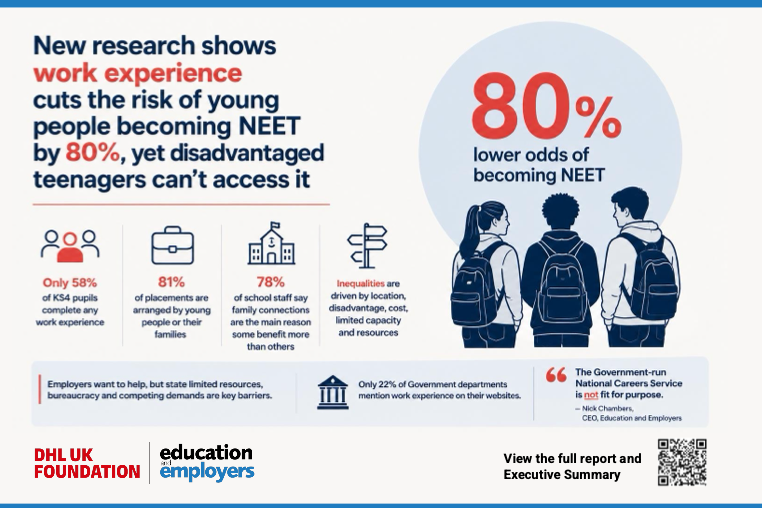
A new report by the education charity Education and Employers has found that young people who experience the highest levels of employer engagement before the age of 16 have 80% lower odds of becoming NEET compared to those who had the least experience.
Work Experience: Past, Present and Future is the most detailed analysis of global research on the impact of employer engagement. Funded by the DHL UK Foundation, it draws on findings from three original surveys of young adults aged 19 to 26, teachers, small employers, and 47 international OECD studies.
The report also found that access to high-quality work experience placements and meaningful employer encounters is often limited to those with well-connected families.
The report found that for 81% of young people, work placements are arranged by them or their families. More than three quarters of school staff (78%) said family connections are the main reason some young people benefit more than others. These inequalities in access are reinforced by a combination of geographic isolation, economic disadvantage, travel costs, limited employer capacity to engage, and insufficient resources in schools.
The study also examines careers provision for young people and raises concerns about the Government-run National Careers Service which Nick Chambers, CEO of Education and Employers says: “is not fit for purpose”.
Whilst the Government have recently announced a new policy requiring all students under 16 to complete ten days of workplace experience, the study found that many teachers were very concerned about its deliverability. The report includes an analysis of Government departments and discovered only 22% of Government departments mention work experience on their own websites. The Department for Education, the Department for Work and Pensions and the Cabinet Office do not appear to offer work experience placements to under-16s.
At the moment:
- only 58% of KS4 pupils complete any work experience
- 94% of teachers said job shadowing would be difficult or very difficult to organise
- 81% of teachers said workplace visits are difficult or very difficult to arrange
- employers are willing to engage, but state limited resources, bureaucracy and competing demands as significant barriers
- schools face a shortage of high-quality placements, competition from other schools, rising travel costs and difficulties releasing staff
The report argues that without proper infrastructure and support the Government’s guarantee of 10 days’ work experience risks becoming a tick-box exercise which will fail to deliver what our young people need and deserve.
Responses