
Beyond Heat Pumps and Headcounts: Rethinking Green Skills in FE


It’s becoming hard to attend a sector conference or read a government paper without hearing about green skills. It’s a phrase that’s everywhere. But what do we really mean by green? And what exactly are the skills we think we need?
This is not a rhetorical question; it’s one that goes to the heart of whether the FE and skills sector can meet workforce needs and societal challenges of the coming decades.
What do we mean when we say ‘green’?
‘Green’ can mean many things: decarbonisation, biodiversity, circular economy, climate resilience, equity, behaviour change, planetary justice. Too often, it’s used as shorthand for something urgent, important, but ill-defined. That lack of clarity creates confusion in strategy and misalignment in delivery, especially in a sector as diverse and pressured as ours.
Let’s be honest: if we don’t have a shared understanding of what the green transition requires from us, how can we expect our learners, partners or communities to?
Green skills aren’t new – but the scale and stakes are
There’s a danger in treating green skills as a new category of knowledge rather than what they are: a continuation of how skills evolve to meet the demands of a changing world. It’s similar to digital skills: Once niche, they are now mainstream and a prerequisite to participate in most of modern work life and learning. The same is happening for sustainability knowledge, behaviours and mindsets across education and employment.
In other words: it’s not just about technical green skills. It’s about how all skills and the ways we think are changing and need to change.
This is not to deny the need for technical skills planning and delivery, far from it. We do need more renewable energy system engineers, retrofitters and regenerative farmers. But we also need explicit long-term policy commitment and consistency, not fragmented or reactive initiatives. Strategic change requires staying power.
What’s more, we must avoid creating a false binary between technical green skills and education for sustainable development (ESD). The diagram below shows how they’re both one of the same:
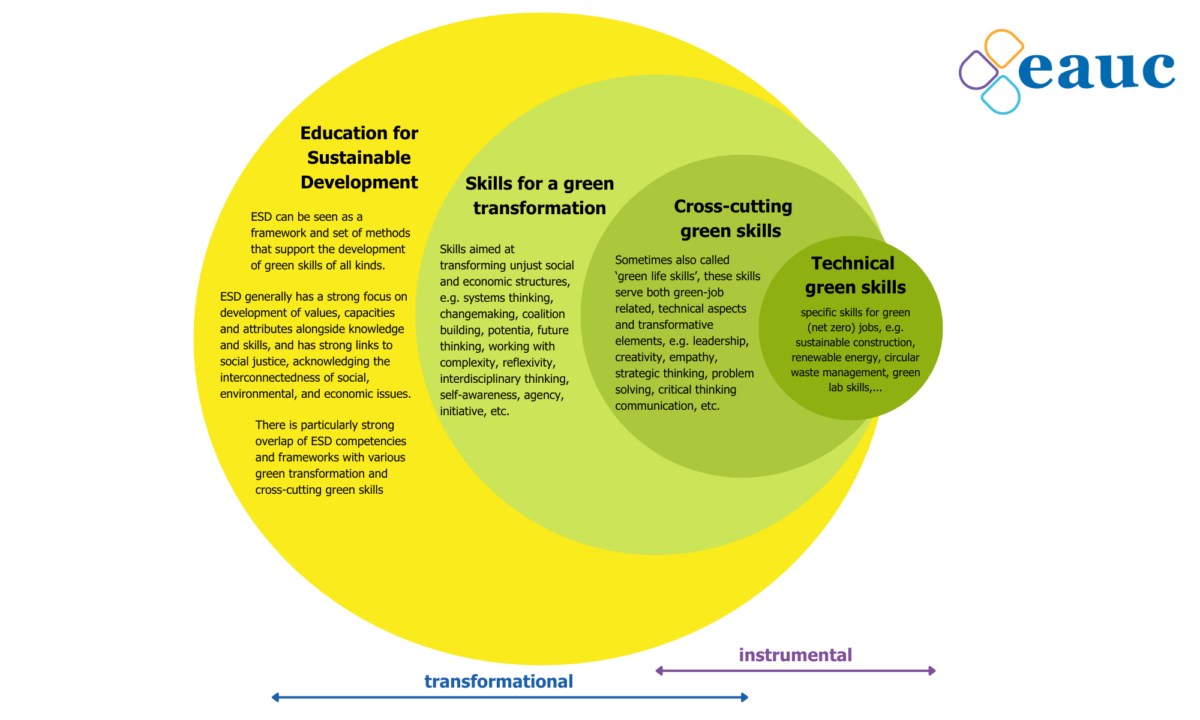
A focus purely on the technical green skills we need in society is risky. When the green transition is seen as only about economic growth and spreadsheets of job titles and numbers of new roles to be created, we risk missing the bigger picture. Because green jobs are not just STEM jobs. They exist across all disciplines, sectors and roles. And done well, this transition isn’t just about creating new jobs, it’s about transforming how existing ones are done: good jobs for all.
A Universal Curriculum – and a confident, capable workforce
A sustainability-literate society needs a workforce equipped not just with technical competencies but with the curiosity to explore new ideas, the courage to do what’s right, and the awareness of how actions affect others and the planet.
Every teacher and trainer in the FE system should have a core understanding of sustainability, but also the freedom and support to adapt their curriculum so it’s fit for purpose, now and in the future. This isn’t just about knowledge. It’s also about skills, values and behaviours: the invisible yet powerful stuff that shapes institutional culture and learner mindsets.
The elephant in the room
Well, there’s a small herd so let’s name a few. There are conflicting data sets that inform our planning. Multiple bodies offering overlapping insights and support. A tendency to repeat enquiries rather than implement recommendations – the Green Jobs Taskforce, for example, laid out many of the right foundations. Are we building on them or starting over?
Meanwhile, the skills system itself continues to shift: Skills England has launched, DWP has increased influence, and funding mechanisms change as quickly as strategies are published. These conditions create understandable fatigue. And if we’re honest, many people in the sector feel cynical, undervalued or overwhelmed. That’s not necessarily a failure of leadership but a reflection of the scale and complexity of the challenge.
What’s striking is how little space we have, to do this well, within our ever-changing environment. Business planning processes and away days can offer a pause for thought within organisations; sector bodies publish reports about their industries; but across the system? Many events talk about the challenges, but few move beyond analysis to collaborative, solution-focused design. And even fewer invite us to think across the whole system rather than just a single policy, sector or job role. Spaces that are strategic, shared, and grounded in real-world complexity remain the exception, not the norm.
This is about people, not just policy
We often treat sustainability like a technical problem. It’s not. It’s an adaptive challenge, a deep cultural shift that demands new thinking, new habits, and new meaning-making. This work will not be done by frameworks alone. It will be done by people. Fallible, brilliant, tired, hopeful people.
So the question becomes: how do we free up the energy, trust and imagination we need to face the deeper realities of our time?
Introducing the Green Mindset Collective
We’re bringing together 50 senior leaders, politicians, awarding bodies, employers and educators not just to talk about the green transition, but to shape it. Through plenary panels and four inquiry tracks exploring themes from workforce development to place-based impact, we’ll co-create a strategic report that acknowledges the complexity of this work, and offers a way forward.
This won’t be a silver bullet. But it might be a space to begin thinking and working differently, as a collective.
Reframing the challenge
So perhaps the real shift we need is not more green skills initiatives, but a deeper green mindset. One that asks: What if every decision we made in the FE and skills system, in policy, pedagogy and practice, was made with sustainability – social and environmental – in mind?
The answer to that might change everything. Or at least, it’s a good place to start.
By Charlotte Bonner, CEO at EAUC (The Environmental Association for Universities and Colleges)
Responses