
Supporting the FE & Skills sector through environmental professional registration


Towards the end of 2025, the first resources from the Green Mindset Collective (an EAUC, ETF and FE News initiative) were published, including a ‘Playbook’. Within this resource, it sets out the micro, meso and macro‑level actions that can help the FE and Skills sector progress towards a more deeply embedded green culture.
Much of what drives the work we are undertaking at the Society for the Environment (SocEnv) focuses on those macro‑level actions, particularly systems and skills policy. This article introduces some of that work and explores why we believe it is so important in its links to the education and skills system.
Landscaping green skills and environmental competency
As the FE & Skills sector continues to adapt to economic, technological and environmental change, its role in preparing people for meaningful, future‑facing careers has never been more important. Sustainability is increasingly embedded across occupations and industries, and education providers are central to ensuring learners and workers are equipped not only with technical capability, but with the understanding and professional behaviours needed to operate responsibly in a changing world. It’s not isolated to a few roles or industries either. It’s a cross‑sector challenge that creates opportunities for connections and solutions between education and industry.
The work outlined here reflects The Society for the Environment’s (SocEnv) commitment to supporting the education and skills system, as it responds to this challenge. Operating under a Royal Charter and working in partnership with licensed professional bodies, SocEnv collaborates with employers, educators and professionals to help strengthen the connection between learning, competence and professional recognition. Our registers hold over 9,000 environmental professionals working across a wide range of sectors, reflecting both the importance of environmental sustainability and the ever-increasing relevance of green skills.
With the Post-16 Education and Skills White Paper published in Autumn 2025, we’ve reflected on the range and type of provision being prioritised, to ensure we play our part in supporting positive post-learning destination, both for those individuals entering the workforce and those growing their careers too, ensuring that an environmental focus remains throughout.
By recognising apprenticeships, technical qualifications and broader FE provision as strong routes towards environmental professionalism, this approach helps to acknowledge the value being delivered by colleges, training providers and awarding organisations. It also reinforces the message that sustainability is not confined to specialist roles, but is relevant across sectors, occupations and career stages.
Crucially, this work is not about creating new barriers or additional requirements for learners. Instead, it aims to provide clarity and visibility around progression, showing how educational achievement can connect to external, independently validated environmental professional standards. For learners, this offers confidence that their qualifications have relevance beyond the learning programme. For providers, it demonstrates how curriculum design and delivery can support longer‑term career development that’s addressing the green skills needs in all sectors.
Apprenticeship Mapping
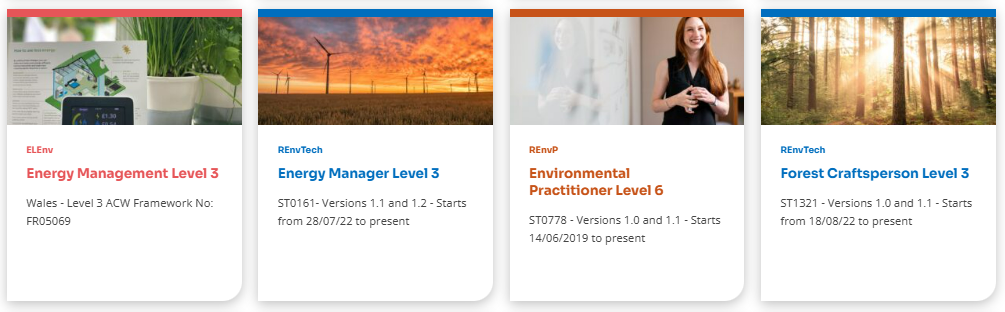
A key element of this work has been the mapping of apprenticeships against the competency requirements for environmental professional registration. This activity recognises the growing role apprenticeships play in developing occupational competence and professional behaviours, particularly in sectors where environmental responsibility is integral to the day‑to‑day practice.
Skills England classifies occupations as either mid-green or dark green, shown by a leaf symbol on their occupational maps. This shows how much they help the UK reach its goal of net-zero carbon emissions by 2050.
Dark Green: ‘ A dark green occupation, for example wind turbine engineer, is embedded within the green occupational landscape and delivering sustainable outcomes’
Mid Green: ‘A mid-green occupation will remain the same in overall scope, but there might be a need for new knowledge, skills and behaviours to be embedded to enable the use of new technologies and approaches’.
Through collaboration with Skills England and Trailblazer groups, x20 apprenticeships have now been identified as delivering substantial alignment with the competency standards required for Registered Environmental Technician (REnvTech) and Registered Environmental Practitioner (REnvP).
This mapping provides greater visibility of how apprenticeship achievement can support progression into professional registration by having those registration competency requirements embedded within the occupational standard itself. Apprentices can apply for professional registration with their apprenticeship achievement serving as evidence of their qualifications and most, or all competencies, a seamless transition from apprenticeship achievement to environmental professional registration.
For apprentices, this creates a stronger connection between their training and longer‑term career development. Achieving the apprenticeship acts as a milestone on a professional journey, helping individuals understand how their skills, knowledge and behaviours translate into externally recognised competence. It also reinforces the value of apprenticeships as credible routes into environmental professions, alongside more traditional academic pathways.
With apprenticeships recognised as a route to professional registration, across sectors such as water, arboriculture, environmental sciences, energy, engineering, construction design, ecology, countryside management, low‑carbon technologies and sustainable resources, this work provides an example of how green skills are embedded across occupations.
For employers and providers, mapping apprenticeships to the professional registers helps articulate the contribution apprenticeships make to quality, consistency and confidence in practice, particularly in sectors navigating regulatory, environmental and sustainability challenges.
This approach supports the FE & Skills sector by recognising what is already being delivered, rather than introducing additional requirements. It strengthens the bridge between education, employment and professional recognition, helping ensure that apprenticeships continue to evolve as high‑value pathways that meet both learner aspirations and wider workforce needs.
A Gateway to Environmental Professionalism
In discussions with colleges, universities and independent training providers, we consistently hear that learners value careers with a strong environmental and sustainability focus, particularly where this connects to wider social and ethical issues. That connection between people and planet is increasingly seen as an essential ingredient for a fulfilling career. Providing a supportive framework that enables this passion to extend beyond time in formal learning, through mechanisms such as the Entry‑Level Environmentalist register, is one way we (as a wider skill system) can help sustain that ambition and momentum.
The introduction of an Entry‑Level Environmentalist (ELEnv) register reflects a commitment to inclusivity and access, that can engage professional recognition with technical and vocational education. By recognising environmental knowledge and emerging competence, it provides a framework of support for diverse routes into environmental careers and ensures learners see environmental sustainability as a continuing thread throughout their working lives, with progressive guidance leading to a competency register within 3 years of being awarded ELEnv.
Historically, there has often been a gap between educational achievement and the prospect of attaining professional registration. In many cases, this has stemmed from an over-emphasis on Chartered status (equivalent to Master’s‑level), which can leave individuals feeling that professional recognition is distant, inaccessible, or simply not relevant at their stage of development.
The introduction of this register, alongside existing Technician and Practitioner pathways, aims to bridge that gap. Together, these routes open the door to environmental professionalism for a wider range of individuals earlier in their careers, ensuring that professional recognition is available at every level within the workforce.
As a practical example of this approach, we have recently ratified a suite of T Levels, Higher Technical Qualifications (HTQs) and Apprenticeships across the UK that embed environmental sustainability to a sufficient depth to align with the Entry‑Level Environmentalist standard. This alignment helps create a bridge between completing these qualifications and achieving professional registration.
In addition, professional bodies consistently provide valuable student memberships that offers access to broader learning networks, mentoring, and development opportunities throughout study. These memberships often progress into clearly defined post‑study grades, enabling a smooth transition from education into recognised professional status. When membership is combined with professional registration, individuals gain a supportive professional community that helps them thrive and build an exciting career with environmental sustainability at its’ core.
Collaborations
As this work develops, it offers a practical example of how collaboration between education, employers and professional bodies can enhance progression, raise awareness of environmental competence, and support a joined‑up skills system, one that values learning at all stages and connects it meaningfully to professional practice.
For the FE & Skills sector, collaboration remains key. Strengthening links between education policy, professional bodies, employers, and assessment organisations creates opportunities to align provision more closely with real‑world practice. It also helps ensure that green skills are understood, valued and supported across the system, as the UK works towards a more environmentally sustainable economy and workforce.
Through continued partnership with the education and skills community, SocEnv will continue to support approaches that recognise learning, encourage progression and reinforce the essential role the FE & Skills sector plays in developing the environmental capability needed for the future – a future shaped by environmental professionalism.
By Tom Cheek, the Education Relationship Manager at the Society for the Environment (SocEnv)
Tom Cheek brings over 20 years of Further Education experience in technical education and apprenticeships. He specialises in connecting learning pathways with professional registration to strengthen routes into green careers.
References
Green themes Skills England Occupational Maps. Available at: https://occupational-maps.skillsengland.education.gov.uk/green-themes/ (Accessed: 9 February 2026).
SocEnv Apprenticeship. Available at: https://skills.socenv.org.uk/apprenticeship/ (Accessed: 9 February 2026).
SocEnv Guidance for educational providers – ELenv. Available at: https://skills.socenv.org.uk/guidance-for-educational-providers-elenv/ (Accessed: 9 February 2026).
The Education Training Foundation. (2026). Green Mindset Collective report. [online] Available at: https://etfoundation.co.uk/news-and-events/green-mindset-collective-report/ (Accessed 10 Feb. 2026).
Responses