
May 2026 ONS: NEETs Pass One Million as Inactivity Climbs Again

- 1,012,000 young people are NEET, up 55,000 on the quarter and 89,000 on the year, passing one million for the first time in over a decade
- 13.5% NEET rate, up 0.7 percentage points on the quarter and 1.0 points on the year
- Economically inactive NEETs jump 66,000 on the quarter to 613,000
- Unemployed NEETs fell 11,000 on the quarter to 400,000, though up 45,000 on the year
- Young men drive the rise, up 55,000 on the year to 553,000; young women up 34,000 to 459,000
- Male NEET rate climbs to 14.4%, up 1.1 points on the quarter, against 12.5% for young women
- 18 to 24 group at 15.8%, with 928,000 young adults NEET
The latest figures released today by the Office for National Statistics show 1,012,000 young people aged 16 to 24 were not in education, employment or training (NEET) in January to March 2026, up from 957,000 in October to December 2025. This represents 13.5% of all young people, up 0.7 percentage points on the quarter and 1.0 points on the year.
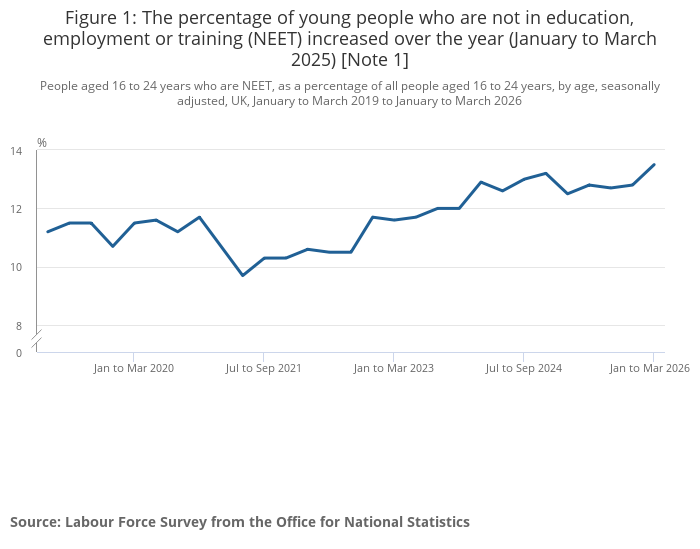
The figure passes one million on the seasonally adjusted measure for the first time in more than a decade, when youth disengagement last peaked in the aftermath of the financial crisis. It also lands the same morning as the interim report of Alan Milburn’s government review into youth inactivity, which warns the cohort could reach 1.25 million within five years.
Young Men Drive the Increase
Young men led the rise this quarter, reversing the pattern of late 2025 when young women drove the increase. The male NEET rate climbed to 14.4%, up 1.1 percentage points on the quarter and 1.2 points on the year, against 12.5% for young women, up 0.3 points on the quarter and 0.8 on the year. In headcount terms there were 553,000 NEET young men and 459,000 NEET young women. Of the 89,000 annual increase, 55,000 was among young men. After several quarters in which the gender gap had narrowed, it has widened out again.
Young Adults Hit Hardest
The 18 to 24 age group continues to carry the higher rates, with 928,000 young adults NEET, up 38,000 on the quarter and 74,000 on the year. At 15.8% the rate rose 0.6 percentage points on the quarter, although it sits 1.0 points lower than the same period last year, a reminder that changes in the size of the population can pull the headcount and the rate in different directions.
The Return to Inactivity
The defining movement this quarter is the reversal of the engagement seen at the end of 2025. Economically inactive NEETs, those not looking for work, rose by 66,000 on the quarter to 613,000, while unemployed NEETs, those actively seeking work, fell by 11,000 to 400,000.
This is the mirror image of the previous quarter, when inactivity fell and unemployment surged as young people moved back into the jobs market. That movement has now more than unwound, with the quarterly rise in inactivity concentrated among young men. On the year the picture is starker still: inactive NEETs are up 44,000 and unemployed NEETs up 45,000, so both measures are climbing together.
Within the annual change there were 297,000 economically inactive young men, up 28,000 on the year, and 316,000 economically inactive young women, up 16,000. Among the unemployed, 257,000 were young men, up 27,000 on the year, while young women fell to 143,000, down 18,000.
Reading the Shift
Last quarter’s data invited a glass half full reading: more young people moving from inactivity into active jobseeking, a necessary first step toward work. This quarter closes off that interpretation. Rather than converting into employment, a significant number appear to have slipped back out of the labour market altogether, with the very cohort that had started looking for work, young men, now leading the return to inactivity.
That is the dynamic Alan Milburn’s review, published the same day, identifies as the heart of the crisis. His diagnosis describes a move away from cyclical youth unemployment toward something more entrenched, with rising health related inactivity keeping young people detached for years rather than months. The composition of today’s figures, inactivity climbing while active jobseeking falls, fits that account closely.
Strategic Implications for FE and Skills
For senior leaders in the FE and skills sector, this quarter’s data points to three priorities.
Reaching the inactive, not just the unemployed. The renewed rise in economic inactivity, particularly among young men, suggests outreach matters as much as employability support. Reaching young people who are not presenting to jobcentres or providers at all is the harder task the numbers now demand.
Converting jobseeking into jobs. A fall in unemployment is not necessarily good news if it reflects discouragement rather than employment. Work placements, employer partnerships and clear progression routes remain essential to ensure those who do start looking are absorbed, rather than cycled back into inactivity.
Watching the gender reversal. With young men driving the increase after several quarters in which young women led, provision may need to flex accordingly, while sustained attention to the barriers affecting young women, including childcare and flexible study, remains warranted.
Data Quality and Context
The ONS continues to badge these Labour Force Survey based statistics as official statistics in development, citing increased volatility from smaller achieved sample sizes, particularly for granular breakdowns such as NEET. It advises caution when interpreting short term change, especially across mid 2023 and 2024, and recommends reading NEET figures alongside other indicators such as the Claimant Count and PAYE Real Time Information estimates.
Looking Ahead
The next NEET update is scheduled for 27 August 2026. With the Youth Guarantee in its implementation phase and Milburn’s final report, carrying recommendations for system reform, due later in 2026, the coming quarters will show whether the slide back into inactivity is a blip or the start of the trajectory his review warns about. For now, with more than a million young people disconnected from both work and study, the data underscores the urgency of coordinated action across government, providers and employers.
Sector Reaction
Simon Ashworth, AELP Deputy CEO and Director of Policy:
“With more than one million young people now outside employment, education or training, the Milburn Review rightly highlights the growing barriers many face in accessing work and progression opportunities. This is a landmark report for a landmark moment.
“We now need a serious national conversation about how employers, providers and government create far more opportunities for young people and build stronger workforce pipelines for the future.
“Many young people are motivated and close to employment if the right opportunities exist. Apprenticeships must be part of the solution, alongside stronger employer engagement and more flexible pathways into work.
“Over the coming months, AELP will work with members, employers, charities and policymakers through an Autumn Summit and forthcoming Mini Commission aimed at developing practical solutions for increasing opportunities for young people.”
Sarah Yong, Deputy CEO at Youth Futures Foundation, said:
“Today’s ONS figures reveal that around 1,012,000 young people are not in education, employment or training (NEET). Taken alongside the findings in Alan Milburn’s diagnostic report, the message is clear; we must act decisively and at pace for young people.
“Growing government focus through the expanded Youth Guarantee and recent apprenticeship reforms have marked a welcome and positive start, but the scale and complexity of the challenge means we need to raise ambition further. Ambitious system reform needs to include acting early in education, working with employers to create more apprenticeship opportunities which we know have high evidence of impact, combined with tailored employment support for young people facing more barriers, like those with SEND or care experience.
“With mental ill health a significant driver of rising inactivity, reforms must also integrate employment and health support in ways that reflect the evidence. We also need to do more to reach ‘hidden’ NEET young people. Approaches that integrate relational support through trusted adults have the potential to provide the connective tissue needed in the system.
“Alongside the evidence, the lived experience of young people is essential to shaping solutions that work. Behind the statistics are real young people facing real and often multiple barriers. We have been pleased to convene the Youth Advisory Panel to help ensure their voices inform the interim report.
“The opportunity is here to drive meaningful change. We have a moral obligation to improve outcomes for young people and additionally there is a huge societal and economic prize if we get this right. Analysis suggests that matching youth participation rates in the Netherlands would mean 567,000 more young people earning or learning, delivering an £86 billion boost to the UK economy.
“As the What Works Centre for Youth Employment, we look forward to supporting the next phase of the review to develop recommendations grounded in what works.”
Prof. Amanda Kirby, Founder of Do-IT Solutions said:
“Not so NEAT …we need to take a universal design approach and work across systems starting much earlier
“Alan Milburn’s interim report today on young people and work should make us pause.
Nearly one million young people aged 16–24 are not in education, employment or training.
But this is not simply a ‘worklessness’ issue!
“For many young people, the pathway to NEET status starts much earlier: unmet neurodevelopmental needs, poverty, trauma, care experience, school exclusion, poor mental health, low confidence and systems that act too late.
“For young people who are neurodivergent and have also experienced adversity, risk is not just added — it can compound.
“A young person may be labelled as difficult, disengaged or not work-ready, when the real story is missed ADHD, autism, DLD, DCD, dyslexia, trauma, anxiety, poor sleep, sensory overload or communication needs or a combination of all of the above (+ Care experience/homelessness)
“The report rightly challenges a system that asks too often, ‘What can’t you do?’ rather than, ‘What would help you take the next step?’
“We need earlier identification, practical support, inclusive employers, accessible training routes and joined-up education, health, welfare and employment systems.
“Most young people want and deserve a future. The question is whether our systems are designed to help them reach it.”
Jon Fitzmaurice, Head of External Engagement, the Work Foundation at Lancaster University, said:
“Today’s figures show the number of young people aged 16–24 not in education, employment or training has surpassed a million for the first time in 13 years.
“NEET levels have risen by 270,000 since 2022, and a landmark review warns the situation could deteriorate further. The Milburn Review is right to describe this as a systemic failure. The number of young people who are not actively looking for work is at its highest number on record at 613,000. Yet around eight in ten young NEETs say they want a job, even as they face an increasingly difficult route into stable employment while navigating complex health, financial and social challenges.
“In this context, current Government youth employment interventions appear to be seriously underpowered.
“The Jobs Guarantee and Youth Jobs Grant could help some young people into work, but together they are expected to support around 50,000 people a year. In an unforgiving labour market, with vacancies continuing to fall and demand for traditional entry-level roles weakening, much more ambitious action will be needed – particularly for young people facing multiple barriers to work.
“These statistics underline the need for a longer-term strategy. Government must take a bolder approach to expanding tailored employment support and job creation, working closely with trusted local partners and employers to help young people access secure and sustainable work. But it must also tackle the deep-rooted inequalities –including educational disadvantage, poor health and unequal access to opportunity – that shape young people’s prospects long before they enter the labour market.”
Responses