
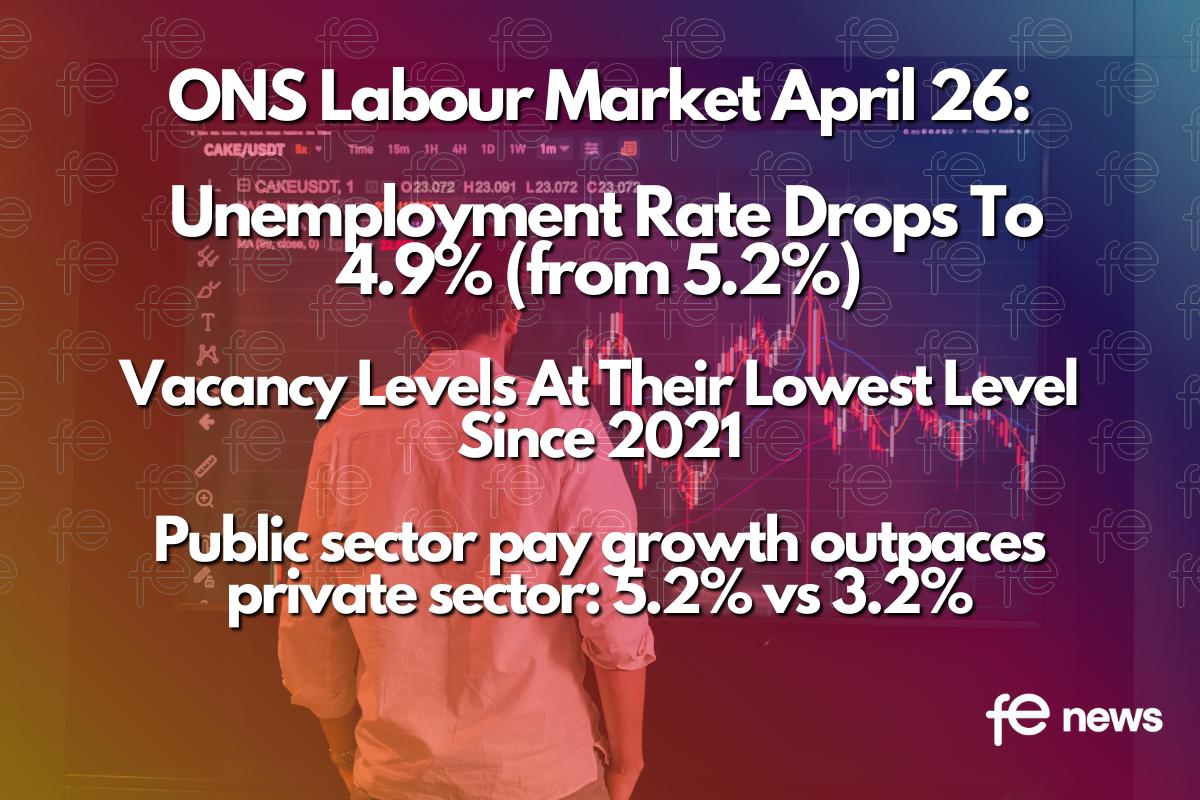
ONS Labour Market April 2026, Unemployment Rate Drops To 4.9%, But Vacancy Levels At Their Lowest Level Since 2021

The latest Office for National Statistics (ONS) Labour Market Data has been released for December 2025 to February 2026.
- UK unemployment rate for people aged 16 years and over is estimated at 4.9%, a drop from 5.2% in March 2026
- UK economic inactivity rate for people aged 16 to 64 years is estimated at 21%
- Vacancy Levels at their lowest level since February to April 2021. With a quarterly drop of -29,000 vacancies and an annual change of -65,000 vacancies.
- UK Claimant Count for March 2026 increased on the month but decreased on the year to an estimated 1.694 million
UK unemployment rate for people aged 16 years and over is estimated at 4.9%
The UK unemployment rate for people aged 16 years and over was estimated at 4.9% in December 2025 to February 2026. This is down in the latest quarter (in March 2026, ONS estimated this to be 5.2%), but above estimates of a year ago. The UK employment rate for people aged 16 to 64 years was estimated at 75% in December 2025 to February 2026. This is down in the latest quarter but largely unchanged compared with estimates of a year ago.
UK economic inactivity rate for people aged 16 to 64 years is estimated at 21%
The UK economic inactivity rate for people aged 16 to 64 years was estimated at 21.0% in December 2025 to February 2026. This is up in the latest quarter but below estimates of a year ago.
UK Claimant Count estimated at 1.694 million
The UK Claimant Count for March 2026 increased on the month but decreased on the year to an estimated 1.694 million. The Claimant Count figure for the latest month is provisional and is subject to revisions after first publication. This is the result of later amendments to records in the administrative systems, for example, as work capability assessments conclude and more information is available about benefit claimants’ ability to work.
Vacancy Levels at their lowest level since February to April 2021
The estimated number of vacancies in the UK has decreased in the latest quarter, following broadly flat estimates since March to May 2025. Early estimates for January to March 2026 suggest a decrease of 29,000 (3.9%), to 711,000, compared with October to December 2025, this is the lowest level of vacancies since February to April 2021. With a quarterly drop of -29,000 vacancies and an annual change of -65,000 vacancies.
30.3 million payrolled employees
The early estimate of payrolled employees for March 2026 decreased by 65,000 (0.2%) on the year, and by 11,000 (0.0%) on the month, to 30.3 million.
Public Sector Tops Earnings Growth – Public sector pay growth outpaces private sector: 5.2% vs 3.2%
Annual growth in employees’ average earnings in Great Britain was 3.6% for regular earnings (excluding bonuses) and 3.8% for total earnings (including bonuses) in December 2025 to February 2026.
Annual average regular earnings growth was 5.2% for the public sector, and 3.2% for the private sector. The public sector annual growth rate has recently been affected by a base effect because of some public sector pay rises being paid earlier in 2025 than in 2024.
Sector Reaction
Harry Hobbs, Head of Business Intelligence at Baltic Apprenticeships, says:
“The latest ONS figures suggest the labour market remains constrained as economic pressures and wider global uncertainty continue to weigh on employers’ minds. There is no doubt that it remains a difficult job market for candidates, particularly those at the start of their careers.
“Youth unemployment remains a major talking point, with vacancies at their lowest level since 2021. Competition for entry-level opportunities is intense, and employers are placing greater scrutiny on recruitment decisions that are expected to deliver long-term value.
“In that environment, apprenticeships can play an important role by giving employers a structured way to identify talent, build capability and support retention over time. But the focus cannot just be on access. It also needs to be on the quality of those opportunities. For employers, that means investing in programmes that are well-supported, aligned to real business needs and capable of delivering lasting value, rather than simply filling vacancies in the short term.”
Responding to the latest ONS figures, Dr Helen Gray, chief economist at Learning and Work Institute (L&W), said:
“This month’s labour market statistics are a tale of two sectors, with regular pay in the public sector increasing by 5.2 per cent over the past year, compared with private sector annual wage growth of 3.2 per cent over the same period. With inflation at 3.2 per cent in the year to February, wage increases are only just keeping up with price rises in the private sector. As the Iran war continues to contribute to inflationary pressures for employees and employers alike, the prospects for job opportunities in general and the standard of living for those in the private sector in particular look increasingly concerning.”
Ben Harrison, Director of the Work Foundation at Lancaster University, a leading think tank for improving working lives in the UK, on the latest labour market figures from the ONS:
“Today’s figures indicate many UK workers and jobseekers are poorly placed to withstand renewed global economic instability.
“Pay growth is at its weakest for more than five years as nominal wage growth fell to 3.6%. This comes as ONS data shows four in ten workers already report cutting back on food and essentials, while many more have reduced spending on non-essential items because of rising living costs.
“Real wage growth has also slowed to just 0.2%, leaving households vulnerable to further price rises. In the private sector, pay growth stands at only 3.2%, the lowest growth since 2020, meaning inflation is already eroding increases to earnings before any additional cost pressures are felt.
“Rising prices will hit low-paid and insecure workers hardest, many of whom are still coming to terms with the lasting effects of the cost of living crisis earlier this decade. Nearly a quarter of workers report they are unable to cover an unexpected £850 expense, and the Government must be ready to increase support for low-income households if conditions worsen further.
“For jobseekers, the labour market remains competitive. While unemployment has eased slightly in recent months, it remains up on the year at 4.9% while vacancies continue to decline. Youth unemployment remains a significant concern at 14.3%, with 19,000 more young people out of work compared to three months ago.
“The risk now is that employers further scale back hiring in response to weaker demand and rising uncertainty, making it even harder for people to find work. With households under pressure and hiring risks growing, the Government must act now to protect living standards, increase access to secure and flexible jobs and prevent young people being locked out of work.”
The ONS published its latest labour market figures this morning. The Recruitment and Employment Confederation (REC) Chief Executive Neil Carberry said:
“The labour market is slowing again, which is no surprise given global uncertainty and an increasingly heavy regulatory agenda that is increasing the cost of creating jobs. That said, overall performance remains resilient.
“A welcome fall in unemployment must be seen in the context of a rise in inactivity this month. After making progress on this for some time, policymakers cannot risk a reversal of this trend, which emphasises again the need to take on the cost of employment crisis that is holding up job creation, large swathes of which are about non-wage regulatory costs.
“With interest rate cuts looking unlikely amid ongoing tensions in the Gulf, today’s data suggest pay growth is not adding further complexity for the Bank of England. What is needed now is a more pragmatic approach to labour market policy which would support business confidence, including a rethink of proposals such as guaranteed hours requirements, which risk becoming a costly misstep for workers who would end up facing less secure forms of work.”
Jack Kennedy, Senior Economist at Indeed comments:
“A surprise dip in the unemployment rate offers a rare flicker of good news and some reassurance that the labour market is holding up in the face of headwinds. However, the underlying picture remains one of softness, leaving the Bank of England in a tricky spot.
“With employers in the driving seat, workers’ bargaining power to offset the rising cost of living is draining away. The concern is that already weak hiring may not just persist – but could give way to more widespread job cutting if businesses come under further pressure from rising costs and economic uncertainty.
“Most troubling is the picture for young people. Weak entry-level hiring is slamming the door on the career ladder at the very moment AI is reshaping the job market beneath their feet.”
Susannah Streeter, chief investment strategist, Wealth Club said
“The latest snapshot of the UK labour market paints a picture of an economy that had been showing signs of more resilience just before the Iran crisis cast a long shadow over the outlook. Employers were taking on more full-time workers, pushing the unemployment rate down to 4.9%, a sign that demand for labour had been holding up better than expected.
“There were tentative signs that confidence had been stabilising, as the cloud of uncertainty around the Budget and potential tax rises began to lift. Pay growth came in slightly stronger than anticipated, with average weekly earnings, including bonuses, rising 3.8% year-on-year. Although that marks a slowdown from the previous 4.1%, it still indicates that wage pressures haven’t faded away entirely. Taken together with better-than-expected growth of 0.5% in the three months to February, the data suggests the UK economy had been regaining some momentum.
“However, that progress now looks increasingly fragile. Just as companies appeared to be rediscovering their mojo, the escalation in the Middle East and the renewed threat to energy supplies risk sapping confidence once again. So, more hiring plans may be shelved and investment suspended as bosses turn ultra-cautious about the unfolding events.
“For policymakers, the easing in wage growth had been keeping hopes of interest rate cuts alive, with pay pressures no longer ringing alarm bells at the Bank of England. But the surge in energy prices and heightened geopolitical uncertainty are raising the prospect that borrowing costs may need to be increased to calm an incoming inflation storm. One interest rate hike is still being priced in by financial markets, and Bank officials are staying wary about how fresh price pressures will emerge. The concern now is that just as the UK economy was beginning to steady itself, a fresh external shock could knock it off course.
“However, hopes are being kept alive for a potential deal to emerge which could limit the economic damage, as Pakistan prepares to host fresh negotiations Even though Donald Trump is still threatening to resume strikes, the key Strait of Hormuz remains blocked, and Iran has not confirmed its sending a delegation to the talks, there are expectations that some kind of deal will be reached. However, for now, a ‘wait-and-see’ mood is swirling, with the FTSE 100 flat in early trade while Brent crude is in a holding pattern, trading around $95 a barrel.”
Responses