
Subject Content for V Levels Revealed

Thousands of young people who might otherwise have been left behind by a one-size-fits-all education system are getting new routes into skilled jobs.
Covering everything from education to hospitality, cybersecurity or finance, the subject content published today for new V Levels, Foundation Certificates, and Occupational Certificates sets out exactly what young people will learn through the new qualifications.
Students can sign up to courses this year to begin studying from next September, and should look out for them at college open days in the coming months.
The qualifications are designed hand-in-hand with employers to best prepare young people for the jobs employers are crying out to fill – tackling skills shortages, cutting the number of young people not in education, employment or training, and giving the economy the boost it needs.
Skills Minister Jacqui Smith said:
“Britain doesn’t have a shortage of talented young people – it has a shortage of routes for them to prove it.
“Teenagers who want to run a professional kitchen, keep a business’s books straight, or shape a child’s earliest years have had to fit themselves into a system built for a different kind of learner.
“That changes for future generations. Our new qualifications are designed with employers, for the jobs they are actually hiring for, to close the skills gaps that are holding businesses back, and give more young people a genuine route into work instead of drifting without one.”
The government is delivering the biggest youth employment reforms in a generation – backed by £2.5 billion – to support almost one million young people and help deliver up to 500,000 opportunities to earn and learn.
This is while prioritising intervention through once-in-a-generation SEND reforms to make sure more children are able to achieve and thrive at their local mainstream school, driving the biggest increase in school attendance in a decade and making sure one million more children will have access to mental health support in school this year, with access for all children by 2029/30.
For the first V Levels, which will allow students to mix and match vocational subjects with academic A Levels, providing a strong foundation for university or apprenticeships:
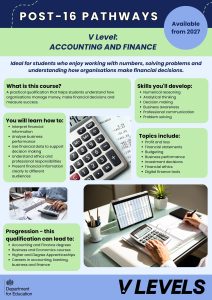
- Accounting & Finance V Level teaches students how to interpret, analyse and evaluate financial information – including financial statements and budgets. It could lead to roles such as Accounting Technician, Assistant Accountant, Business Administrator, Commercial Finance Analyst or Finance Business Partner.
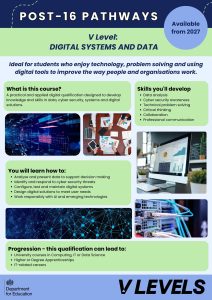
- Digital Systems and Data V Level covers analysing and presenting data, applying security protocols, identifying cyber security concerns, and configuring systems. It could lead to a range of roles in the Digital IT sector as such as Data technician, Cyber Security Technician and IT Solution Technician.
- Education V Level covers planning inclusive learning sessions, carrying out risk assessments, and using assessment data to set individual learning goals. It spans education from birth to adult learning and could lead to roles such as Teaching Assistant or Early Years Educator.
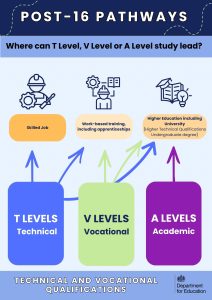
V Levels and A Levels sit alongside T Levels, which are technical, sector-focused studies that combine study and real‑world work experience.
For the first Foundation Certificates which provide a year of study to support students who want to go on to do T Levels, V Levels or A Levels:
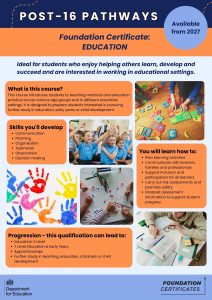
- Education Foundation Certificate teaches students how to plan learning activities, support inclusive practice, and interpret assessment data to support student progress. It could go on to lead to roles such as teaching assistant, nursery worker, or learning mentor.
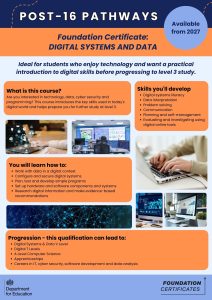
- Digital Systems & Data Foundation Certificate teaches students to clean, analyse and visualise datasets, set up and secure networks, and identify cybersecurity weaknesses. It can go on to lead to roles in software development, data analysis, IT support, and cybersecurity.
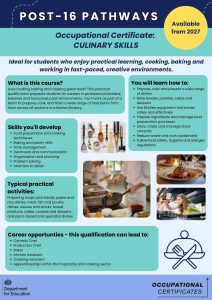
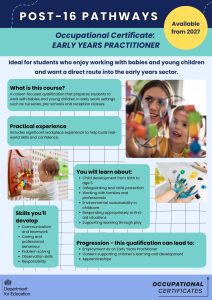
- Occupational Certificates support the new Occupational Pathway – a two-year programme to provide extra support while developing the skills to go into employment or an apprenticeship.
- Occupational Certificate in Culinary Skills teaches food preparation, cooking, baking, service and presentation, plus food safety, hygiene, equipment use and customer communication. It leads to entry-level roles such as baker, commis chef or production chef in restaurants, bakeries, contract catering, cafes and takeaways.
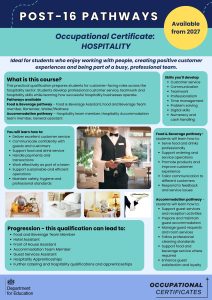
- The Occupational Certificate in Hospitality teaches professional service delivery, customer communication, transactions and teamwork, then specialise via a Food and Beverage or Accommodation pathway. It leads to front-of-house roles in food and drink service or hotel/accommodation operations, such as a food and beverage or hotel accommodation team member.
- The Early Years Practitioner Occupational Certificate teaches child development, safeguarding and emergency first aid, alongside transferable skills like teamworking and decision-making, in caring for children from birth to age seven. Leads to entry-level roles such as nursery assistant, childcare practitioner or early years support worker in nurseries, pre-schools, children’s centres and home-based provision.
Responses