
NEET at 16 or 17 brings a 71% chance of being NEET again by 21

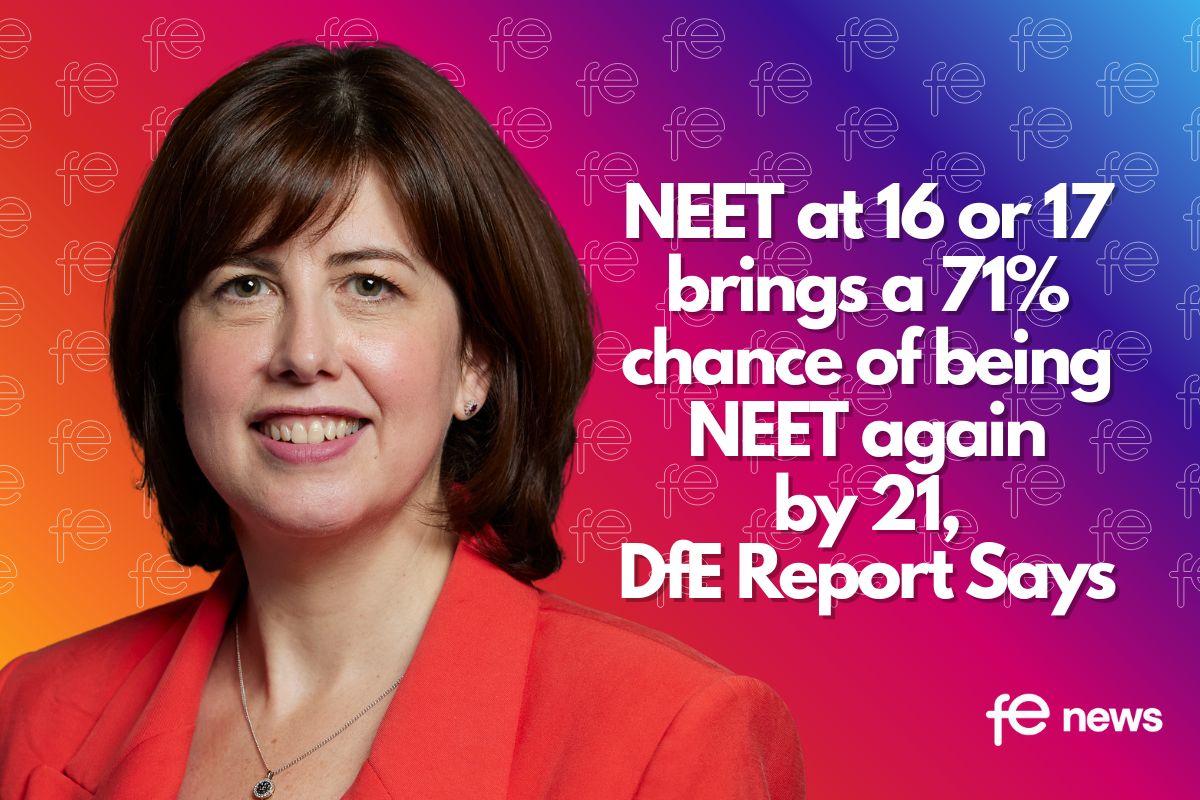
Young people who are not in education, employment or training at 16 or 17 have a 71% chance of being NEET again in at least one year between the ages of 18 and 21, according to experimental research published this morning by the Department for Education. For those NEET at both 16 and 17, that figure rises to 82%. Young people who avoided being NEET at either age face a 21% chance.
The research, Post-16 education: pathways and outcomes for disadvantaged learners, tracks 1.7 million young people across three cohorts from age 16 to 21, alongside a separate cohort of 579,750 learners followed from GCSEs through to earnings at age 25. It sets out how far the first year after school shapes everything that follows, and how heavily disadvantage weighs on that moment.
Being NEET, the analysis shows, is rarely a single year. Around 65% of those NEET at 16, 17 or 18 remain NEET the following year, rising to 70% for those NEET at 19 or 20. A quarter of everyone who experiences being NEET is NEET for four or more years, roughly 43,000 people in an average cohort.
That group is defined by disadvantage. More than half, 54%, were eligible for free school meals at some point between the ages of 10 and 15, against 19% of those who were never NEET. Some 43% had special educational needs at 15, compared with 10% of the never NEET group. Fewer than one in five, 18%, achieved a Level 2 in English and maths at 15, against 69% of their peers.
Education Secretary Lucy Powell said:
“This research reinforces the vital role our education system plays in preventing young people from becoming NEET. Too often, too many young people’s life chances are being determined by their lowest point in school. Disadvantage is being entrenched and young people are working against the odds before they’ve even got going. What happens at 16 becomes a lifetime of struggle.
“Making sure young people stay connected to education, training and opportunity starts long before results day. We’re rewiring the entire education system, to give young people from all backgrounds the chance to thrive.
“From fixing the SEND system and a focus on securing a strong foundation in core subjects for all, to transformational reforms that stop technical and vocational career paths playing second fiddle in schools, we’re making sure all students have the chance to achieve excellence – whatever shape or form that takes.”
Qualifications do not close the earnings gap
The second strand of the research follows learners who were 15 in 2012/13 through to their earnings at 25, and finds the disadvantage gap survives even where attainment matches.
Just 22% of learners eligible for free school meals held a Level 6 or above qualification at 25, against 42% of their peers. Only 21% earned more than £30,000 by 25, compared with 38%. Among learners with special educational needs, 15% reached Level 6 or above and 19% cleared £30,000.
The finding likely to draw most attention in the sector is what happens at the top. Learners eligible for free school meals who held a Level 6 qualification at 25 were still 8 to 9 percentage points less likely to be high earners than peers holding the same qualification. For learners with special educational needs the gap was 10 to 12 percentage points. Attainment narrows the gap. It does not remove it.
Outcomes for learners with an education, health and care plan are weaker again. Only 8% reached Level 6 or above by 25 and 8% earned above £30,000, against 17% and 21% respectively for learners on SEN support. Female learners with special educational needs recorded the weakest earnings outcomes of any group, at 13% earning above £30,000 compared with 22% of SEN males, despite being more likely to hold higher qualifications. The department notes that part time earnings cannot be identified in the data and may account for some of that difference.
Vocational routes carry a disproportionate share of the load. By 25, 62% of learners with special educational needs held a vocational qualification as their highest level of learning, against 37% of learners without. Among learners eligible for free school meals, 55% held a Level 2 or Level 3 vocational qualification as their highest attainment, compared with 13% holding an academic qualification at the same level.
Responses