
Indeed Reveals the UK’s Biggest Job Hotspots


- London dominates UK hiring, accounting for 13% of all job postings
- Manchester, Birmingham and Bristol are the biggest hiring hubs outside the capital
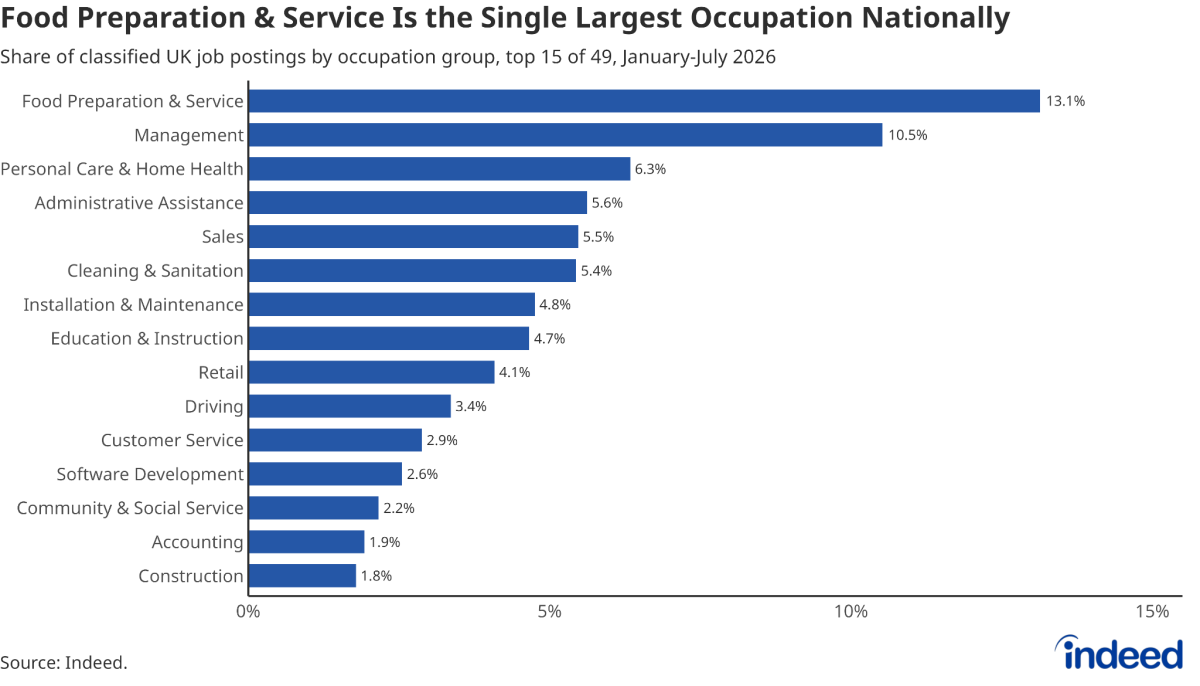
- Food preparation and service is the UK’s largest occupation, accounting for 13.1% of classified job postings
- Every major UK city has its own hiring specialism – from media in London and engineering in Bristol to childcare in Birmingham and manufacturing in Nottingham
- Manchester stands out for marketing and tech, while Edinburgh punches above its weight for hospitality
Where you live could make a significant difference to the types of jobs on offer, with new Indeed data revealing that Britain’s biggest cities have developed distinct hiring specialisms.
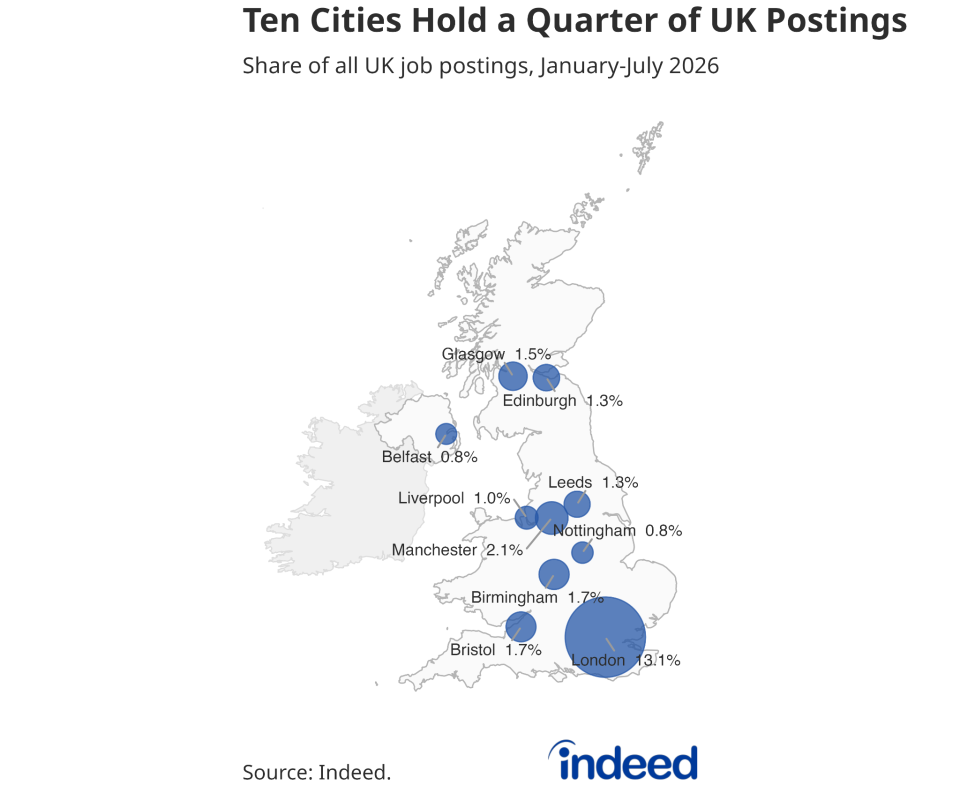
Analysis of UK job postings on Indeed between January and July 2026 reveals London remains the country’s biggest hiring centre by a considerable margin, accounting for 13.1% of all UK job postings.
Manchester ranks second, accounting for 2.1%, followed by Birmingham (1.7%), Bristol (1.7%) and Glasgow (1.5%).
But looking beyond the overall volume of jobs reveals a much more varied picture. Indeed’s analysis shows that each of the UK’s 10 biggest hiring cities has occupations in which it posts considerably more heavily than its peers – creating distinct pockets of opportunity across the country.
The data also reveals how AI is reshaping different parts of the jobs market at very different speeds, with more than half of postings in some technology occupations now identified as AI-related.
London Leads UK Hiring – But Opportunity Spreads Across the Country
“London’s scale is hard to argue with, with almost one in eight UK postings in the capital. But that still leaves the large majority of hiring happening elsewhere. Manchester, Birmingham and Bristol together account for more than five per cent of UK postings, and Glasgow, Edinburgh and Leeds are close behind. The choice for jobseekers isn’t London or nothing, and employers are competing for talent in far more places than the capital” said Matthew Burney, Senior Strategic Advisor at Indeed.
UK’s Top 10 Cities for Job Postings
Share of all UK job postings on Indeed, January–July 2026
- London – 13.1%
- Manchester – 2.1%
- Birmingham – 1.7%
- Bristol – 1.7%
- Glasgow – 1.5%
- Edinburgh – 1.3%
- Leeds – 1.3%
- Liverpool – 1%
- Nottingham – 0.8%
- Belfast – 0.8%
Food Service and Management Dominate Hiring Across the UK
Across Britain as a whole, food preparation and service is the largest occupation by postings, accounting for 13.1% of classified postings, followed by management (10.5%), personal care and home health (6.3%), administrative assistance (5.6%) and sales and cleaning and sanitation (both 5.4%).
Matthew Burney, Senior Strategic Advisor at Indeed said,
“hospitality and management are the backbone of hiring in every big city we looked at. It’s easy to focus on the newer, higher-profile roles, but the jobs that keep the country running are still where most of the demand sits.”
UK’s Top 10 Occupations by Job Postings
Share of classified UK job postings, January–July 2026
- Food Preparation & Service – 13.1%
- Management – 10.5%
- Personal Care & Home Health – 6.3%
- Administrative Assistance – 5.6%
- Sales – 5.5%
- Cleaning & Sanitation – 5.4%
- Installation & Maintenance – 4.8%
- Education & Instruction – 4.7%
- Retail – 4.1%
- Driving – 3.4%
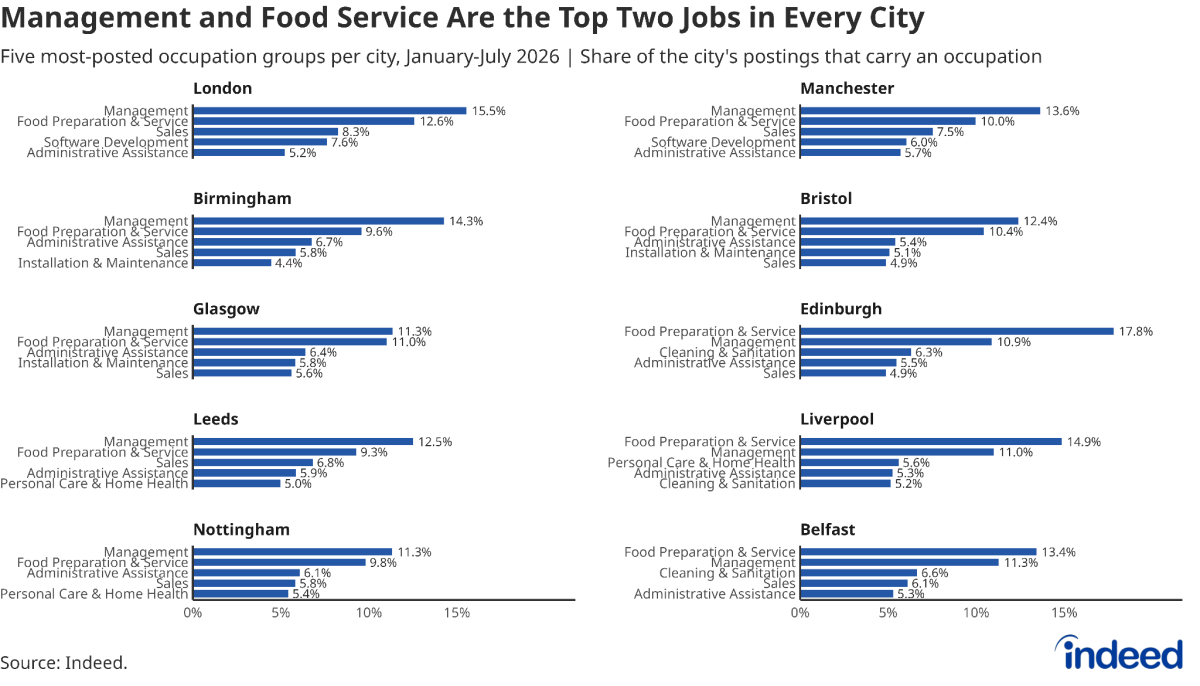
The findings show a clear common thread across Britain’s biggest hiring cities, with management and food preparation and service consistently accounting for the largest shares of postings. Beyond these two dominant occupations, however, local differences start to emerge. Software development makes the top five in London and Manchester, installation and maintenance features in Birmingham, Bristol and Glasgow, while personal care and home health makes the top five in Leeds, Liverpool and Nottingham.
AI Is Reshaping Some Occupations Faster Than Others
Alongside significant regional differences, Indeed’s data shows a growing divide in how prominently AI features across different occupations.
“A year ago, AI skills were still largely associated with specialist data and software roles. Now, around half of postings in these areas mention AI, while we’re also seeing demand spread rapidly into fields such as marketing and media. It’s a clear sign that AI is moving beyond the tech sector and becoming a skill employers increasingly value across a much broader range of roles” said Matthew Burney, Senior Strategic Advisor at Indeed.
In July 2026, 51.5% of data & analytics postings were identified as AI-related, up from 40.8% in July 2025. Software development was close behind at 50.4%, rising sharply from 32.4% a year earlier.
AI-related postings also accounted for 33.2% of IT systems & solutions roles, 30.3% of scientific research & development roles and 27.7% of marketing roles.
Some of the fastest increases have occurred outside the occupations traditionally most closely associated with AI. The share of marketing postings identified as AI-related rose from 14.0% to 27.7% over the year, while media & communications increased from 11.2% to 24.8%.
Occupations With the Highest Share of AI-Related Job Postings
Share of UK occupation postings identified as AI-related, July 2026
- Data & Analytics – 51.5%
- Software Development – 50.4%
- IT Systems & Solutions – 33.2%
- Scientific Research & Development – 30.3%
- Marketing – 27.7%
- Media & Communications – 24.8%
- Industrial Engineering – 20.0%
- IT Infrastructure, Operations & Support – 19.8%
- Banking & Finance – 19.1%
- Arts & Entertainment – 17.2%
What Are the Most-Posted Jobs in Each UK City?
Five largest occupation groups by share of each city’s classified job postings, January–July 2026
- London: Management (15.5%), food preparation and service (12.6%), sales (8.3%), software development (7.6%) and administrative assistance (5.2%).
- Manchester: Management (13.6%), food preparation and service (10%), sales (7.5%), software development (6.0%) and administrative assistance (5.7%).
- Birmingham: Management (14.3%), food preparation and service (9.6%), administrative assistance (6.7%), sales (5.8%) and installation and maintenance (4.4%).
- Bristol: Management (12.4%), food preparation and service (10.4%), administrative assistance (5.4%), installation and maintenance (5.1%) and sales (4.9%).
- Glasgow: Management (11.3%), food preparation and service (11%), administrative assistance (6.4%), installation and maintenance (5.8%) and sales (5.6%).
- Edinburgh: Food preparation and service (17.8%), management (10.9%), cleaning and sanitation (6.3%), administrative assistance (5.5%) and sales (4.9%).
- Leeds: Management (12.5%), food preparation and service (9.3%), sales (6.8%), administrative assistance (5.9%) and personal care and home health (5%).
- Liverpool: Food preparation and service (14.9%), management (11%), personal care and home health (5.6%), administrative assistance (5.3%) and cleaning and sanitation (5.2%).
- Nottingham: Management (11.3%), food preparation and service (9.8%), administrative assistance (6.1%), sales (5.8%) and personal care and home health (5.4%).
- Belfast: Food preparation and service (13.4%), management (11.3%), cleaning and sanitation (6.6%), sales (6.1%) and administrative assistance (5.3%).
Every Big City Has Its Own Hiring Specialism
While some occupations are common across the country, Indeed’s analysis reveals that each of the UK’s biggest hiring cities has its own distinct job specialisms.
Matthew Burney, Senior Strategic Advisor at Indeed said,
“once you look past the management and hospitality jobs that every city has, each place starts to show its character. Bristol has a strong engineering base, Nottingham remains a manufacturing city, and Birmingham has more childcare roles than any of its peers. These strengths have built up over decades, and they matter. A jobseeker with the right skills might find far more opportunity in a city they’d never considered than in the one with the most vacancies overall.”
Rather than simply looking at the occupations with the most vacancies, the analysis identifies the types of jobs that are more prevalent in each city compared with the other nine leading cities.
What Does Each UK City Specialise In?
- London – Media, marketing and data: Media & communications and marketing jobs are both around 2.6 times as prevalent in the capital compared with the other leading cities, while data & analytics roles are 2.2 times as prevalent.
- Bristol – Engineering and IT: Mechanical engineering jobs are 2.4 times as prevalent as among its peers. Industrial engineering is 1.7 times as prevalent, followed by IT systems & solutions at 1.6 times.
- Edinburgh – Hospitality and tourism: Hospitality & tourism roles are 2.2 times as prevalent as across the other nine cities. Food preparation & service jobs are 1.7 times as prevalent, while scientific research & development roles are 1.6 times.
- Nottingham – Manufacturing, care and construction: Production & manufacturing is Nottingham’s strongest specialism, at 1.9 times the prevalence seen among its peers, followed by personal care & home health at 1.7 times and construction at 1.5 times.
- Manchester – Marketing and technology: Marketing and IT systems & solutions jobs are around 1.8 times as prevalent as among its peers, while software development is also a local strength at 1.5 times.
- Birmingham – Childcare, projects and HR: Childcare opportunities are 1.7 times as prevalent as among the other leading cities. Project management follows at 1.5 times, with human resources at 1.4 times.
- Liverpool – Care, legal and community roles: Personal care & home health is 1.7 times as prevalent as among its peers. Legal roles are 1.6 times as prevalent, followed by community & social service jobs at 1.5 times.
- Glasgow – Nursing, construction and driving: Nursing is Glasgow’s strongest specialism at 1.6 times the prevalence seen across the other cities. Construction and driving are both 1.5 times as prevalent.
- Leeds – Manufacturing, care and driving: Production & manufacturing is 1.6 times as prevalent as among its peers. Personal care & home health follows at 1.5 times, with driving at 1.4 times.
- Belfast – Cleaning, nursing and IT: Cleaning & sanitation is 1.6 times as prevalent as among its peers, followed by nursing at 1.5 times and IT systems & solutions at 1.4 times.
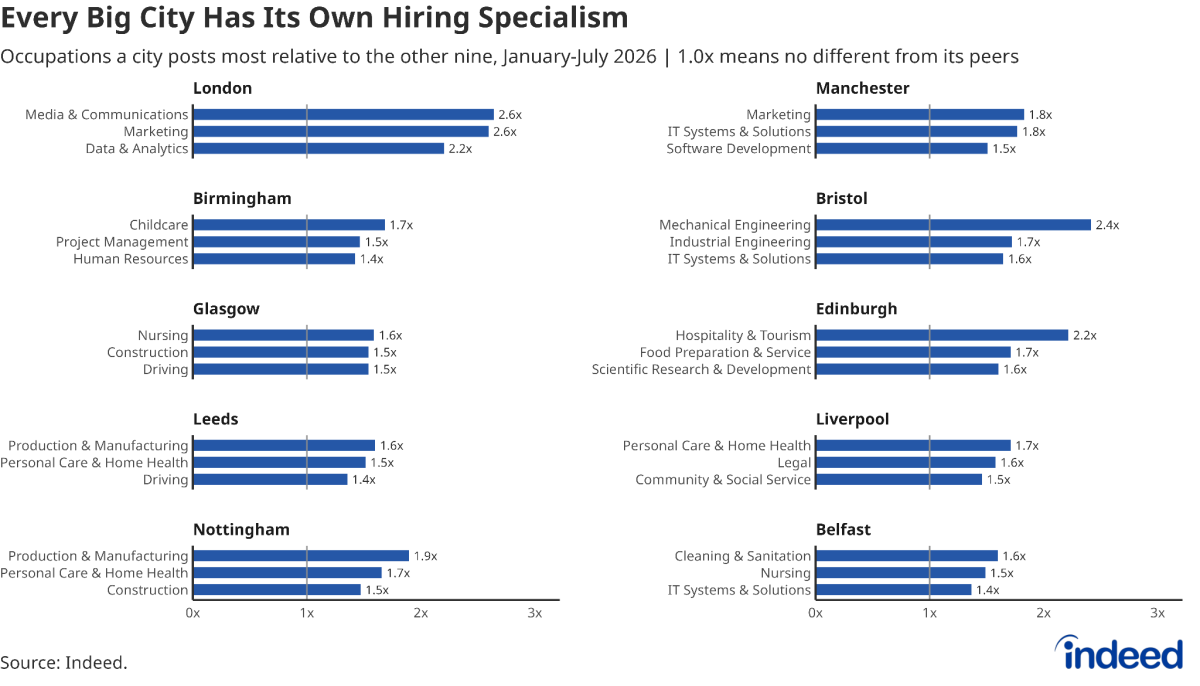
The findings reveal how different local jobs markets can be. London leads for media and marketing, Bristol for engineering, Edinburgh for hospitality and tourism, Nottingham for manufacturing and Birmingham for childcare. For jobseekers with flexibility over where they work, looking beyond the overall number of vacancies could therefore help identify cities where their particular skills are especially prevalent.
Matthew Burney, Senior Talent Strategy Advisor at Indeed, said:
“London remains the country’s biggest hiring centre, but looking only at overall job numbers misses an important part of the picture. Cities across the UK have developed their own areas of strength, whether that’s engineering in Bristol, manufacturing in Nottingham, childcare in Birmingham or hospitality in Edinburgh.
“We’re also seeing technology reshape the skills employers are looking for, with AI now featuring prominently across a growing range of occupations. While that is particularly visible in areas like software and data, the growth we’re seeing in marketing and media shows this isn’t just a technology-sector story.
“For jobseekers, particularly those who have some flexibility around where they work, it can be valuable to look at where their skills are most in demand rather than simply where the largest number of jobs are advertised. A city that isn’t the biggest jobs market overall could still be a particularly strong place to look for work in your profession.
“For employers, these differences also underline the importance of understanding local labour markets. The availability of skills and competition for talent can look very different depending on where you’re hiring.”
Responses