
Anyone Can Type ‘Resilient’: Burnham and Gove are on the Wrong Route


Andy Burnham means business. Two weeks into the job, the new Prime Minister has promised to end rough sleeping, fix social care, cap energy bills and, of course, this being Andy, sort out the buses. Rome wasn’t built in a day, but apparently much of Britain can be franchised in a fortnight.
The Future is education
The announcement which matters most for young people and the future, though, relates to education. In a world changing faster than any curriculum can track, Burnham has unveiled sweeping proposed reform in England: from 14, pupils will be able to combine the core academic subjects with technical pathways built around the industries of their own regions. It is constructed on the Manchester template, and anyone who watched him build the Greater Manchester Baccalaureate as mayor will recognise the blueprint. The backlash arrived on schedule. Michael Gove accused Burnham of “bringing back stupid“. The Institute for Fiscal Studies warned against asking young people to specialise too soon. The fight is on.
But it is the wrong fight. Their argument is about routes: the battle of the routemasters, if you like. The problem is that both viewpoints end in the same place: grades, but nothing about the person, their character, experiences and capabilities for life.
The old wound
To understand the venom in Gove’s jibe, you have to hear what he thinks he is defending. The old tripartite system, built in 1944, rested on a theory of human nature: that children came in ‘kinds’. Toby Weaver, a senior civil servant of that era, later described the doctrine with contempt: golden children who had minds and could handle abstract thinking, and went to grammar school; silver children who were ‘technically orientated’; and iron children who could manage neither. Whole generations carry the scar of being filtered at eleven, and every parent old enough to remember it, or raised by someone who was, feels the old wound open at the words ‘technical pathway at fourteen’. Alan Milburn absolutely nailed the residue of that thinking only last month: vocational education, he said, has traditionally been “a good idea for other people’s children“.
The case against the gold-silver-iron doctrine united education ministers from Anthony Crosland to Gove himself: nearly all children can handle a serious academic education. When Gove says Burnham is ‘bringing back stupid’, he does not mean children are stupid. He means the reform recreates the category, the child officially deemed unfit for ideas. In his own eyes, Gove is not being the snob in this argument, he is being the egalitarian.
It might be good politics, but the system he is defending is broken at both ends.
The golden ticket has lost its lustre
Start with the currency, and its devaluation. In 2000, half of graduates received a first or a 2:1. Today three-quarters do, and nearly one in three gets a first, a proportion that has more than doubled in under two decades. The universities’ own regulator, the Office for Students, has found that half of first-class degrees cannot be explained by students’ entry qualifications or subject of study. When top grades become the norm rather than the mark of distinction, it stops being of value in telling anyone anything.
Then the market. According to the Institute of Student Employers, competition for graduate jobs has broken its own record at every crisis and never come back down: 69 applications per vacancy at the depth of the global financial crisis, 91 at the pandemic’s peak, then a 59 per cent leap in a single year to 140, where it has stayed. That is double the pandemic record and nearly four times the level of twenty years ago. Employers put this surge employers largely down to AI making it effortless to fire off applications by the dozen.
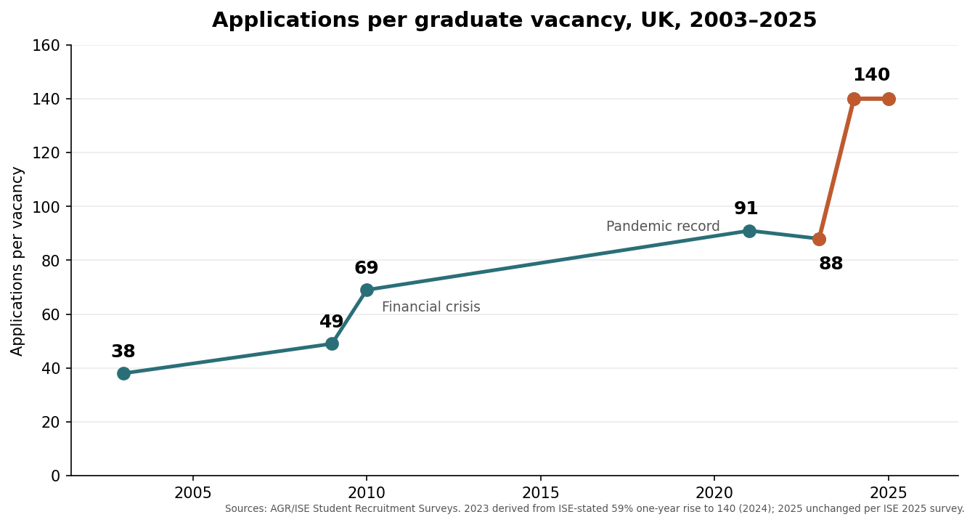
Applications per graduate vacancy, UK, 2003–2025. Sources: AGR/ISE Student Recruitment Surveys.
Then there’s the huge financial liability. The average graduate leaves with around £50,000 of debt, repayable over 40 years under the new loan terms. My own modelling suggests a typical graduate will repay roughly three times what they would have done under the old system, while the graduate salary premium has been shrinking since the 1990s. For a growing number of courses and careers, the arithmetic reveals that there’s no longer a graduate premium at all. It is a graduate deficit.
The academic route is not completely dead. Most graduates do land a job somewhere within fifteen months or so. But the guarantee – of a job, let alone a higher paid role – is no longer there. Work hard, get the degree, be sure to collect the secure, well-paid, graduate job: that deal is off the table. The world changed and the golden ticket is tarnished.
At the other end of the same system
At the other end of the same system, around a third of pupils still finish school without at least a grade 4 in both English and Maths, and over a million young people sit outside education, employment and training altogether. A system failing at both ends is not a system worth going to war over.
Stephen Bush argues in the FT that the NEETs crisis is an economy problem, not a curriculum problem – you are twice as likely to be out of education and work in the north east of England as the south west, and that is not because schools there teach the wrong things. He is half right and it’s a half which matters: no pathway can conjure up local jobs a regional economy does not offer.
The IFS is half right too. Fourteen is young. How does a 14-year-old know about what they are going to be good at and what they want to do? Based on what? Left to itself, the choice gets made by proxy, steered by teachers, careers advisers, parents and peers, each pushing their own map of a world which no longer exists.
The choice at 14 is only dangerous if it is uninformed. A teenager picking a pathway off a careers leaflet is guessing. A teenager choosing on the evidence of what they have actually done, what they have made, led, fixed, stuck at and come back to, is doing something different. Neither the academic route defended by Gove nor Burnham’s new structure offers that informed, evidence-based choice. Nothing in the current system does.
Ask the people doing the hiring
Employers are trapped in the same broken loop. Over the past decade many loosened their degree requirements, Google, PwC and EY among them, with barely 40 per cent of recruiters still insisting on at least a 2:1, down from nearly 80 per cent, and around one in five recruiting qualification-blind. Yet when the jobs market tightened, Bloomberg’s analysis of Reed vacancy data found firms reaching straight back for the degree, demanding one even for jobs which never before needed it, because faced with 140 applications for every role a manager needs a sieve, and the system has given them nothing better.
That is telling. The degree is not being read as proof of capability. It is being used as a crude filter in the absence of any real evidence about the person, their character, experiences and capabilities for life. Employers cycle between debased proxies because what they actually want to see – what a candidate has done and who they are – is the one thing no part of the education system captures. The CBI and the World Economic Forum have said it in survey after survey: what they cannot find is evidence of problem-solving, communication, resilience, teamwork; that is, character. One careers consultant, Sally Marnan, told the FT: “we generally hire people we trust, like or make us feel seen”, and nothing on a results slip demonstrates any of those aspects of character.
Asserted versus evidenced
The real divide in English education is not academic versus technical. It is asserted versus evidenced. On either route, a young person leaves with a set of grades: proof of what they scored, not about who they are. Anyone can type “resilient” on a CV, but almost nobody can show or prove it.
There is one more reason the grades-only record is running out of road. Recalling and reproducing knowledge is now something a machine does instantly and for nothing, so a qualification which certifies remembering facts and processes has never had less value. What cannot be automated is the doing: the judgement, the graft, the teamwork, the showing up on the fifth wet Tuesday.
The term ahead
The detail of Burnham’s proposed reform waits for the autumn white paper and the Budget in October. But schools do not need to wait, and in one respect they cannot. The Department for Education published its Enrichment Framework in June: eight benchmarks, five categories of activity from sport to civic engagement, an entitlement for every child, and from September, Ofsted will be considering the lot under personal development. The government has already told schools that young people should be doing things beyond the timetable, and that schools should be able to evidence it.
Participation data is a start, but it is not the point. The register can show that a child was there, however, it cannot show what she made, led, fixed, stuck at and became. The schools which use this next term well to do that will go one step further than the framework asks: capturing not just attendance at enrichment but the evidence of formation itself, the projects, the sport, the volunteering, the Saturday job, built into a living record rather than a fading memory.
Burnham and Gove will carry on arguing about routes, because that is what politicians do. Schools do not need a winner. Whichever route a young person takes, the question at the end of it is the one employers are already asking: not what did you score, but what can you do, and how do we know? Character and capability are formed by doing. Those schools which spend the term making the doing visible will be ready for Ofsted’s new focus, ready for the white paper in autumn, and their young people will be the ones who can answer it, not with a word typed on a CV, but with the evidence.
By Neil Wolstenholme, Chairman of Kloodle
Responses