
Green Changemakers – 3 Years On

September marks the three-year anniversary of the Green Changemakers programme and we have learned so much in that time. On this quiet morning in my garden, I wanted to take a moment to reflect.
The programme began with a LSIF grant via West Midlands Combined Authority, led by Fircroft College of Adult Education and part of the Green Skills Roadmap in that region. In the first year, we trained 40 Green Changemakers across 18 colleges – crucially, in changemaking skills: curation, futures-thinking, influence and systems-awareness. In the second year, together with the Green Changemakers, we co-designed a Green Changemakers Digital Hub (free for all to use), which won the Green Gown Award for Digital Futures in 2025.
Green Changemakers is a systems and mindset change programme, consequently also a culture change initiative. Our USP is that we drive momentum around climate action and environmental justice, something which is challenging to maintain (despite good intentions). Since March 2025, we’ve been a social enterprise, still operating out of Fircroft (and with our sights set on becoming a Community Interest Company). The original programme gave us proof of concept and the pioneer Green Changemakers – doing amazing work in their colleges – still travel with us.
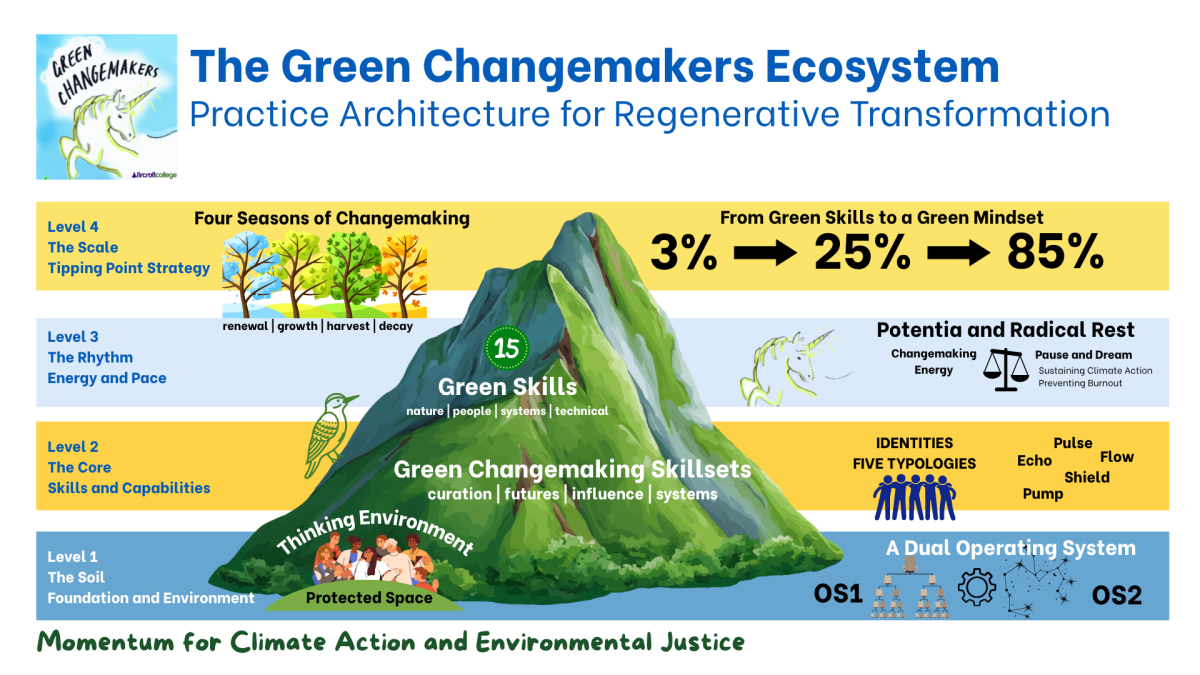
We are currently working with three College Groups, with more on the horizon.
Learning 1 – Everybody Cares
Everybody cares about the planet, and nearly everyone within an organisation is willing to put their care to action, once they know how. The first question on any Green Changemakers programme is, ‘What is your climate joy?’ and I’ve never encountered a single person who doesn’t love the beach, or walking the dog, or spending time with their grandkids. What influences us is Helen Bevan’s work with the NHS Horizons team, a large-scale changemaker initiative which established 3% of the workforce as a starting point of ‘superconnectors’, who can influence 85% of their peers (with a 25% momentum tipping point along the way).
Learning 2 – Every Organisation is Different
We knew, of course, that every organisation has a different starting point, but it’s more than that. We stay true to the basic architecture of Green Changemakers (the image above) and we hold fast to the programme’s foundational value that there can be no environmental justice without social, racial and economic justice. But every organisation has a different set of systems, a different culture and a different mindset. When we begin working with a new organisation, we have learned to start small, training 3% of the workforce (not just teachers) as Green Changemakers. From there, we negotiate, feel and co-design our way to what the organisation needs. Is it mindset change? (seeding small ‘green confetti’ initiatives, running roadshows, speaking at all-staff events). Is it culture change? (working with specific groups, especially managers, to enable them to open pathways for the work). Is it systems change? (influencing systems gatekeepers to open time and resource opportunities, design a new strategy or role). Each organisation has a specific blend of needs, to establish momentum.
Learning 3 – We Can Influence on the National Stage
And we have. The unpaid work of Green Changemakers is popping up everywhere – “getting where water can’t“, as we say in Yorkshire. It’s more than marketing, it’s ethical influence. At the Green Mindset Collective held in Manchester in November 2025, organised by FE News, Education Training Foundation and EAUC, this tireless work bore fruit, as we saw many of these learnings reflected back to us in the Playbook from the event. Meanwhile, Green Changemakers are influencing not only their organisations, but nationally via LSRN and other gatherings where practitioners meet. FE now understands that a systemic approach is needed.
Learning 4 – It’s OK to Use New Language
When we began, ‘sustainability’ had already been boxed off as a term which had a specific meaning in FE and Skills. We expanded this, firstly by broadening the concept of what ‘green skills’ are. Fuelled by AimHi Earth’s 15 Green Skills research, we lifted our eyes up from the narrowly technical and recognised skills around connecting with nature, how we are as people and shifting systems. This enables every participant to recognise the green skills they already hold, enabling agency and a sense of changemaking power.
Which brings me to potentia, a new (in fact, very old) concept of power. Potentia is the joyful changemaking power we all have within us, which organisations need, for transformational change to take hold. Its counterpart is potestas, which we recognise as power-as-usual, enshrined in our systems, structures and hierarchies. Everybody gets what potentia is, once they are encouraged to recognise it within them. We need both types of power to work together and Green Changemakers are the cogs that join them.
Learning 5 – Work Hopefully
The climate emergency is real – and it’s terrifying. Many of us try not to think about it (I used to be like this) and if we rooted Green Changemakers in scary facts and figures, no-one would ever be able to unlock their potentia. Many Green Changemakers work directly with students, who will inherit this world that we’ve created. Most of us also worry about our kids and grandkids. We work with hope as an active practice; a renewable energy contained in potentia. We put hope to work – holding our boundaries, pausing to think together and doing the work that is ours to do. We do this practically, and with joy.
Freshest Thinking
Green Changemakers are out there making a difference. After all, isn’t that what most of us came into education to do? We believe that the Government lacks ambition when it comes to holding us to account, because it cannot deal with what’s not quantifiable (mindset, culture). We appreciate our infrastructure organisations for platforming us and – most of all – for having a more expansive vision for how our sector can take its place in a more environmentally just world.
By Dr Lou Mycroft, Green ChangeMaker
Responses