
Teaching Young People How To Read The Feed


This is Part Two of three on children, social media and the ban.
The government is introducing legislation to bar children from the platforms. It has no plans in place to support them when the barrier is lifted at 16. This piece makes the case for digital literacy as a fourth R – as basic as reading, writing and arithmetic – reading the feed: the skills a young person needs to be able to assess their options to vote at sixteen, to work, and to live a decent adult life online. A ban has a deadline, but it does not prepare a child for the day after.
Handed The Keys
A child has been barred from Snapchat, TikTok and the rest. It is Monday, the day before their sixteenth birthday. On the following morning, the barrier is suddenly lifted. Full access becomes available, overnight…result – overload. No testing, no lessons, no supervised hours. Just whatever they have picked up by watching older children and the adults around them.
We do not treat driving this way. We require a sixteen-year-old to learn the rules, to practise sitting beside an instructor, to pass a test. We would not hand them the car keys and send them onto the motorway on the strength of what they had seen from the back seat.
Yet that is how we hand over the feed.
In further education this is not abstract. The teenager who turns sixteen and gains full access to the internet is the student who walks into a new college in September. A ban determines the day they get access, but it doesn’t help them then cope with it. That gap is a problem for the college.
The Barrier Will Hinder Education
The response to a feed which has dangers and can cause personal harm is not simply to forbid it until sixteen and hope. It is surely to teach young people how to engage with it, to understand and deal with what they see and experience. Not the old lesson of passwords and stranger-danger, but something harder and more practical: how to question what you read, how to tell truth from fabrication, how to spot a deepfake, how to recognise a conspiracy before it takes hold.
This is a necessary basic life skill. We can call it a fourth R. Reading, writing, arithmetic…and reading the feed. There are two big reasons why it belongs in this company.
First, Because Young People Will Vote
Sixteen-year-olds are about to get the vote, and politics now plays out largely online. The Reuters Institute reported this month that social media and video have overtaken news websites as the most widely used source of news in the world, on 54 per cent,¹ and the young rely on it most.
It is not a trustworthy place, nor a neutral one. Only 22 per cent of people trust the news they find on social media and UK trust in news has fallen to an alarmingly low 30 per cent.² Online feeds are weighted by their owners: a study in Nature this year found the algorithm on Elon Musk’s X promotes conservative content and demotes traditional media.³
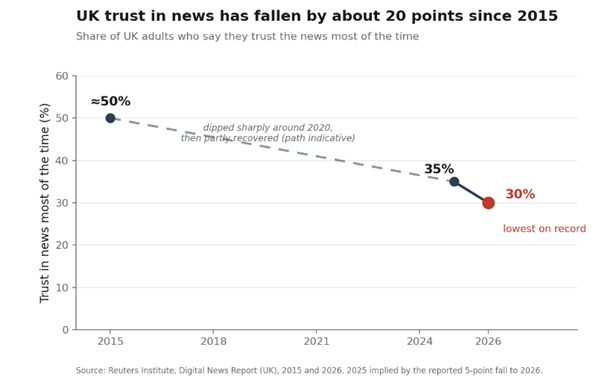
A vote is only as good as the voter’s power to tell fact from manipulation and so make an informed choice. If we judge a sixteen-year-old grown up enough to help choose a government in a democracy, we surely ought to give them the means to choose well. To truly enfranchise them you must equip them. The two go together.
Second, Beyond The Ballot, The World Of Work And The Rest Of Life
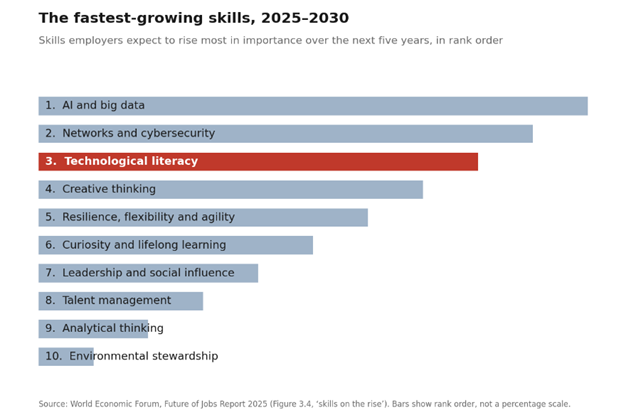
Digital literacy is essential to adult-life readiness. The World Economic Forum ranks technological literacy among the fastest-growing skills of the next five years and reports that some employers now rate reading, writing and mathematics as falling in importance.⁵ The ground has shifted under the curriculum’s foundations.
Here the comparison with financial literacy is worth making, because it shows a deeper problem. Understanding money, one of the key skills for adult life, sits on the curriculum inside maths and citizenship. Yet ask most adults where they actually learned to handle money and they tell you: after leaving school, from a first wage and a bill to pay. Financial sense, or “literacy”, depends on contextual experience and understanding. It means little as a worksheet and everything when the money and the bills are real.
Digital literacy is the same. You cannot teach judgement about the feed in the abstract, then expect it to switch on at sixteen. It has to be learned through use, applied, in a real setting with real stakes. Which is exactly why work-based learning, community work and apprenticeships teach the relevant skills better than any classroom exercise. They teach in context, the only place such skills take root – further education already recognises this. The feed young people must learn to read is not static. It is becoming, with AI, more personal, more persuasive, more intrusive than anything experienced so far. The fourth R has to reach forward to recognise and equip for that, or it teaches yesterday’s skills.
Banning Drives It Underground
In addition to all this, a ban wouldn’t even hold. Australia barred under-sixteens in December. Three months in, by the researchers’ own account, close to 70 per cent of under-sixteen accounts were still active.⁴ Young people find a way around a ban with fake adult accounts, and in doing so shed the parental controls a child’s account carried. A ban is a locked front door at the top of a steep flight of stairs, beside an open window. The door from the apartment to the stairway might be locked, but the window is open.
Worse, the ban itself teaches the wrong lesson. A rule which everyone evades breeds contempt for rules and also rewards lying, in this case lying about your age. It removes the safety nets and teaches nothing about how to behave once inside. We have run this logic before. We do not keep children off the roads; we teach them the Green Cross Code. Prohibition without instruction is not protection. It only looks like it.
The stakes are not theoretical. Beyond conspiracy theories, it is the young who are now targeted hardest by scams, financial fraud and sextortion. The young person who cannot read the feed is not only misinformed, they become a target.
There Are Democracies Who Teach
Two front-line democracies chose to teach, rather than ban. In Finland, media literacy is woven through the curriculum from as young as three, has been taught for decades and is now extended to AI and deepfakes.⁷ Finnish children learn to read a news story the way ours learn to read a sentence, because they border Russia and have lived with its disinformation for years.
Taiwan does the same, and for the same reason. Facing a constant campaign of disinformation from China, it built media literacy into the national curriculum as one of nine core values, with a promotion committee, teacher training and lesson plans to match.⁸ Its former digital minister, Audrey Tang, described the aim as helping students to think critically rather than consume passively.⁸
Two democracies under pressure reached the same conclusion that you do not defend a population by banning the feed; you defend it by teaching people how to read and understand it. Australia locked the door to the stairway but left the window open.
UK Is A Late Starter
UK is moving, at last. From September 2026, updated statutory guidance for relationships, sex and health education will fold online safety through the curriculum and, at secondary level, will add lessons on AI and deepfakes.⁹ It is a positive step. It is also a late and partial one, arriving almost twenty years after these platforms reached our children.
Reactive not proactive. It applied to the ban and it applies to the classroom too. We are addressing a harm a generation after it emerged, rather than equipping the next generation before it does.
What Good Would Look Like
Picture the young person we are aiming for – sixteen, and able to spot a deepfake, shrug off a scam, follow a political argument to its source, and conduct themselves online with some judgement and decency. That is not a pipe dream. It should be an ordinary, teachable outcome, and it is within reach of any college which decides to teach it. We are not short of the means, we are just short of the will to treat it as core.
Character Cannot Be Set As Homework
There is a limit to what digital literacy can do, however. Teaching a child to spot a fake does not teach them to be kind. When Marcus Rashford, Jadon Sancho and Bukayo Saka missed penalties in the Euro 2020 final, they were buried in racist abuse within minutes, much of it from accounts hiding behind no name at all.10 No media-literacy lesson would have stopped it.
So the task is larger than a module on the timetable. You might be able teach a child to read the feed. You also have to raise one who can think for themselves.
By Neil Wolstenholme, Kloodle Chairman
Endnotes
BBC News and others, reporting on racist abuse of England players after the Euro 2020 final, July 2021.
Reuters Institute for the Study of Journalism, Digital News Report 2026, University of Oxford, June 2026.
Digital News Report 2026, UK findings: trust in news 30 per cent; trust in news on social media 22 per cent.
Zhuravskaya, E., et al., field experiment on X’s algorithmic “For You” feed (4,965 US users, 2023), published in Nature, February 2026. The interpretation is contested by some commentators.
Neff Lind, M., et al., guest editorial, Frontiers in Developmental Psychology, 2026, reporting that close to 70 per cent of under-sixteen accounts remained active three months into Australia’s ban.
World Economic Forum, Future of Jobs Report 2025 (and 2023 edition for employers rating the traditional basics as declining).
Commission into Countering Online Conspiracies in Schools (Public First, funded by the Pears Foundation), research findings, 2026.
Associated Press, reporting on Finland’s media literacy education, 2026.
Global Taiwan Institute (2024) and The Diplomat (2025) on Taiwan’s curriculum; Audrey Tang quotation via The News Lens.
Department for Education, updated Relationships, Sex and Health Education statutory guidance (2025), in force September 2026.
Department for Education, updated Relationships, Sex and Health Education statutory guidance (2025), in force September 2026.
Responses