
When Words Shape Worlds: Rethinking Literacy in the Age of Thinking Machines


As artificial intelligence begins to shape the way we write, speak, and learn, our understanding of literacy must evolve. This article explores how writing remains one of the most powerful cognitive acts we teach, and why, in the age of intelligent tools, the ability to think through language may be the ultimate human advantage.
We teach young people to read and write, but do we teach them to mean what they say?
Across colleges and classrooms in the UK, literacy is under quiet siege. According to the National Literacy Trust, reading enjoyment has fallen to its lowest level in two decades. While students are typing, posting, and messaging more than ever, the quality of written communication is often declining. In an age overflowing with words, clarity has become a rare commodity.
Yet perhaps the problem isn’t that young people write less carefully; it’s that we’ve stopped treating writing as a thinking process.
Writing as a Cognitive Act
Every sentence we construct is a small act of cognition: organising thoughts, weighing intent, anticipating how others might interpret meaning. The process forces metacognition, the ability to think about one’s own thinking. It’s this skill, not grammar drills, that lies at the heart of genuine literacy (in my view).
Advanced writing support tools, from AI-based feedback platforms to tone and structure advisors such as Grammarly, are beginning to illuminate this truth. Their value is not simply in catching errors but in making thinking visible. When learners see suggestions about tone, clarity, or logic, they are invited into a moment of reflection: “Is this really what I meant?”
That pause, that fleeting act of awareness, is where much learning occurs.
The New Literacy Divide
The modern literacy gap isn’t between those who can read and those who can’t. It’s between those who can interpret and express complexity and those who cannot. Employers consistently highlight communication as one of the most in-demand skills, yet it is also one of the hardest to find.
Therefore, we face a choice in education: continue teaching writing as performance, or reclaim it as a process.
Digital writing assistants, when used wisely, offer feedback loops that were previously impossible in the margins of a page. They are not a replacement for teachers, nor should they be, but they can act as cognitive mirrors, allowing students to experiment safely, reflect, and iterate. I use one of these tools daily (Grammarly), and it has been transformative in my work across multiple sectors, from my business roles to those in the public sector, particularly in the world of education.
Technology as a Thinking Partner
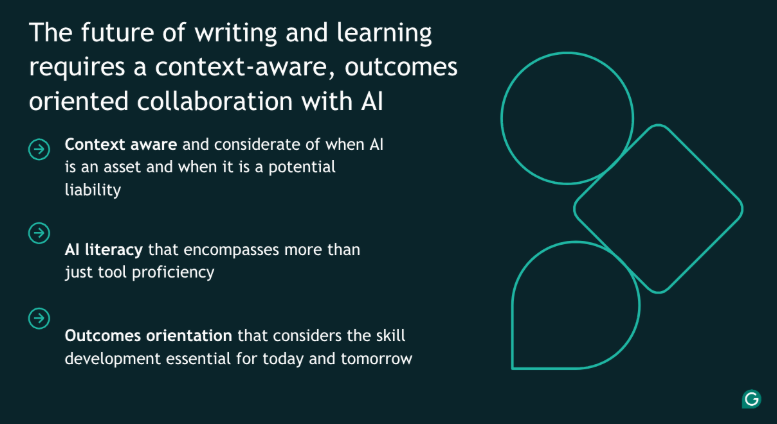
The future of literacy is not just about teaching students how to write, but also how to think critically through writing. When routine feedback is handled by intelligent systems, educators are freed to guide higher-order reflection, including argumentation, empathy, and ethical reasoning.
In behavioural science, this is known as cognitive scaffolding, the gentle support that helps a learner stretch beyond what they could achieve on their own. In this light, technology becomes less a convenience and more an act of empowerment.
A Generation That Writes Itself into the Future
The words we use shape not only our relationships but our reality. If our education system can reframe writing as a space for curiosity, rather than compliance, we may rediscover literacy’s true purpose: connection.
AI will continue to evolve, and its capacity to assist us in communication will expand. But the task of meaning-making remains beautifully, irreducibly human.
Perhaps the future of education is not about choosing between human and machine, but about cultivating a partnership where one sharpens the other.
Because in the end, it’s not the algorithms that define our words, it’s our words that define us.
By Jamie Farnell-Smith Hon DTech, MBA, BA (Hons) FRSA.
Jamie is the Chairman of C-Learning, supporting digital transformation and leadership across the education and wider sectors. He writes about the intersection of technology, learning, and human potential.
Responses