
Where Is the Love? A start-of-term challenge to Further Education

Ten academic years ago, I wrote for FE News about challenging stereotypes, inspired by the late MP Jo Cox. As another academic year begins, I find myself wondering how much has really changed.
We have lived through Brexit, George Floyd, Covid, political turbulence, war, the rise of polarisation and increasingly angry public debate. Social media has accelerated all of it, amplifying outrage and too easily reducing human beings to labels.
We called it a VUCA world volatile, uncertain, complex and ambiguous.
Ten academic years later, it seems faster and louder still. And amongst all that noise, I keep returning to a very simple question asked by the Black Eyed Peas more than twenty years ago:
Where is the love?
Good teachers have always known
Perhaps education already knows part of the answer. Good teachers have been creating belonging long before we had a term for it. They know their students. They stretch one and support another. They notice who has gone quiet, who has stopped attending and who needs somebody to believe in them. They understand that fairness does not always mean treating everybody identically.
At its heart, isn’t that belonging?
To be seen. To be known. To know that you matter.
Perhaps that is why most of us remember a teacher long after we have forgotten much of what they actually taught us. We remember the person who saw something in us, challenged us, encouraged us or simply refused to give up on us.
Relationships matter.
And then I think about Professor Arday
Following the tragic death of Professor Jason Arday, I have found myself thinking about the way our society responds when somebody becomes caught in the very culture of polarisation I am describing.
There are legitimate questions that institutions and journalists have a responsibility to ask. But somewhere in the intensity of what followed, we should also ask ourselves whether we lost sight of the human being at its centre.
I have also been struck by how little we in FE appear to have reflected publicly on what happened. Perhaps that silence should make us think. Not because we need to agree about every aspect of what happened. We don’t.
But because education should be the place capable of holding complexity without losing compassion. That is why one of Professor Arday’s own reflections now feels particularly powerful.
When asked how he would change society, he spoke of taking a needle and thread and weaving love into it.
Think about that. In a culture increasingly driven by outrage and division, his answer was love. Not sentimentality. Not weakness. Love as dignity. Love as justice. Love as refusing to dehumanise somebody with whom we disagree.
And perhaps love is also the discipline of remembering that behind every argument, every headline and every label is a human being.
That feels like a challenge for education.
Britain is better than its algorithm
Because I genuinely believe there is far more compassion in this country than our social-media feeds would have us believe. Millions of acts of human decency happen every day without a camera, hashtag or headline. We see them in our colleges.
A teacher refuses to give up on a student. A member of support staff quietly removes a barrier. A student notices somebody sitting alone. Young people from completely different backgrounds learn, disagree and laugh alongside one another. Those moments rarely go viral.
But they tell us far more about who we are than the anger that does.
FE is where society is practised
That is why Further Education has a particular responsibility. Our colleges bring together people of different ages, races, religions, identities, abilities, backgrounds and beliefs. An FE college is much more than somewhere qualifications are achieved.
We cannot control the next crisis or what appears on a student’s phone at midnight. But we can influence the culture they experience when they walk through our doors the next morning. We can show that disagreement does not require hatred. That belonging does not require somebody else to be excluded. That kindness and high expectations can coexist.
Most importantly, we have to model it ourselves. Whether we work in a classroom, workshop, reception, finance office or executive team, we are all educators.
Our students are growing up in a world where algorithms will become ever better at capturing their attention and feeding division. Our job is to nurture something an algorithm cannot give them: humanity, empathy, curiosity, courage and compassion.
So where is the love? I believe it is here. There is more love than hate. We just don’t always hear it as loudly. And perhaps Professor Arday’s challenge to us is not simply something to remember him by. Perhaps it is something to do.
Take the needle and thread. Weave love into what we do.
Because if education cannot model a different way of living alongside one another, who will? Love is not the soft alternative to education.
It might just be its foundation.
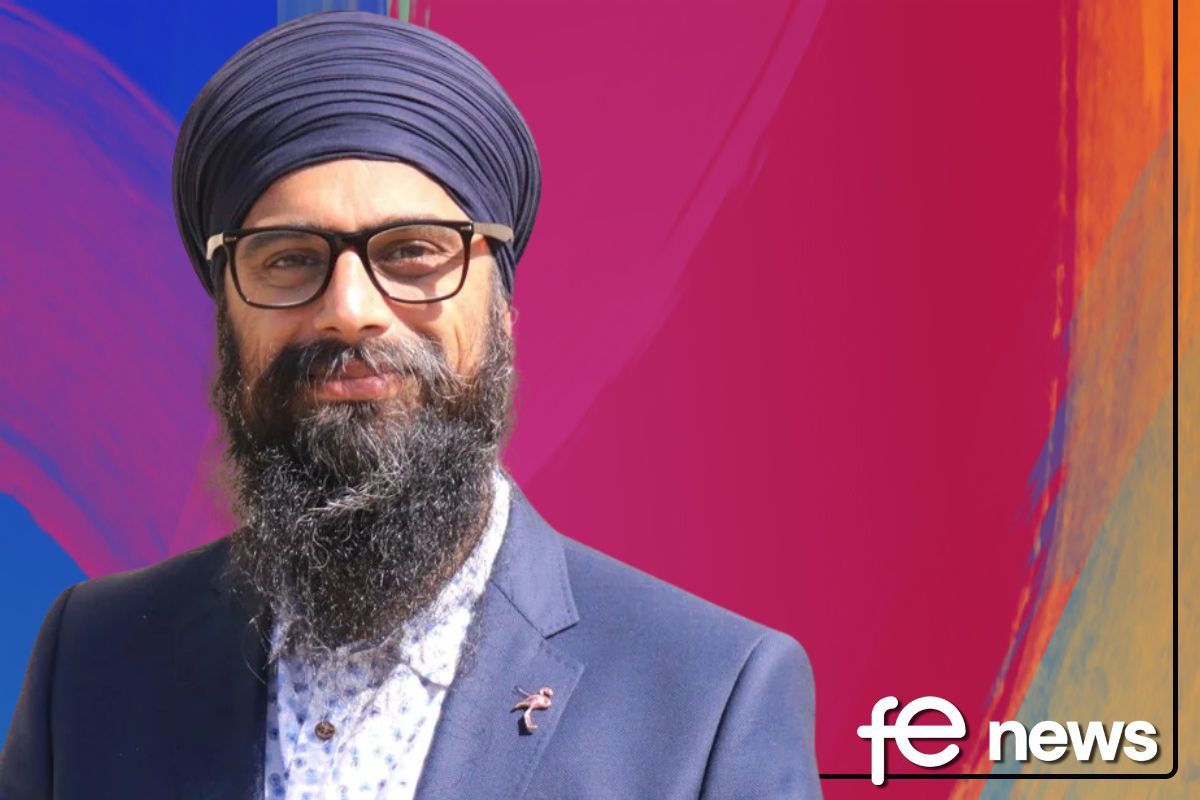
By Palvinder Singh, Principal & Chief Executive, Kirklees College
Responses