
February 2026 ONS: NEETs Rise to 957,000 as Unemployment Surges

- 957,000 young people currently classified as NEET, up from 946,000 last quarter
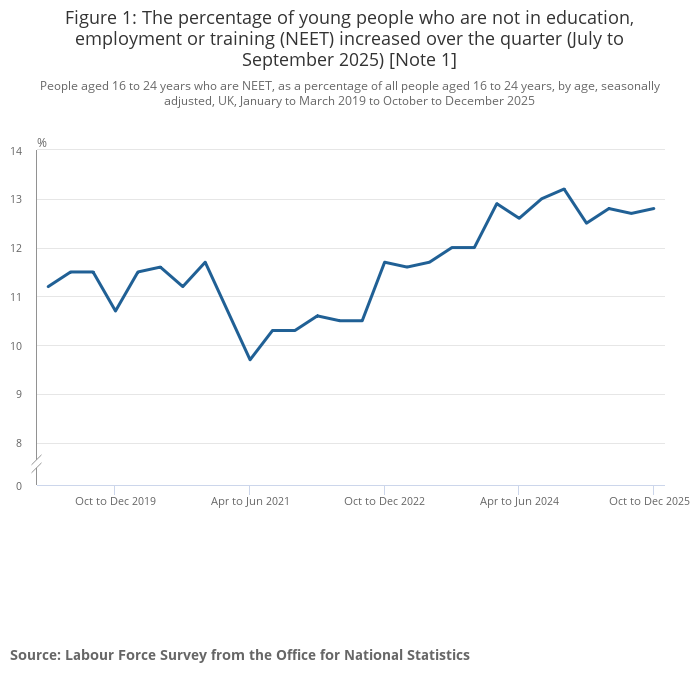
- 12.8% NEET rate, up 0.1 percentage points on quarter, down 0.4 points year-on-year
- Unemployed NEETs surge by 45,000 on the quarter to 411,000
- Economically inactive NEETs fall by 34,000 to 547,000
- Young women drive quarterly increase, up 13,000; young men down 2,000
- 18-24 age group at 15.2%, with 891,000 young adults NEET
- Male unemployment rises sharply, up 28,000 on the quarter to 266,000
The latest figures released today by the Office for National Statistics (ONS) show 957,000 young people aged 16-24 were not in education, employment, or training (NEET) in October to December 2025, up from 946,000 in July to September 2025. This represents 12.8% of all young people, up 0.1 percentage points on the quarter, though still 0.4 percentage points lower than the 987,000 (13.2%) recorded in the same period last year.
The increase reverses the modest improvement seen last quarter and pushes NEET numbers closer to the one million mark, reinforcing the scale of the challenge facing policymakers and the FE and skills sector.
Gender Trends Reverse Again
The data shows a return to the pattern seen earlier in 2025, with young women once again driving the quarterly increase. Young women NEET rose by 13,000 on the quarter to 448,000 (12.2%), while young men decreased by 2,000 to 510,000 (13.3%).
This reverses the gender dynamics observed in the previous quarter, when young men had driven the increase. Year-on-year, the female NEET rate has risen from 11.2% to 12.2%, while the male rate has fallen from 14.5% to 13.3%, continuing a longer-term narrowing of the gender gap.
Young Adults Hit Hardest
The 18-24 age group continues to show significantly higher NEET rates, with 891,000 individuals (15.2%) in this category. This is up 11,000 on the previous quarter and represents a 0.1 percentage point increase, though it remains 0.3 percentage points lower than the same period last year.
The Unemployment Surge: A Structural Shift
The most striking development in this quarter’s data is the sharp rise in unemployed NEETs, which increased by 45,000 to reach 411,000, the highest figure in recent quarters. This is also up 19,000 on the year.
The unemployment increase was broad-based across both genders:
- 411,000 unemployed NEETs (up 45,000 on the quarter, up 19,000 on the year)
- Young men: 266,000 (up 28,000 on quarter)
- Young women: 145,000 (up 17,000 on quarter)
- 547,000 economically inactive NEETs (down 34,000 on the quarter, down 33,000 on the year)
- Young men: 244,000 (down 30,000 on quarter)
- Young women: 303,000 (down 3,000 on quarter)
The contrasting movements, rising unemployment alongside falling inactivity, suggest a significant number of previously inactive young people are now re-engaging with the labour market but struggling to find work. The 34,000 drop in economic inactivity is largely driven by young men, with a decrease of 30,000 on the quarter.
Reading the Shift: A Glass Half Full?
While the headline NEET figure is unwelcome, the underlying composition tells a more nuanced story. The movement from economic inactivity into unemployment may indicate that more young people are actively seeking work, a necessary step before entering employment. However, the scale of the unemployment increase, particularly among young men, suggests that the labour market is not absorbing these re-engaged young people quickly enough.
The year-on-year picture offers some encouragement: economically inactive NEETs are down 33,000 compared with October to December 2024, even as unemployed NEETs have risen by 19,000, a net improvement of 14,000 fewer inactive young people.
Strategic Implications for FE and Skills
For senior leaders in the FE and skills sector, this quarter’s data points to three priorities:
Bridging the Gap from Re-engagement to Employment: The shift from inactivity to unemployment signals that more young people are job-ready or at least job-seeking. Providers must ensure employability programmes, work placements, and employer partnerships are in place to convert this re-engagement into sustained outcomes.
Targeted Support for Young Men: The 28,000 quarterly rise in male unemployment, coupled with 30,000 fewer economically inactive young men, suggests a cohort actively seeking work but unable to find it. Sector-specific training aligned to local labour market demand will be critical.
Sustained Focus on Female Participation: With young women driving the headline NEET increase for the second time in three quarters, the structural barriers affecting female participation, including childcare, flexible provision, and progression routes, demand continued attention.
Data Quality and Context
The ONS notes that Labour Force Survey (LFS) estimates remain subject to increased volatility due to smaller achieved sample sizes, though the number of interviewers has recently been increased. An increased amount of volatility will remain in the estimates from mid-2023 and throughout 2024, so caution is advised when interpreting change involving those periods. LFS-based labour market statistics will continue to be badged as official statistics in development until further review.
The ONS recommends using NEET statistics alongside other labour market indicators such as Workforce Jobs (WFJ), Claimant Count data, and Pay As You Earn (PAYE) Real Time Information estimates.
Looking Ahead
The next update on NEET statistics is scheduled for May 28, 2026. With the Youth Guarantee now in its implementation phase and the government’s broader youth participation strategy taking shape, the coming quarters will be crucial in determining whether the shift from inactivity to active job-seeking translates into meaningful employment outcomes.
For now, with 957,000 young people still disconnected from education and employment, the data underscores the urgency of coordinated action across government, providers, and employers to ensure no young person is left behind.
Sector Reaction
Chair of the Social Mobility Commission, Alun Francis OBE, said:
“Today’s ONS stats showing an increase in young NEETs must not distract from the fact that this is a long standing problem which has not been getting sufficient attention from policymakers. The growth in numbers has forced it onto the policy agenda and we urgently need to develop long term, sustainable solutions.
“Our latest State of the Nation report showed the rate of NEETs among those of a lower socio-economic class were more than double that for those of a professional background. The current trends are a major obstacle for improving social mobility and conversations are failing to address the stark inequality behind these statistics head on.
“That’s why the Social Mobility Commission is diving deeper into the data by collecting new evidence in Blackpool through conversations with young people to find out the stories behind the statistics, and gain better insights into the changes that are needed to support these individuals.”
Barry Fletcher, CEO at Youth Futures Foundation, comments:
“Today’s ONS figures show around 957,000 young people are not in education, employment or training (NEET). The number remains persistently high, with little change over the past year where we have consistently seen over 900,000 young people out of work or learning in each quarter.
“Addressing the challenge is urgent, particularly against the backdrop of a weakened labour market, where employer hiring is slowing down and where we know young people are set to continue bearing the brunt of this challenge. Without dedicated and coordinated action, even more young people risk falling further from the labour market, increasing their likelihood of being long-term unemployed and suffering from scarring which can significantly impact their wellbeing, health and earning prospects throughout their life.
“The Government’s recent focus and investment to support more young people into work through the Youth Guarantee and apprenticeship reform is positive, but today’s stark figures continue to underline that more will be needed to meaningfully shift the dial for young people.
“The ongoing review into Young People and Work led by Alan Milburn presents an opportunity to build on this positive start with greater ambition and scale, backed by the evidence, to enable more young people to be in good work.”
Susannah Hardyman MBE, CEO of Impetus, said:
“957,000 young people neither earning nor learning is a moral and economic catastrophe, costing the UK billions in GDP and even more in lost potential. What we need now is a comprehensive Government strategy to support more of these young people into work.
“For those furthest from the labour market, young people facing compounding barriers in the form of socioeconomic disadvantage, low qualifications, and special educational needs, support must be offered at the earliest opportunity, starting in school. From there, evidence shows that interventions combining targeted employment skills with holistic wraparound support can make a real difference for young people who are NEET. Positive external evaluations of Impetus partners’ Spear and Generation Uk demonstrate the effectiveness of this approach.
“Recent investments in the Youth Guarantee and the upcoming Milburn Review on youth inactivity are promising steps, but to solve a problem of this scale, Government must be prepared to approach the NEET challenge from all sides, from its roots in schools through to the crisis point in the labour market. This requires a thorough, joined-up strategy that aligns education and employment policy, including better data sharing between the Department for Education and the Department for Work and Pensions, and evidence-backed interventions that target the precise barriers young people face. With £21bn lost in GDP, we simply cannot afford not to act.”
Ben Harrison, Director of the Work Foundation at Lancaster University, said:
“Today’s data is a stark reminder of the magnitude of the challenge facing young people and the Government. One in eight young people aged 16-24 are stuck out of education, employment, or training, with the overall number remaining stubbornly close to one million.
“Disabled young people are hit particularly hard, and there is a considerable risk that more young people will slip into long-term worklessness unless Government acts to address the causes of this rise. Failure to do so could have damaging consequences, with previous studies suggesting that young people who fall out of work for health reasons could be more than £1 million worse off over the course of their lifetime.
“The data indicates that more young people are now looking for work, with the number classified as ‘inactive’ down by 34,000 on the quarter. Although the number of young people in unemployment has risen by 45,000 over the same period, counterintuitively this may reflect more young people moving closer to entering employment – but only if they’re able to find work.
“With vacancies having fallen significantly since the pandemic, the Government’s Youth Guarantee has the potential to help here, but only if done well. In particular, the potential participation of employers such as KFC and JD Sports in the Jobs Guarantee raises concerns regarding the quality of roles likely to be on offer, and what the policy will ultimately achieve.
“The reality is that if a young person has not already found this kind of work after 18 months of coaching and the threat of welfare sanctions, then more significant barriers are likely to exist, either in their lives, or in their local economy. Government should be squarely focussed on understanding and supporting positive change in these areas, and must ensure the Youth Guarantee provides young people with secure work, fair pay and real progression for the future.”
Stephen Evans, Chief Executive at Learning and Work Institute (L&W), said:
“Almost one in seven young people is not in education, employment or training, risking long-term damage to their career prospects. The good news is that this seems to be stabilising, but at a far too high level. Rises in the number of unemployed NEETs and falls in the number economically inactive shows more young people are looking for work, but many are facing challenges finding a job. Underneath the headlines, young men are more likely to be NEET than young women, a trend that has emerged since the pandemic. And NEET rates are highest among 21-24 year olds, yet the Government’s Youth Guarantee in England is focused on 18-21 year olds.”
Responses