
Just 1 in 5 Level 2 and 3 starts lead to a Priority Occupation, new DfE Measure Reveals

The Department for Education and Department for Work and Pensions have published a new measure tracking how many learners start courses likely to lead to jobs in the economy’s priority sectors, and the first baseline shows a wide gap between provision types, with full level 2 and 3 FE the lowest performer.
Key figures
- 616,000 starts on a pathway to a priority occupation in 2023 to 2024, 33% of all starts
- 19% of full level 2 or 3 FE starts lead to priority occupations, the lowest of any provision type
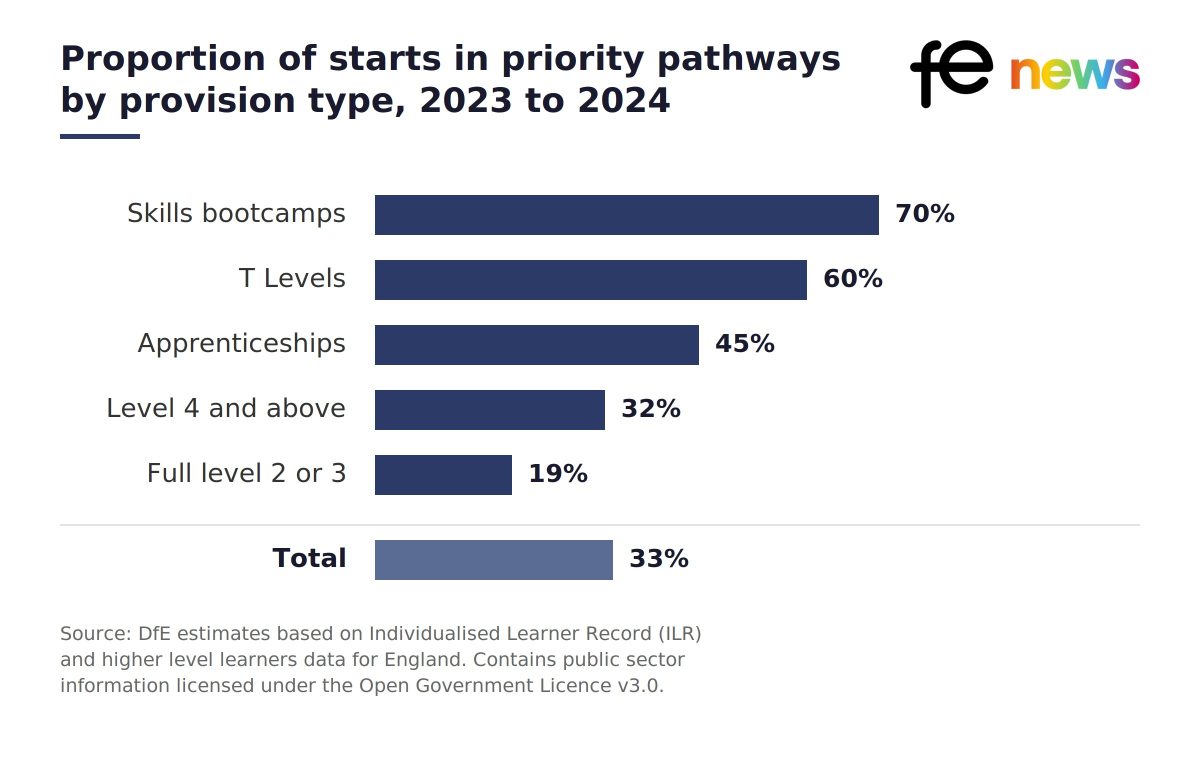
- 70% for skills bootcamps, 60% for T Levels, 45% for apprenticeships, 32% for level 4 and above
- 1.8 million more workers needed in priority occupations through to 2035, per Skills England
What the measure does
Published on 25 June, the measure fulfils a commitment in the October 2025 post-16 education and skills white paper to monitor “increasing starts in priority courses” mapped to the eight Industrial Strategy priority sectors, plus construction and health and social care.
To build it, the DfE identified the pathways most likely to lead to employment in priority occupations, based either on mapping to occupational standards or on historic progression into those occupations. Applying that method to the 2023 to 2024 cohort produced a baseline of 616,000 starts, or a third of all starts, drawing on academic year starts for HE and FE at level 4 and above, full level 2 and 3 FE, apprenticeships and T Levels, plus financial year starts for skills bootcamps.
Reading the split
The headline 33% masks a wide spread by provision type. Skills bootcamps (70%) and T Levels (60%) sit at the top, with apprenticeships at 45%. Full level 2 or 3 FE sits lowest at 19%, and level 4 and above at 32%, close to the overall average.
The paper identifies priority pathways by mapping to occupational standards or to historic progression into priority occupations. It states that where there are high numbers of starts but poor progression to priority occupations, the government will explore the causes through jobs plans and work with mayoral strategic authorities on local skills improvement plans.
The DfE is explicit that the measure looks backwards, and is a strong indicator of future career outcomes rather than a definitive predictor.
Why it matters for providers
The white paper commits government and Skills England to targeting public funding at priority sectors, and this measure is framed as one tool to inform that targeting. It sits alongside substantial existing commitments: £295 million for Technical Excellence Colleges in digital, clean energy, advanced manufacturing and defence; a £625 million construction package aiming to deliver 60,000 additional workers over this Parliament; and a £182 million defence package.
New qualifications are positioned as part of the alignment effort. V Levels, linked to occupational standards set by Skills England, alongside new Occupational and Foundation Certificates at level 2, are intended to give clearer routes into skilled employment or further study. Foundation Certificates lead to further study at level 3; Occupational Certificates lead to skilled level 2 employment. Recent Growth and Skills Levy reforms aim to support rapid upskilling through new apprenticeship units and to reverse the decline in apprenticeship starts among young people.
The caveats
The DfE stresses this is a first baseline and a single lens, not a definitive judgement on course value. It is backward-looking by design, will be refined in partnership with Skills England, and will be updated annually, with further breakdowns, including on the learner cohort and place-based participation, promised in future publications.
The measure sits alongside the white paper’s broader ambitions: two-thirds of young people in higher-level learning by age 25, a sub-target of at least 10% entering level 4 or 5 study including apprenticeships by 2040, 6,500 more teachers across colleges and schools this Parliament, and a falling NEET rate.
Responses