
ONS September 2026 Labour Market: Education leads fall as UK Vacancies hit 702,000

The number of job vacancies in the UK has fallen to 702,000, the lowest figure recorded outside the coronavirus pandemic period since 2014, with education seeing the largest decline of any industry sector.
Office for National Statistics figures published on 15 September 2026 show vacancies down 8,000, or 1.1%, in June to August 2026 compared with the previous quarter, and down 36,000, or 4.9%, on the year. Total vacancies are now 86,000 below the level recorded in January to March 2020, before the pandemic. The last comparable figure outside the pandemic was in August to October 2014, when there were 701,000 vacancies.
Education records the largest fall of any sector
Vacancies fell in 10 of the 18 industry sectors. Education recorded the largest fall in volume terms, down 5,000 vacancies, and the second largest in percentage terms, down 9.7% on the quarter. Only water supply, sewerage, waste and remediation activities fell faster, down 14.9%. Education also has the lowest vacancy rate of any sector in the economy at 1.5%, compared with 2.9% in mining and quarrying and 2.8% in accommodation and food service activities. There were 3.127 million workforce jobs in education in June 2026.
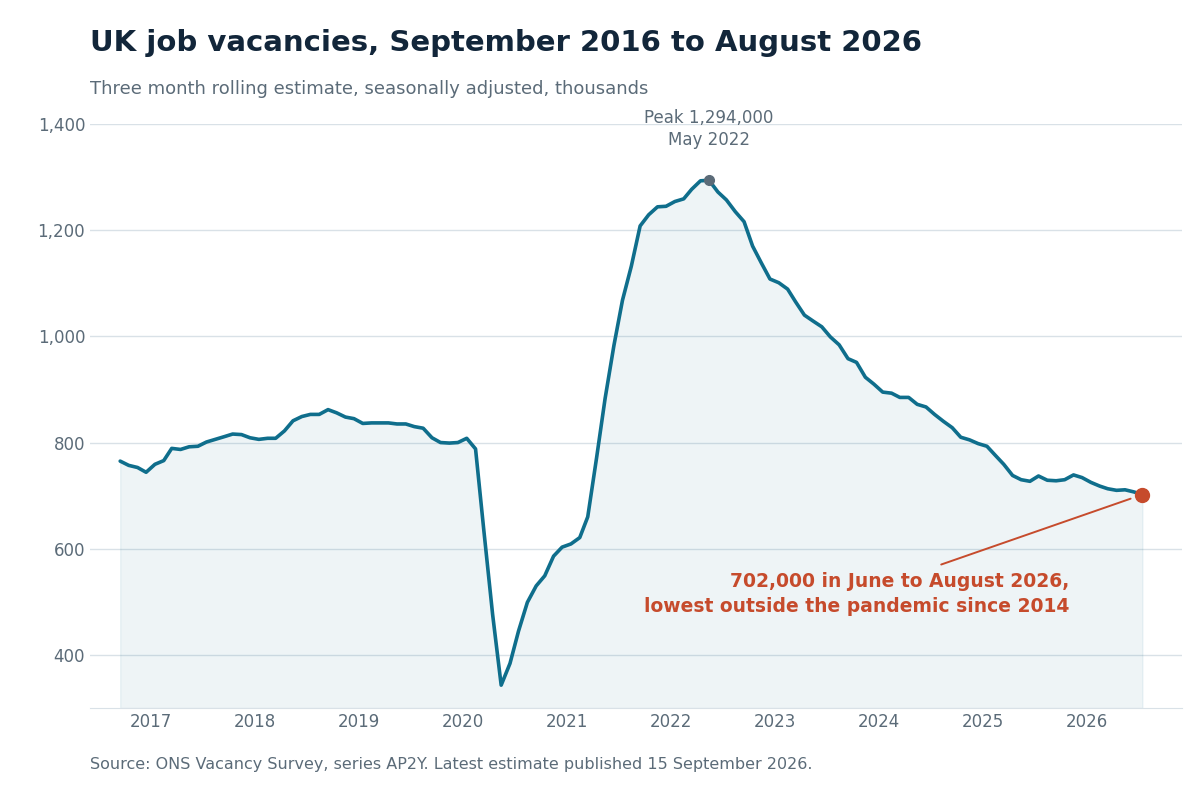
The longer series puts the figure in context. Vacancies peaked at 1,294,000 in May 2022 and then fell for 35 consecutive months to 738,000 in April 2025, a drop of 43%. Since then the series has been broadly flat, moving within a band of around 30,000 for more than a year, which is roughly the size of the ONS confidence interval for the estimate. Ten years ago, in September 2016, there were 765,000 vacancies. The decade has therefore seen a boom, a sustained collapse and a period of stagnation that has left vacancies slightly below where they started.
Smaller employers account for much of the recent decline. Businesses with one to nine employees recorded the largest quarterly fall, down 7,000 vacancies or 7.5% to 91,000, and are down 28,000 or 23.5% over the year. Outside the pandemic, that is the lowest level for this size band since late 2013. The ONS said feedback from its Vacancy Survey continues to suggest that smaller firms may not be recruiting because of increases in labour costs.
There were 2.5 unemployed people for every vacancy in May to July 2026, up from 2.3 a year earlier. The ratio has been unchanged at 2.5 since July to September 2025, having risen each quarter before that.
Employment, regional gaps and pay
Headline rates were largely unchanged. The employment rate for people aged 16 to 64 was estimated at 75.1% in May to July 2026, down 0.1 percentage points on the year. The unemployment rate for those aged 16 and over was 4.9%, up 0.2 percentage points on the year. The economic inactivity rate was 20.9%, down 0.1 percentage points on both the year and the quarter. The claimant count rose in August 2026 to a provisional 1.692 million and has been increasing since January.
The regional picture shows considerable variation. The highest employment rate was in the South East and South West, both at 78.2%, while the lowest was in the North East at 71.3%, a gap of nearly seven percentage points. London recorded the highest unemployment rate at 6.8% and Northern Ireland the lowest at 2.4%. Northern Ireland also had the highest economic inactivity rate at 26.0%, compared with 18.2% in the South East, which points to a smaller labour market rather than a stronger one.
Payrolled employee numbers, taken from HMRC administrative records, continue to fall. The early estimate for August 2026 was 30.2 million, down 26,000 on the month and 145,000, or 0.5%, on the year. The ONS said this measure currently provides the most reliable count of employees.
On pay, annual growth in regular earnings excluding bonuses was 3.5% in May to July 2026 and has been stable across five consecutive three month periods. Total earnings growth including bonuses was 3.9%, down from 4.2% and the lowest since September to November 2020. Public sector regular pay growth was 6.3% against 2.9% in the private sector, a gap the ONS attributes to the timing of NHS pay awards this year. Adjusted for inflation using CPIH, regular pay grew by 0.6% and total pay by 0.9%.
Liz McKeown, Director of Economic Statistics, Office for National Statistics (ONS) said:
“The labour market remains broadly stable, with employment and unemployment rates largely unchanged in the latest period. However, payrolled employee numbers continue to edge down, with falls over the past year particularly evident in the retail and hospitality sectors.
“Vacancies remain at their lowest level outside the pandemic period for more than a decade, with smaller businesses continuing to report that increased labour costs are affecting hiring decisions.
“Regular wage growth has remained relatively stable in recent months, while total pay growth, which includes bonuses, has eased and was last lower nearly six years ago. There remains a notable difference between public and private sector pay growth, with public sector figures continuing to be affected by the timing of NHS pay awards this year.”
Pat McFadden, Secretary of State for Work and Pensions, said:
“Today’s figures show a labour market that remains resilient in the face of significant global economic pressures, with unemployment steady in recent months and vacancies around their long-term average.
“But we know there is more work to do, particularly to ensure young people gain the skills, experience and confidence needed to succeed.
“That’s why we’re backing young people with new work experience opportunities through our partnership with the British Retail Consortium, supporting the retail sector’s ambition to create 100,000 jobs, alongside a £2.5 billion investment to transform youth employment support and £3.5 billion in tailored employment support for disabled people.”
Labour Force Survey estimates are official statistics rather than accredited official statistics, and the ONS advises caution when drawing conclusions from short term changes, recommending that they be read alongside workforce jobs, claimant count and PAYE Real Time Information data. The next release is due on 20 October 2026.
Sector Reaction
Stephen Evans, chief executive at Learning and Work Institute (L&W), said:
“Headline stability in the job stats masks two underlying and related challenges. The first is that one million young people are not in education, employment or training, risking long-term harm to their career prospects. Ramping up efforts to change that can’t wait. The second is the stalling of job growth in parts of the private sectors like retail and hospitality, down 150,000 payroll jobs since last year. This limits first job opportunities for young people and reflects underlying economic weakness that ongoing international uncertainty won’t help. The employment rate is relatively high by international standards, but risks trending in the wrong direction with 3.9 million people not in work but saying they want a job.”
Maxine Bligh, Interim Chief Executive of the Recruitment and Employment Confederation (REC) said:
“Jobseekers have been watching the same job market movie for a while now.
“A steady but unspectacular picture for both jobseekers and the wider economy, with employment and unemployment barely shifting. Falling payrolled employment suggests too much tentativeness remains in hiring decisions, although the temporary job market has at least stabilised, offering reassurance for those looking for immediate work or those unable to work permanently.
“The lack of momentum in the labour market shows the government must do more to give employers the confidence to take on staff. This means lessening the cost of doing business, giving firms a chance to switch from resilience to risk against the background of ongoing uncertainty.
“Pay growth remains resilient and will be watched closely by pension policymakers and ahead of the Bank of England’s next interest rate decision.
“Businesses will back the government going bold with the Budget next month to rebuild employer confidence by supporting growth, boosting hiring and strengthening labour market participation.”
Jack Kennedy, Senior Economist at Indeed, says:
“The figures underscore the dilemma facing the Bank of England, with the job market remaining weak but inflation concerns mounting amid the continued run-up in global energy prices. The fragile labour market remains the counterweight to arguments for near-term interest rate rises, particularly with recent economic growth having been unexpectedly resilient.
“Youth unemployment remains one of the most concerning features of this labour market having risen back to its joint-highest for over a decade, signalling a real pocket of distress among young people trying to enter the workforce.
“Employers continued to cut payrolled employment in August, while private sector wage growth remains within the Bank’s tolerance zone, suggesting a lesser risk of second-round inflation effects. Still, there remains an outside chance of an interest rate hike this Thursday.
“Government schemes like youth jobs grants and guarantees are a step toward addressing this, but with cost pressures and uncertainty continuing to weigh heavily on businesses, a meaningful turnaround looks a long way off.”
Chris Goulden, Deputy CEO, Youth Futures Foundation, comments:
“The latest labour market data from the Office for National Statistics shows that youth unemployment continues to rise. Around 1 in 7 (14.1%) young people who are not in full-time-education and economically active are unemployed, representing around 469,000 16-24-year-olds. Since last year, this is an increase of 67,000 more young people that are out of work and actively looking for a job.”
“With youth unemployment rising, expanding opportunities for young people that are underpinned by evidence will be vital, so every young person can move into, and stay in, good work. We therefore welcomed the government’s recent focus on increasing access to apprenticeships, alongside its delivery of the Youth Guarantee. International evidence from our newly expanded Youth Employment Toolkit shows that good-quality apprenticeships positively impact employment outcomes. For every 100 young people who are NEET and participate in an apprenticeship, around 10 more are in employment 12 to 24 months later compared with similar young people who do not undertake an apprenticeship.”
“However, apprenticeship starts for young people have declined in recent years, alongside exposure to apprenticeship pathways. We must do more to encourage participation, particularly among marginalised young people stand to benefit most.”
“As we approach publication of Alan Milburn’s final ‘Young People and Work’ Report and the Autumn Budget, it’s important to emphasise how substantial the prize for helping more young people earn or learn is – not only for our young people but for the wider economy too. If the UK matched the Netherlands’ youth participation rate, approximately 567,000 more young people would be in work or education, boosting the economy by as much as £86 billion in the long-term.”
Responses