
Graduate with autonomic nervous system disorder overcomes obstacles to achieve academic goals

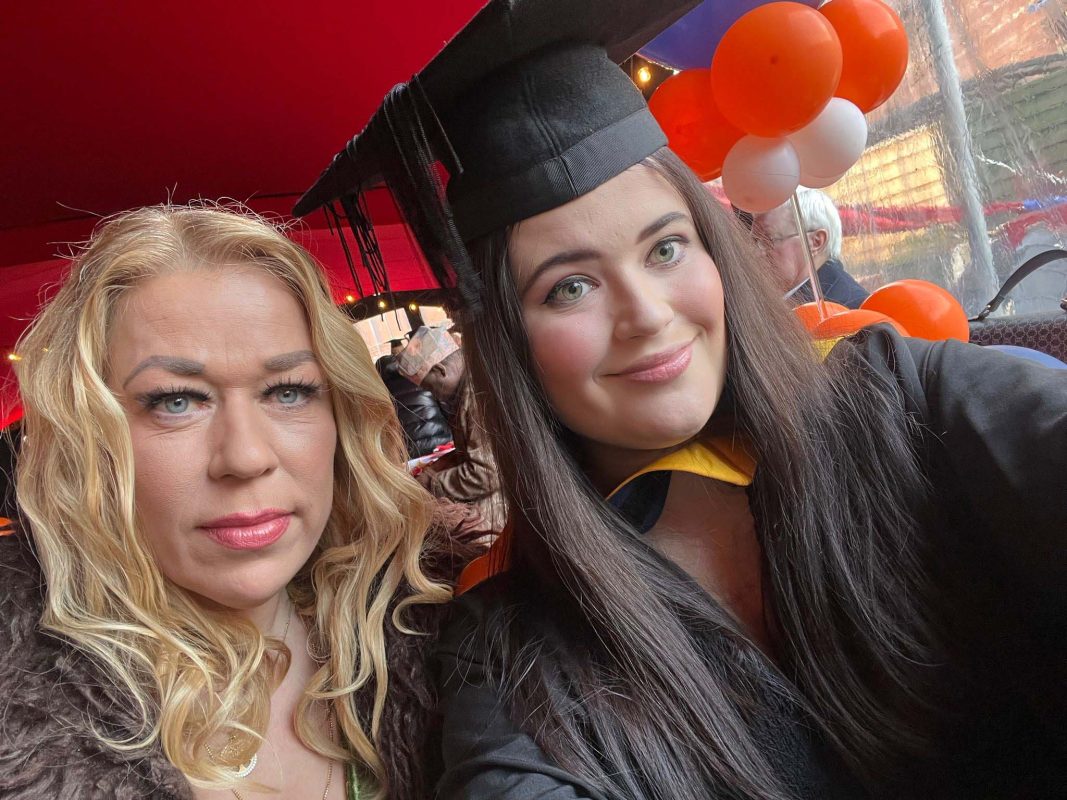
A student who overcame immense challenges to reach her academic goals while managing the daily impact of Postural Tachycardia Syndrome (PoTS) has graduated from the University of Sunderland.
Kara Barron, 25, who studied MSc Psychology (Conversion), graduated alongside fellow students at the Winter Graduation Ceremonies at The Fire Station, a moment she once thought might never come.
PoTS affects the autonomic nervous system, which regulates automatic functions such as heart rate and blood pressure. For Kara, this means that simply standing up can cause her heart rate to spike and blood pressure to drop, leading to dizziness, fainting, and exhaustion.
Kara, who first began experiencing symptoms at the age of 13, said: “I remember coming home from school exhausted and just sleeping all the time. I fainted for the first time when I was fourteen and that was when I knew something was very wrong.”
Her condition quickly worsened, and by her mid-teens, she was fainting up to seven times a day. Kara said:
“It got to the point where I had to use a wheelchair as it was too dangerous to be standing up.
“I experience extreme fatigue, migraines, brain fog, stomach issues and weakness, even basic tasks can feel exhausting,” Kara said. “Living with this condition has completely changed my life. I’ve had to learn to listen to my body and accept that some days will be harder than others.”
Despite these difficulties, Kara remained determined to pursue her education. With treatment and medication, she went on to complete her A-Levels and later enrolled at the University of Sunderland to study for a BA in Primary Education.
Kara said:
“I had always dreamed of becoming a teacher. I still got the degree, but I was unable to achieve Qualified Teacher Status due to my health, as I couldn’t complete my classroom placement. That was a devastating setback, but I knew I still wanted to make a difference in young people’s lives.”
Kara’s interest in wellbeing and human behaviour inspired her to pursue an MSc Psychology (Conversion) degree at the University. However, managing a chronic condition alongside postgraduate study brought new challenges.
Kara said:
“Living with PoTS can make my days unpredictable, which made it difficult at times to meet deadlines. There were days when I physically could not focus, and it was frustrating.”
When her health and mental wellbeing reached a low point, Kara credits the University’s academic and wellbeing teams for helping her achieve success.
Kara said:
“Every single member of staff on the Primary Education and MSc Psychology programmes has been amazing. Staying resilient through the toughest times has not been easy.
“They were understanding and flexible when my health has affected my studies which took a lot of pressure off and allowed me to focus on trying my best rather than keeping up with everyone else.
“Knowing that my lecturers and the wellbeing team believed in me and genuinely wanted me to succeed helped me to stay motivated during the most difficult periods.”
Throughout her journey, Kara’s determination was constant. She said:
“What made me stay on my course was my belief that this was the right path for me. University staff reminded me that setbacks don’t mean failure, they just mean finding a different way forward. That’s an important life lesson for anyone.”
Kara’s experiences have shaped her future goals.
“Living with a chronic condition and completing this course has taught me the importance of perseverance and self-compassion,” she said.
“It’s made me more understanding of how personal circumstances can affect learning. I want to help create supportive environments where every child or young person feels understood and capable, no matter what challenges they face.”
Dr Rebecca Owens, Head of the School of Psychology at the University, said:
“Kara’s story is one which reminds me why I am so proud to work for the University.
“In the School of Psychology, we focus on creating a rigorous, challenging and interesting curriculum as well as supporting students to find their own path and to achieve their best.
“Many of our students are juggling different commitments or challenges and our academic team work hard to support them in finding and achieving success – whatever that looks like for them.
“I will always be in awe of how our staff work so diligently to support individual students in different ways, and the resilience and determination of our students.”
Now living in Andover, Hampshire with her partner, Kara currently works as a graduate learning support assistant gaining valuable experience as she works toward her goal of beginning a PhD in Educational Psychology.
As she reflects on how far she’s come, Kara said:
“If you’d told 14-year-old me that I’d graduate with a master’s degree, I never would have believed it.
“There were so many moments when I doubted, I’d ever reach this point. To finally be here feels like such an achievement, I’m incredibly proud and so grateful to everyone who’s supported me along the way.”
Responses