
University of Salford awarded with Queen Elizabeth Prize for Education by Their Majesties, The King and Queen

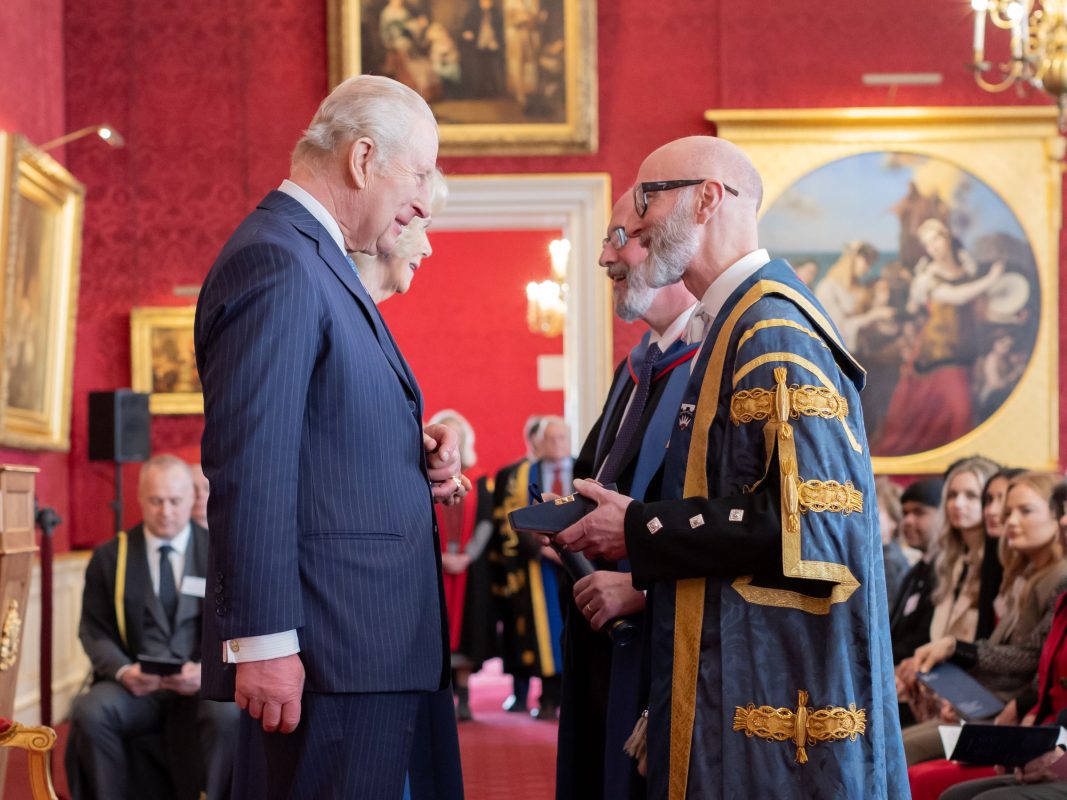
Representatives from the University of Salford were presented with a Queen Elizabeth Prize for Education by Their Majesties The King and Queen on Tuesday 24 February 2026. Awarded at St James’s Palace, the Prize recognises the University’s pioneering research driving innovation in sustainable building design and tackling fuel poverty.
Chair of Council, Lord Keith Bradley, Vice-Chancellor, Professor Nic Beech, Director of Energy House Laboratories, Professor Will Swan, and Professor Richard Fitton attended the ceremony at the Palace along with other members of the award-winning team, before a Prize-winners’ reception and dinner at Guildhall in London.
The prestigious award recognises the efforts of the team at the University’s Energy House Labs, led by Professor Will Swan and Professor Richard Fitton. Their pioneering research is a vital part of the University’s strategy, ‘Innovating to Enrich Lives’, building a more sustainable, equitable, just, healthy, creative and prosperous society. Energy House Labs embodies this goal, developing clear responses to environmental challenges and helping ensure a sustainable future for generations to come.
Professor Nic Beech, Vice-Chancellor at the University of Salford, said: “It was an incredible privilege to be invited to the Palace to receive this prestigious award from Their Majesties. It is recognition of our purpose to innovate to enrich lives, particularly through our commitment to sustainability and tackling the climate crisis.
“The work of the Energy House Labs is outstanding in transforming the way homes are designed and built, tackling fuel poverty and improving quality of life for people who need it most.”
The world-leading research facility supports innovators to build and retrofit more energy efficient houses and rapidly bring new energy efficient products to market, creating economic growth, increasing innovation in carbon reduction and helping consumers to reduce their energy bills. Their critical research is accelerating progress towards net zero housing design, helping millions to save money on energy bills, and is currently shaping a quarter of all new homes being built in the UK today.
Professor Will Swan, Director of Energy House Labs at the University of Salford, said: “We’re truly honoured to be presented with the Queen Elizabeth Prize for Education by the King and Queen – it has been such a momentous occasion for us. This recognition reflects the incredible commitment and effort of everyone who has been part of Energy House Labs, along with the vital support of our partners.”
The Queen Elizabeth Prizes for Education (formerly known as the Queen’s Anniversary Prizes) are part of the UK’s national Honours system, recognising outstanding work by UK universities and colleges that demonstrates excellence, innovation and benefit for the wider world.
Professor of Building Performance at the University of Salford, Professor Richard Fitton, added: “The need for low‑carbon, energy‑efficient homes that are warm and well‑insulated has never been more pressing. Our ambition is that our research is used to support the people who can benefit from it most. We’re so proud of what we’ve achieved so far and continue to be driven by the knowledge that our work is making a tangible difference, both today and for generations to come.”
Sir Damon Buffini, Chair of the Royal Anniversary Trust, said: “The Queen Elizabeth Prizes for Higher and Further Education celebrate the power of education to change the world for the better. This much-loved national honour recognises, at the highest level of state, outstanding work in UK universities and colleges, and the remarkable benefit they bring to our economy, society and the wider world.”
First awarded in 1994, the Queen Elizabeth Prizes are granted every two years by the Monarch on the advice of the Prime Minister following a rigorous, independent review process carried out by The Royal Anniversary Trust, an independent charity.
Responses