
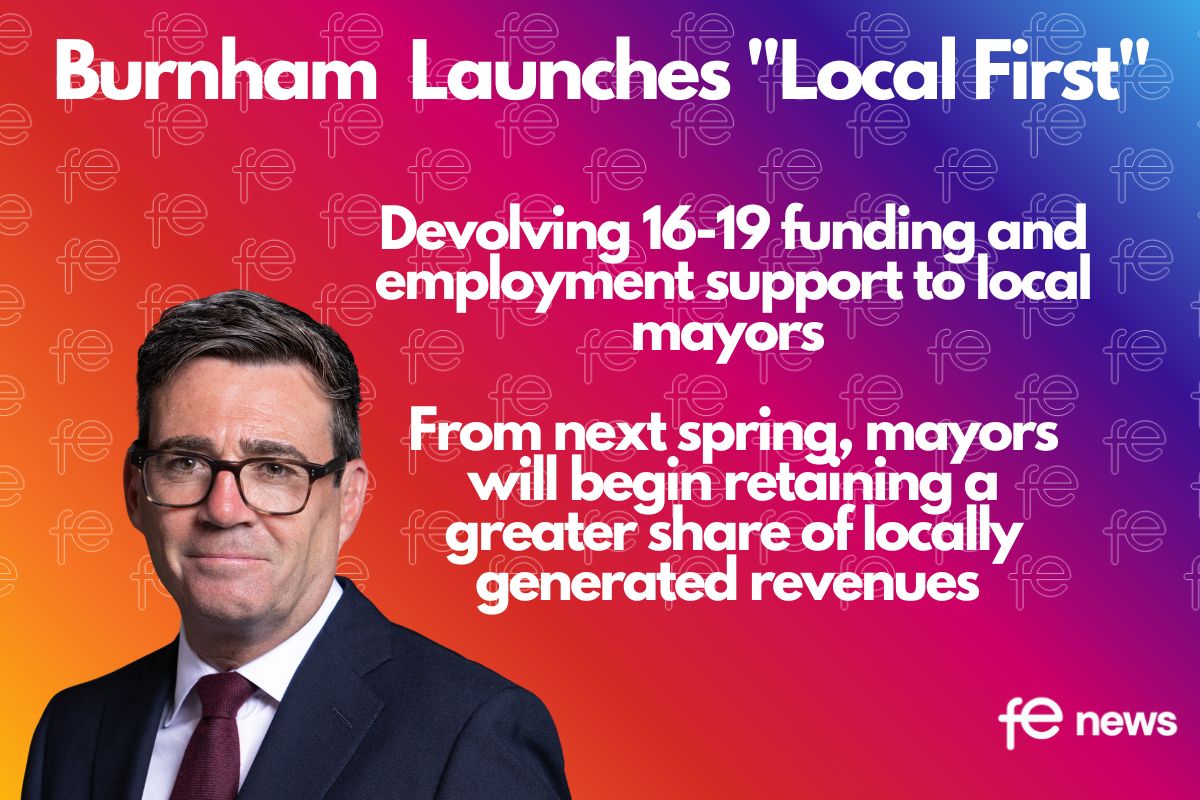
Burnham Launches New “Local First” Principle, With Plans To Devolve 16-19 Funding and Employment Support

The Prime Minister will today launch the biggest transfer of power from Westminster in a generation, giving communities greater control over the decisions that shape jobs, transport, housing and public services in their area.
As part of the largest package of financial powers ever offered to English mayors, mayors will receive a share of income tax revenues for the first time.
This means when places create jobs and grow their economies, they will now keep more of the rewards – giving local leaders new powers to invest in what matters most locally. From next spring, mayors will begin retaining a greater share of locally generated revenues, starting with business rates.
Mayors to control 16-19 funding and employment support
This includes giving mayors control over 16-19 funding and employment support, so young people can train for the jobs local employers need and people out of work can get tailored support back into employment.
This means when places create jobs and grow their economies, they will now keep more of the rewards – giving local leaders new powers to invest in what matters most locally.
- Biggest transfer of power, funding and responsibility from Westminster in a generation
- Mayors to keep a share of income tax and business rates revenues so communities directly benefit when their economy grows, with new powers for communities still on the road to devolution
- Taking a tried and tested approach nationwide – delivering better transport, more homes and skills training matched to local jobs
Areas without a mayor will still be supported to establish strategic authorities and gain greater control over local priorities.
The government wants every community to benefit from stronger local decision-making. Areas without a mayor will still be supported to establish strategic authorities and gain greater control over local priorities.
In his second week in office, the Prime Minister will tell his Cabinet that it is time to launch a new era of devolution – taking power and decision-making out of SW1 and putting it closer to people’s lives.
Prime Minister Andy Burnham said:
“I said we’d take power out of Westminster and carry it into every postcode in the country. Today, we make good on that promise.
“Under our plans, more of the taxes raised in a community will stay in that community. Soon, every local leader will have the power and resources to improve public transport, build homes and create jobs.
“I know what it’s like to be ignored by politicians in Westminster. I’m not going to make that same mistake now I’m PM.
“The whole of government will now pull together behind the people and places that desperately need our support. This is how we’ll bring back hope and bring power home to you.”
The plans will end the Whitehall-first culture that has held back local areas for decades, forcing departments to justify why powers should stay in Westminster rather than be handed to local leaders.
By shifting power, funding and decision-making closer to people, the changes will give every part of the country the tools to create strong local economies, improve public services and shape its own future.
Chancellor of the Exchequer, John Healey MP said:
“The people who best understand what skills employers want, what transport an area needs and where investment can make the biggest difference are those who live there.
“For the first time we’re giving Mayors a share of income tax so communities directly benefit when their economy grows – passing power out of Westminster and driving growth in every postcode.
“This is the way we start to build new hope and advance the working people of this country.”
From next spring, mayors will begin retaining a greater share of locally generated revenues
From next spring, mayors will begin retaining a greater share of locally generated revenues, starting with business rates. Further details on this and on income tax retention will be set out in a roadmap at the Budget and will be underpinned by the government’s firm commitment to fiscal discipline.
Over time, local areas will move away from dependence on Whitehall grants and towards funding that rewards local growth. The ambition is to extend the benefits of devolution across the whole UK, working with devolved governments and local leaders to give communities more control over their future.
Secretary of State for Housing, Communities and Local Government Angela Rayner said:
“This is the first step in our plan to rewire this country and build a better future, where power is no longer hoarded in Westminster but is put back in the hands of local people – where it belongs.
“Our devolution revolution is about bringing an end to the begging-bowl culture of the past, and instead making sure our local leaders have the tools they need to drive the change that communities have been crying out for.
“We need every region to be firing on all cylinders if we want good growth in every postcode, and we will do everything in our power to make that a reality.”
The reforms will be driven by a strengthened No10 North operation
The reforms will be driven by a strengthened No10 North operation, working with mayors, local leaders and other partners to remove barriers to growth, accelerate delivery and ensure government is better connected to communities across the country.
Local leaders will gain greater control over the services that shape people’s lives, including housing, transport, skills, employment support and public services.
This includes powers to:
- Bring rail and bus services under greater local control, helping introduce integrated ticketing and more reliable services.
- Build more homes where they’re needed and unlock stalled development sites by giving local leaders stronger planning and regeneration powers and more devolved funding.
- Get local transport schemes, trams and metros built faster by removing Whitehall barriers and speeding up approvals.
- Give mayors control over 16-19 funding and employment support, so young people can train for the jobs local employers need and people out of work can get tailored support back into employment.
- Back local industries and innovative businesses, and attract investment, creating more well-paid jobs.
- Where power is devolved, Whitehall resource will follow, giving devolved leaders the resources they need to drive change closer to home
Immediate reforms will remove barriers that prevent locally led transport projects from going ahead, activate new planning powers for mayors and give local areas greater flexibility over how funding is spent.
Local First Principle
Under a new “local first” principle, ministers will be expected to justify why powers should remain in Whitehall rather than being devolved.
The United Kingdom has invested less in its future than any other G7 country over the past three decades. Giving local leaders greater control over funding and investment decisions will help unlock opportunities that have too often been overlooked by a Whitehall-led approach. Between 1997 and 2025, ONS data shows UK whole economy investment as a proportion of GDP averaging 17.3%, the lowest in the G7
The Prime Minister believes the country’s towns, cities and communities can drive far more growth and opportunity if they are given the tools to do so. Where local leaders have been trusted with greater responsibility, they have already delivered results:
- In West Yorkshire, a Housing Investment Fund of up to £334 million is helping unlock land for development and bring forward stalled sites, supporting the delivery of thousands of new homes.
- In the Liverpool City Region, local leaders are transforming transport through the rollout of Tap and Go ticketing on Merseyrail, bringing the bus network into local control later this year and taking rail services back into public ownership by 2028.
- In the North East, 65,000 residents have been supported to gain qualifications, opening up new employment opportunities in sectors including construction and childcare.
Spreading Opportunity More Widely
The UK cannot rely on success in a small number of places alone. By giving more communities the tools to succeed, these reforms will help spread opportunity more widely, raise living standards and ensure more people feel the benefits of economic success in their everyday lives.
As powers move out of Westminster, the Civil Service will become smaller and more strategic
As powers move out of Westminster, the Civil Service will become smaller and more strategic, focusing on the responsibilities that are best exercised at a national level.
The government will publish a White Paper alongside the autumn Budget setting out the full programme of reforms and a clear timetable for implementation. These announcements are for England only. The Government will be developing the ambition for devolution to communities and regions within nations with devolved governments.
The plan for devolution will form a major part of the Civil Service’s future operating model, being developed as part of the Cabinet Secretary’s wider Review into the Organisation, Performance, and Transformation of the permanent Civil Service.
The reforms will not change the rate of income tax paid by residents. The government will retain a system of equalisation so that areas benefit from local growth while funding remains fair across the country. Similar approaches already operate through business rates retention and the local government finance settlement, which distributes funding based on relative local needs rather than simply the amount of revenue raised locally.
Update – 31st July 2026:
The Chancellor has confirmed that the date of the Budget will be Wednesday 28 October.
The Chancellor of the Exchequer, John Healey MP said:
“This government is working fast to restore hope and back Britain’s communities.
“In the past two weeks, we have begun to kickstart growth in every postcode.
“We have backed British jobs, British skills and British businesses.
“And we have provided just a bit of breathing-space for those families and businesses that feel so squeezed, that feel without hope.
“Today, I’m confirming the date of my first Budget as Chancellor will be Wednesday 28th October.
“This will be a Budget that moves money and power out of Westminster, and into every postcode around Britain.
“It will be built on fiscal discipline.
“It will meet our fiscal rules. It’ll give businesses and families some of the stability they need to plan for the future.”
Sector Reaction
David Hughes, Chief Executive, Association of Colleges, said:
“The Prime Minister came into power with a clear vision for giving more powers to elected mayors and this announcement shows that he means it. For colleges, which sit at the heart of their communities, this could be a very positive step, giving them the investment, support and priority positioning to carry out their role in local economic growth and helping people develop the skills and learning they need to find good jobs. Colleges do an amazing job already in supporting education and training that is best for their students and local employers. They do that in a national system which has many constraints and high levels of bureaucracy, and with funding that has still not recovered from a decade of severe cuts from 2010.
“This announcement proposes to tear up that national system and replace it with one where colleges and schools (for their sixth forms) are accountable to elected mayors locally. Where that is done well, colleges will flourish because they deliver, despite the poor funding and restrictions, what local mayors want. With more local control, colleges should see more investment to scale up what they do for more young people to help them progress and succeed.
There are many risks with the shift
“There are many risks though with the shift, because it is a complex national system spending £9.5billion on 1,275,000 students in over 2,500 colleges, schools and other organisations. I will be urging the government to tread very carefully, work through the details with us and other partners, and to pilot the change before rolling it out more fully. I look forward to sharing our experience in the discussions with government officials and ministers that have already started this week.
“At the headline level, there are five key issues which we will press for. The first is that there is a strong national framework for 16-19 devolution which put in place some ‘guide-rails’ to help reduce the risks of the change.
“Second, we will be looking for early movement to remove the existing national regulatory rules and restrictions which colleges are subject to in order to be able to be accountable for meeting local priorities.
“Third, colleges will need long-term capital and revenue investment to scale up, including more funding to pay staff in line with schools and industry.
“Fourth, we will need to see mayors convene and engage employers much more to support the delivery of technical and vocational training, education and skills from the age of 14.
“And finally, we will need to see mayors step in much more with powers over schools to ensure that they collaborate with colleges to develop the new pathways.
“None of these things are straightforward, and this devolution will take significant time to work through the system and best serve students. At AoC, alongside our member colleges, we are ready with the expertise and insight to support the roll-out of the Prime Minister’s plans.”
Commenting following the announcement that mayors will be given control of 16-19 funding and employment support, Pepe Di’Iasio, General Secretary of the Association of School and College Leaders, said:
“Yet again this week, there is very little detail about what this will mean in practice for colleges and schools. Improved links between education, skills and local employment opportunities could be a positive step towards reducing the staggering number of young people not currently learning nor earning. However, headteachers and college principals have already raised concerns about the timescales and workload implications of delivering the Prime Minister’s new reforms, on top of a mountain of policy changes already underway. The real test will be whether there are more opportunities for young people in the postcodes where this is most needed, not fewer; and that devil will be in the detail, detail that we don’t yet have.”
Responding to the government’s Cabinet Statement setting out plans to devolve significant new powers over skills, innovation funding and public services to mayors and local leaders across England, Dr Joe Marshall, Chief Executive of the National Centre for Universities and Business (NCUB), said:
“This is a significant moment for how research, skills and innovation policy will be shaped and delivered in England. The commitment to devolve by default, including a substantially increased share of later-stage innovation funding and significant control over technical and vocational pathways, represents much more than an incremental extension of existing devolution.
“It creates a major opportunity. Local leaders, working with universities and businesses, could align investment much more closely with the distinctive research strengths, industrial capabilities and skills needs of their regions. Done well, this could help places build new industries around frontier sectors, attract private investment and translate innovation into jobs and growth into places where the benefits will be genuinely felt.”
However, NCUB cautioned that the scale of the proposed change also raises important questions about how the new settlement will work in practice.
Dr Marshall continued:
“The direction is ambitious, but many of the most important design questions remain open and must be shaped by those at the heart of local decision-making – namely universities and businesses that drive skills, research and innovation ecosystems. Which decisions are best taken locally, which require national coordination, and which should be shared? How will local priorities remain connected to the UK’s national research base and to opportunities that cross regional boundaries? And how will we ensure that places with different levels of institutional capacity are all able to benefit?
“Innovation does not stop at administrative borders. Research strengths, specialist facilities, supply chains, skills and investment frequently connect several parts of the country. Devolution must therefore strengthen local leadership without fragmenting the national relationships and institutions that successful innovation depends on. NCUB stands ready to work with government, UKRI, local leaders and our members to help build a settlement that combines stronger local agency with national coherence and turns this significant reform into lasting economic opportunity.”
Responses