
Samsung Solve for Tomorrow is now Open for its Seventh Year

The number of young people not in education, employment or training (NEET) remains one of the most stubborn problems facing UK schools and families. But a growing body of evidence suggests that some of the answer lies not in new qualifications, but in something simpler: giving students the confidence to solve real problems and pitch their own ideas.
That’s the thinking behind Samsung Solve for Tomorrow, a free national competition now open for its seventh year, which challenges 11-18-year-olds across the UK and Ireland to turn a problem they care about into a real tech-for-good solution. It’s built on the idea that creativity is a skill every young person can develop – not a talent reserved for a select few.
What the competition actually involves
Students identify a problem in their community or the wider world and develop a tech-based solution to address it. Teachers can run the programme in a single lesson, across six lessons, or as a self-guided independent project, with no specialist tech knowledge or extra budget needed. As teams progress, they receive mentoring from Samsung Solve for Tomorrow volunteers and access to prototype funding, before pitching to a panel of industry experts at a national final at Samsung’s London base. Winners receive Samsung technology, national recognition, and work experience placements.
Why it matters beyond the prizes
The real value, according to the programme’s own data, is in what happens to students’ confidence and capability along the way. Last year, participants’ self-reported confidence rose from 45% to 73%, and their broader capability across creativity, problem-solving, collaboration and self-management improved from 43% to 65%. These are exactly the transferable skills that keep young people engaged in education and employable once they leave it – the skills that a qualification alone often doesn’t teach.
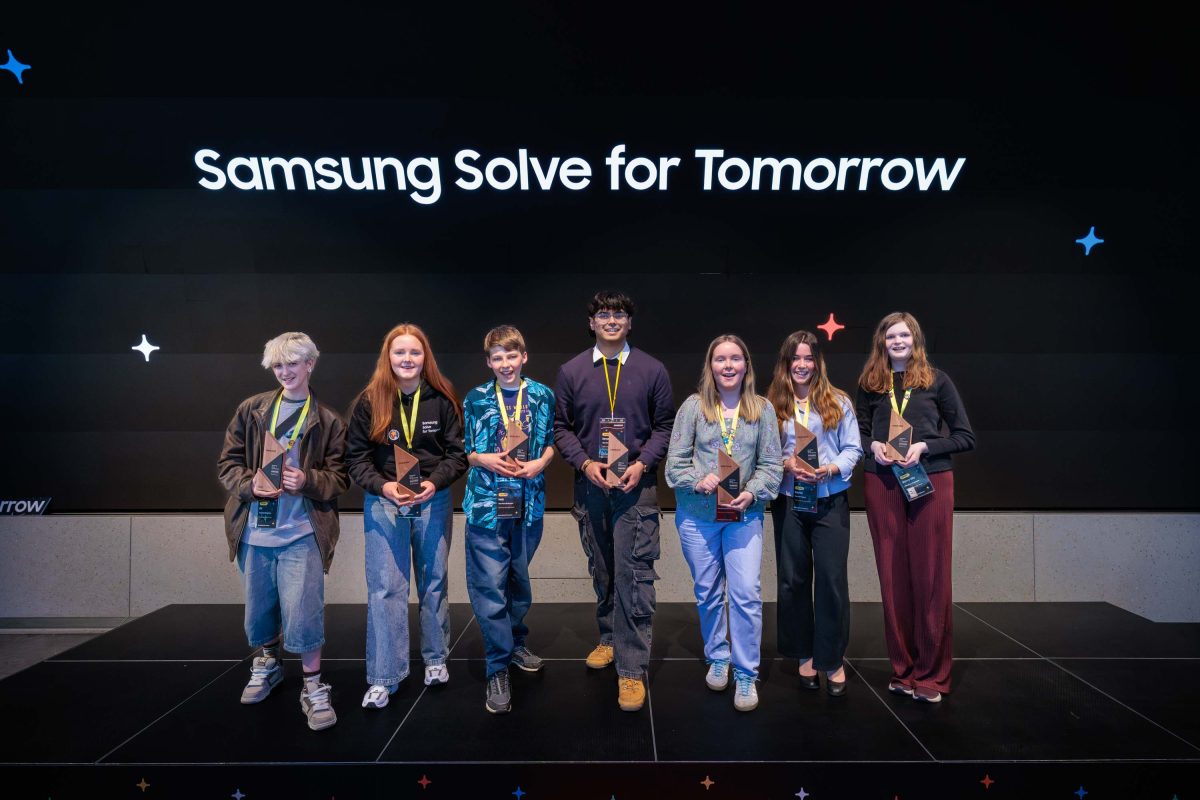
Past winners bear this out. Devansh, who won the 16-18 category with a wound-healing scanner called The Green Cross, says the process taught him how to present, how to sell an idea, and to put himself forward – skills he’s carried well beyond the competition itself. Nell, a 14-16 category winner from County Limerick, credits it with transforming her confidence with public speaking. Indy’s 11-14 category-winning app, Plant Enforcers, went from a classroom project to a national award.
This year, the programme is going further to reach schools that don’t already engage with STEM or edtech initiatives. For the first time, Samsung is taking Solve for Tomorrow on the road, with in-person regional innovation workshops in Glasgow, London, Birmingham and Manchester, backed by teacher training designed to build lasting confidence rather than a one-off session. It’s delivered with partners including the Design & Technology Association, Design Council, Tech She Can and Internet Matters, and it directly supports schools’ careers provision and the Gatsby Benchmarks – making it useful for careers leads and senior leadership, not just classroom teachers.
Among teachers who took part last year, 82% say it builds both STEM and life skills, and 71% say it improved how their students see Design & Technology as a subject.
Responses