
How AI Is Reshaping Entry-Level Marketing, and How to Stand Out in 2026


Aspiring marketers are set to enter the industry at a challenging, but exciting time.
Competition for jobs may only become greater, with the recent Milburn Review revealing that the number of young people who are not in education, employment, or training (NEET), may rise from 1 in 8 to 1 in 6 young people within five years, equalling around 1.25 million young people.
The Department of Work and Pensions has recently committed to providing 300,000 new work experience and training placements, but the NEET figures are a stark warning for the government, and an indication of the state of the current labour market.
This issue and economic pressures are creating challenges for professionals stepping into their first roles. Yet these same pressures have also made marketing more important than ever. As brands work hard to build customer trust and loyalty, junior marketers have a unique opportunity to make a meaningful impact from the very start of their careers.
However, marketing students and apprentices can’t afford to rest on their laurels; they must adapt to a rapidly evolving landscape that looks set to reshape the jobs market.
Young marketers facing challenging circumstances
New research from the Chartered Institute of Marketing (CIM), conducted with YouGov, reveals that 19% of marketing professionals at large businesses (250+ employees) expect their company to reduce headcount in favour of AI automation, followed by 12% of those at small businesses (10-49 employees) and 11% of marketers working at medium-sized businesses (50-249 employees).
While AI is reshaping marketing roles, it is also increasing the value of human judgement, creativity and experience. As a result, the anticipated 19% reduction in headcount among large businesses may not affect senior leadership positions such as CMOs or marketing directors as heavily.
Instead, the greatest impact may be felt at entry-level, where AI may be able to automate several tasks previously undertaken by junior marketers. Aspiring professionals must therefore adapt now, recognising that AI is reshaping the skills and capabilities employers expect from candidates.
Adapting to the transformative impact of AI
AI literacy – the ability to understand, use and critically evaluate artificial intelligence tools effectively and responsibly – is quickly becoming a must-have for aspiring marketers. In the coming years, AI will likely become a core part of many marketing teams, making this capability a baseline expectation rather than a specialist advantage.
A brand’s ability to retain trust and attention in the coming months and years is likely to be dictated by its AI usage – and interestingly – Gen Z could have a big role to play in shaping those standards.
CIM’s research shows 18–24-year-olds are the age group most likely to reject content which they believe has been created by AI (79%) and the second most likely age group to feel uncomfortable with AI having access to their personal data. This scepticism can become a strength. It encourages critical evaluation of AI-generated outputs, helping organisations improve quality, maintain authenticity and ensure robust compliance processes that protect customer trust.
Prompt engineering and generative engine optimisation (GEO), the latter essential for visibility within large language models (LLMs), are critical skills marketers must develop to maximise business impact. The rise of LLMs, such as ChatGPT and Gemini, has also impacted many websites’ impressions and click-through rates.
This presents a challenge to many current and aspiring performance marketers. But it also means data fluency has become as important as ever. Knowing which metrics matter, understanding how to interpret performance data and communicating insights clearly to stakeholders are all becoming critical differentiators.
Core marketing skills remain critical
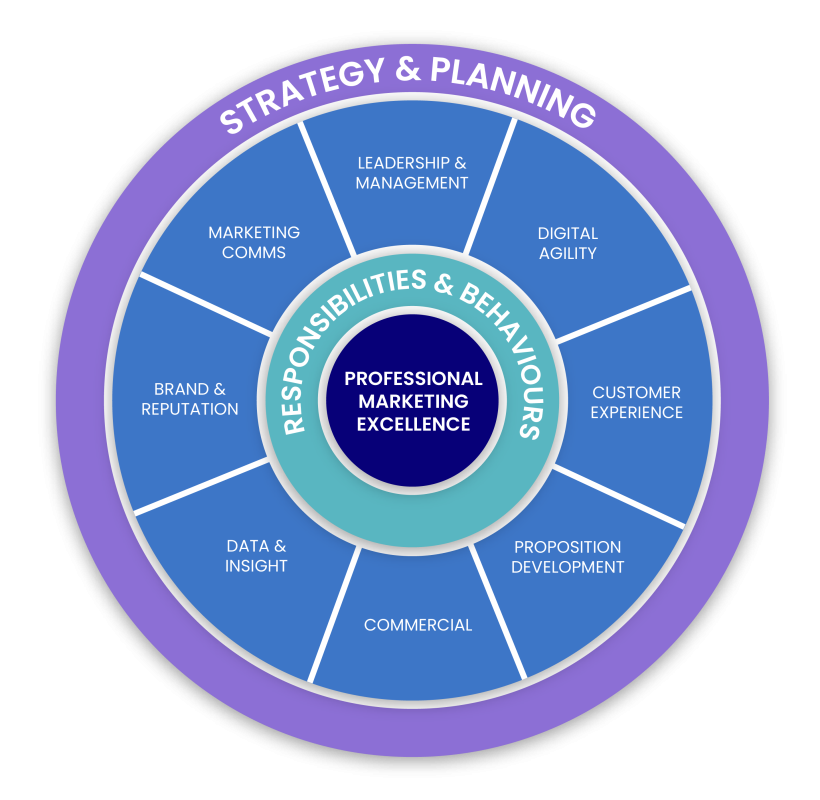
Despite the rapid emergence of AI, foundational marketing skills remain essential. Key areas within CIM’s Global Professional Marketing Framework (GPMF), including customer experience, marketing communications and proposition development, continue to underpin effective marketing practice.
Delivering first-class customer experiences increasingly requires a blend of data-driven personalisation and strong communication skills. Authentic communication remains deeply human, and this authenticity could become a major differentiator as AI-generated content risks creating a growing ‘sea of sameness’ across brands.
Proposition development, another core competency of the GPMF, is equally important. Businesses that clearly understand customer needs and align their products and services with those requirements are better positioned to strengthen loyalty, drive revenue and build long-term trust.
Ultimately, the marketers who stand out in 2026 will be those who combine AI literacy with strong core capabilities to create a hybrid skillset, which is becoming a must-have as AI continues to transform the sector.
The power of mentoring and practical experience
Reaching out to a mentor can also be extremely valuable in the early stages of someone’s marketing journey, as they can offer guidance, share experiences and act as a sounding board, equipping junior marketers with the knowledge and confidence to maximise their chances of securing their first professional role.
Those keen to stand out should also look to apply the skills they have learnt in practical settings, using these opportunities to build a portfolio of work that demonstrates initiative.
Aspiring marketers should think of their portfolio as a snapshot of their journey rather than a finished product. It should reflect their interests, strengths, curiosity and, importantly, their ability to apply skills they have learnt.
In an increasingly competitive market, employers are not only looking for theoretical knowledge gained from university lectures, though professional certification like CIM qualifications are important to unlocking opportunities. Evidence that candidates can apply their understanding to real-world challenges, collaborate effectively and think strategically is also vital, making a portfolio and practical experience a vitally important part of a junior marketer’s toolkit.
A helping hand to gain practical experience
At CIM, we have seen students grow through their participation in The Pitch, CIM’s annual global competition, which tasks undergraduate and postgraduate university students with responding to a real-life marketing brief.
Experiences like these, and being part of communities like CIM’s The Marketing Club, help students develop their confidence and problem-solving skills, while also giving them examples of work they can include in their portfolios and present to future employers.
If businesses do reduce entry-level hiring as AI adoption increases, practical experience could become one of the clearest differentiators between candidates.
Staying ahead of the curve
At the same time, the rapid pace of change in the sector means learning cannot stop after graduating from university or completing an apprenticeship. Continued professional development is a must.
Aspiring marketers, alongside those already thriving in the sector, will need to continually refresh their skills, embrace emerging technologies and remain willing to adapt as business requirements evolve.
Employers increasingly value professionals who are proactive about staying current, adapting to change and developing future-ready capabilities. Those who combine technical understanding with practical application and a willingness to learn will be best placed to succeed.
By Maggie Jones, Director of Qualifications and Partnerships at CIM
Responses