
Young People, Work, and the Risk of Solving the Wrong Problem


It’s been a couple of weeks since the Milburn report was published, and I like everyone have been digesting the report and the analysis. Like a well-trained student, I went straight to the closing paragraph to read the conclusion, and I confess I was not prepared for it to hit me so squarely in the chest.
The report does not attempt to soften the picture, and on that basis, I have a glimmer of hope and anticipation for what may come next.
I hope this signals the step change we need, a move away from near constant reform, from a layering of initiatives, all done with good intentions because fundamentally if the system stays the same so do ways of operating. When participation is the headline measure, we focus on quicker routes, shorter programmes, more flexible entry points. But this is a multifaceted challenge, we keep moving young people around the system but with little forward momentum.
The report sets out, plainly, the volume of young people who are disconnected from the concept of work and the long-lasting consequences of that. The “persistent scarring effects” that early experiences of disengagement can have on employment and earnings. This is not a marginal issue or a short-term fluctuation – it is a structural challenge with deep implications for individuals, employers and the wider economy. I welcome the candour.
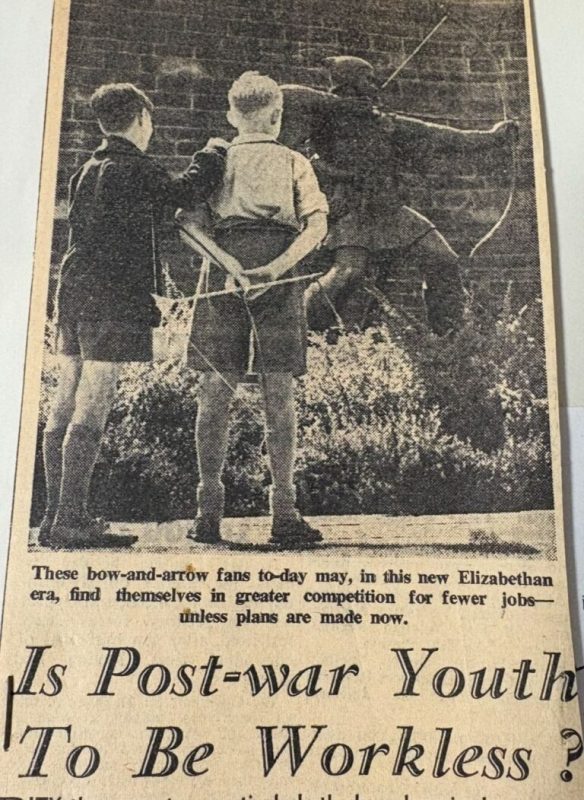
This is also where our own heritage at Skills and Education Group gives me pause for thought. Last year, as part of our work for Heritage Open Days 2025, our team discovered an article from 1958 in our archive asking a question that feels uncomfortably familiar today: “Is Post-war Youth To Be Workless?”
The language belongs to another era, but the sentiment does not. The article warned of “more and more children” becoming available for “fewer and fewer jobs” and asked whether the country could afford to lose young people’s “enthusiastic but, as yet, untrained ability”. It spoke about the danger of killing young people’s keenness before it could be channelled into something constructive, and it called for government, education and employers to think seriously about training, apprenticeships and purpose.
More than six decades later, the context has changed, but the central challenge has not disappeared. The report frames both a participation challenge and a productivity one. When young people fail to connect to the labour market early, the impact is felt not only in individual lives, but in local economies already struggling to drive growth.
How do we make sure young people do not simply enter a system, but find a route through it? How do we ensure that ability, confidence and aspiration are not lost because the right structures, support and opportunities are missing?
As an awarding organisation with a long history in skills, education and vocational learning, these are challenges we have helped the sector navigate before. That history does not give us all the answers, but it does remind us that moments like this require more than another initiative. They require honesty, coordination and a serious commitment to building routes that young people, employers and communities can trust.
Too often, the system has tried to widen participation and been perceived as softening expectations. If we’re serious about changing outcomes for young people, then policy needs to move beyond simply getting more individuals into the system and focus much more deliberately on what happens inside the system and, of course, after.
We need to create the space to think on twin tracks, yes, employer-led qualifications, but also unitisation, stackability, character and skills development. A holistic approach. From an awarding perspective, we can provide the frameworks and guard rails – competence isn’t abstract, it is visible, measurable, and, at times, safety critical. Employers need confidence that when someone is deemed “ready”, it genuinely means something , yet at the same time, we need those with the furthest to travel to have the opportunity to build skills incrementally. We must be realistic about the wider barriers many young people face, from transport and wellbeing to confidence and stability. Skills policy cannot solve those alone, but it must be designed with them in mind.
So, what now for the assessment as we try to predict the future system… There is a growing narrative that assessment itself is part of the problem something to be simplified or reduced to remove barriers. I would challenge that high-quality assessment is not an obstacle; it is one of the few things in the system that anchors trust. It provides a shared, reliable signal of competence particularly for those young people who don’t have networks or experience to fall back on. If we dilute that, we do not level the playing field, we tilt it further.
Our role is to reduce friction by creating assessment approaches that widen access, particularly for young people balancing work, caring responsibilities, health conditions or confidence barriers. Digitisation, flexibility, and innovation that strengthen assurance. This is what we will be getting on with whilst we await the next steps.
By Emma Beal, CEO, Skills and Education Group
Responses