
AI Readiness Can’t Be Taught in a Classroom Alone: Why Universities and Industry Need to Build It Together

Universities are facing a difficult timing problem. The technologies students will use in their careers are evolving faster than academic institutions can update curricula, retrain educators and redesign the way students learn. Artificial intelligence has made this gap particularly visible. Students are already using AI in their studies, employers are redesigning workflows around it, and the skills required in many professions are changing, while higher education often operates on academic cycles that move much more slowly than technology.
The question is no longer whether universities should teach AI, but how they can prepare graduates for a professional environment in which AI will continue to evolve long after they leave campus. Simply adding more AI courses risks missing the larger issue. Universities cannot predict which tools will dominate five years from now, but they can help students develop the ability to work with new technologies critically, make sound decisions when the technology is uncertain and continue learning as professional practice changes.
This is where the distinction between AI literacy and AI readiness becomes important. AI literacy means understanding what AI can do, where it can fail and how it should be used responsibly. AI readiness goes further. It means being able to apply that knowledge in a real professional setting: framing problems, evaluating AI-generated outputs, identifying risks, exercising professional judgment, collaborating with AI and people, and adapting when the tools themselves change. The objective is not to produce graduates who are experts in today’s AI products, but people who can remain effective as those products evolve.
The workplace is moving faster than the curriculum
The pressure to make that shift is already visible in industry. Research from MIT Technology Review Insights, conducted in partnership with SoftServe and based on a survey of 300 senior technology leaders across six countries, found that 51% of respondents were already using agentic AI, while another 45% expected to implement it within 6–12 months. By 2029, 84% expect agentic AI to become one of their organizations’ primary technology priorities. The findings are detailed in the Redefining the Future of Software Engineering report.
The implications go well beyond adopting another set of software tools. As AI takes on more routine technical work, skills such as defining the right problem, translating business needs into technical requirements, evaluating outputs, challenging assumptions and taking responsibility for decisions become increasingly important. For universities, this creates a difficult challenge: they are preparing students for professions whose underlying workflows may change substantially between the beginning and end of a degree program.
That does not mean universities should try to chase every technological development. It means they need a stronger connection with the environments where those changes are happening. Industry can provide a view of how professional roles are evolving, while universities can turn that insight into durable knowledge and learning experiences. The challenge is to make that exchange continuous rather than something that happens through an occasional guest lecture, career fair or internship.
AI literacy is only the starting point
The scale of the gap inside higher education is becoming clearer. The Digital Education Council’s AI in Higher Education Global Survey 2026, based on 45,398 responses from 118 institutions across 35 countries, found that only 15% of students said AI was integrated into many of their courses. Forty-three percent encountered AI in only a few courses, while another 43% reported no AI integration in their courses.
These numbers do not necessarily mean universities are ignoring AI. Many institutions are experimenting with new tools, developing policies and launching individual initiatives. The more difficult challenge is turning those experiments into something integrated across teaching, assessment, faculty development and institutional practice. The Digital Education Council’s Beyond the Pilot: A Higher Education AI Roadmap and Action Guide focuses on this transition from individual experiments toward broader institutional adoption and continuous adaptation.
That distinction matters because AI readiness cannot be measured simply by asking whether a student has used an AI tool. A student may know how to formulate a sophisticated prompt and still struggle to determine whether the resulting answer is reliable. Another may be comfortable using generative AI but lack the disciplinary knowledge needed to recognize when its recommendation is flawed. The ability to use AI effectively depends on the knowledge, judgment and context surrounding the technology.
For universities, this means AI should increasingly be treated as part of how students learn within their disciplines rather than as a subject that sits separately from them. An engineering student needs to understand how AI affects engineering practice; a business student needs to understand how AI changes decision-making and organizational processes; and a future educator needs to understand both the opportunities and limitations of AI in the classroom. The technology may differ, but the underlying capability is the same: knowing how to work with AI without surrendering professional judgment to it.
Universities and industry need each other
Building that capability is difficult for either side to do alone. Universities provide the foundations that industry cannot easily replicate: disciplinary knowledge, research, critical thinking and an environment in which students can explore ideas before applying them professionally. Industry, meanwhile, sees how technologies are actually being used, which skills are becoming more valuable and where graduates still struggle when they enter the workplace.
Bringing those perspectives together can create a more responsive learning environment. Industry can help universities identify emerging skills and provide real problems for students to work on. Educators can translate those experiences into structured learning and help students understand not only how a technology works, but when and why it should be used. Students can then test their knowledge through projects, mentoring, research and work experience, creating feedback that can inform the next iteration of the curriculum.
This is particularly important in AI because the distance between academic knowledge and professional practice can grow quickly. A curriculum may take years to change, while an organization can adopt a new AI-enabled workflow within months. Strong university-industry partnerships can help narrow that gap by creating a continuous exchange between the two environments.
What this looks like in practice
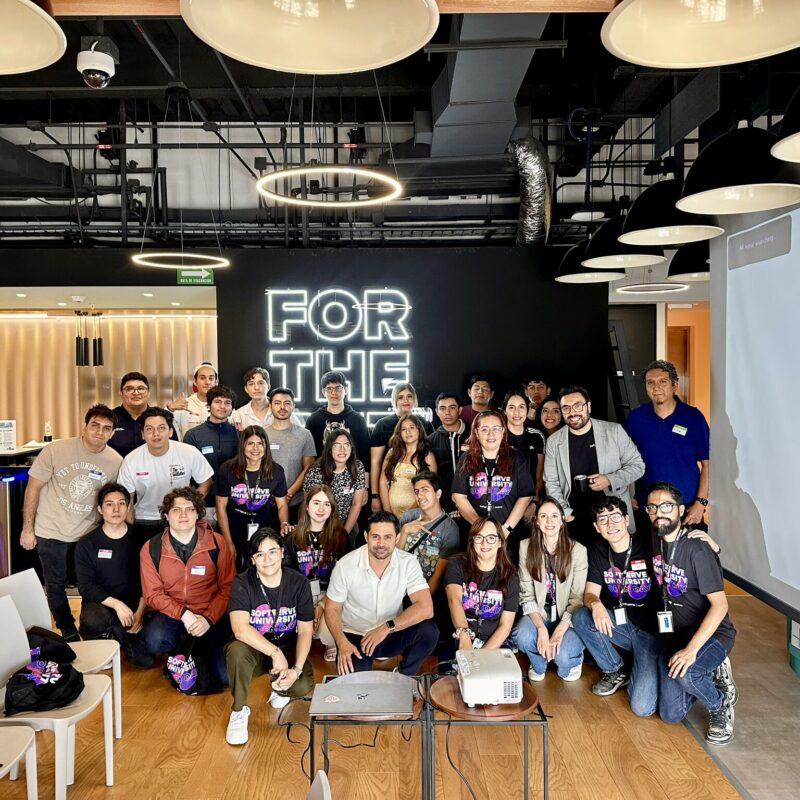
SoftServe’s work with universities provides one example of how such an ecosystem can operate at scale. Its university partnership ecosystem spans 97 universities across seven countries and brings together students, educators and academic programs through different forms of collaboration. Rather than treating AI as a standalone subject or a one-off educational event, the approach connects educator development, curriculum updates, practical learning, industry mentoring, dual education, research and innovation, and career pathways.
The underlying principle is that each part of the system should strengthen the others. Educators need opportunities to understand and experiment with new technologies before they can confidently integrate them into teaching. Curricula need regular input from industry so students are developing skills that remain relevant beyond the classroom. Students need opportunities to apply those skills to realistic problems, while industry professionals can provide the context and feedback that academic assignments often cannot.
Dual education makes that connection particularly tangible. Sixteen partner universities across Ukraine, Bulgaria, Poland and Colombia are implementing dual education across 50 IT curricula, allowing students to combine academic learning with hands-on industry experience. For students, this creates an opportunity to test their knowledge in a professional environment before graduation and understand how their skills translate into actual work. For universities, it provides a direct feedback mechanism that can inform how programs evolve.
The broader ecosystem has engaged 29,883 students in educational activities and built a global community of more than 8,800 technology educators, while supporting updates to 86 academic programs. These figures demonstrate the scale of the work, but scale is not the most important measure. What matters is whether the connections between educators, curricula, students and industry create a system that can keep adapting.
Building for a future we cannot predict
Universities do not need to predict exactly which AI tools their graduates will use. They need to create the conditions that allow educators to keep learning, curricula to evolve and students to develop the judgment and adaptability required to work in an environment that will continue to change.
Industry also has a role beyond recruiting graduates. Companies can contribute technology expertise, real-world challenges, mentors and insight into how professional roles are evolving. In return, they gain a closer connection to the academic environment and a better understanding of how future talent is being developed.
AI readiness therefore sits between these two worlds. It is built through an ongoing exchange of knowledge, experience and feedback rather than through a single course or initiative. The universities best prepared for an AI-shaped future may not be those that offer the largest number of AI subjects, but those that have created the strongest mechanisms for learning between academia and the world of work.
The specific tools will change. The ability to understand a new technology, question its outputs, apply it thoughtfully and keep learning when the rules change is much more likely to endure. That is the kind of AI readiness universities and industry should be building together.
By Andriy Pereymybida, Talent Acceleration Center Director at SoftServe and Mariia Rashkevych, Global University Alliances Manager at SoftServe
Responses