
August ONS: NEETs Rise to 948k, But Female Inactivity Increases

New ONS data published this morning reveals that the number of young people not in employment, education, or training (NEETs) has risen again. The total is currently estimated at 948,000, up from 923,000 in January to March 2025. This represents 12.8% of all 16–24-year-olds, an increase of 0.3 percentage points on the quarter.
The increase was driven primarily by young women, with female NEETs rising by 25,000, while the number of young men NEET fell slightly by 1,000. Overall, 497,000 young men and 450,000 young women are currently NEET.
Among 18–24-year-olds specifically, the NEET rate now stands at 15.0%, also up 0.3 percentage points compared with the previous quarter.
Interestingly, the ONS NEET figures were released on the same day as GCSE Results Day with Level 1 and 2 results announced today!
Youth Participation Pressures
The gender divide in NEET trends is stark. While male unemployment decreased slightly, the overall rise was fuelled by higher female inactivity, which is becoming an increasingly significant structural challenge.
This shift suggests more young women are disengaging from both education and the labour market, a trend with long-term consequences for workforce participation, social mobility, and the skills pipeline.
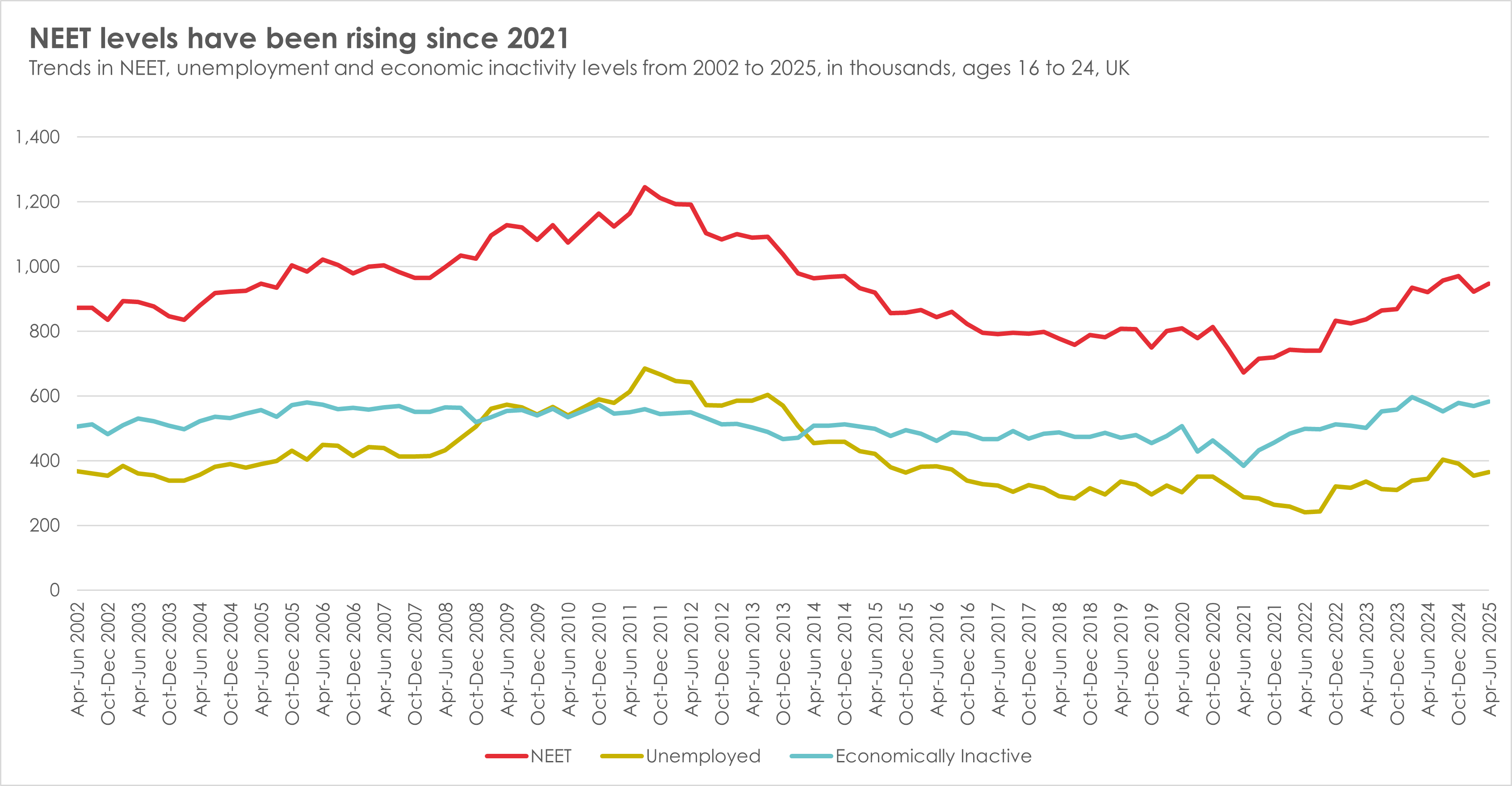
Graph supplied by Youth Futures Foundation
Unemployment and Inactivity Split
The NEET population remains split between unemployment and inactivity, but the latest quarter shows contrasting gender dynamics:
- 365,000 unemployed NEETs (up 10,000 on the quarter).
- Men: 224,000 (down 5,000).
- Women: 140,000 (up 15,000).
- 583,000 economically inactive NEETs (up 14,000 on the quarter).
- Men: 273,000 (up 4,000).
- Women: 310,000 (up 10,000).
While unemployment among young men eased, the rise in female inactivity accounts for the bulk of the overall increase. This divergence highlights that structural barriers, such as childcare, affordability, or progression opportunities, may be disproportionately affecting women.
Strategic Implications for FE and Skills
For senior leaders in the FE and skills sector, the data underline three immediate priorities:
Closing the Participation Gap: The rise in female inactivity raises questions around access and engagement. Tailored outreach and flexible provision will be essential to re-engage young women at risk of long-term disengagement.
Workforce Readiness: With youth unemployment still elevated and entry-level opportunities constrained, providers face growing pressure to deliver employability-focused outcomes, bridging the gap between qualifications and work.
Policy Leverage: With the next NEET release due in November and the autumn budget cycle approaching, this quarter represents a crucial window for FE and skills leaders to influence youth employment and participation policy.
Policy and Data Considerations
The ONS cautions that Labour Force Survey (LFS) estimates remain subject to volatility due to methodological changes and reduced response rates. For this reason, labour market statistics based on the LFS are currently classified as official statistics in development.
Nevertheless, the consistency of the NEET rise across both unemployment and inactivity suggests a genuine trend requiring immediate strategic attention from FE and skills leaders.
Sector Reaction
Jacqueline Hall, Head of Apprenticeships and Skills at BAE Systems, said:
“The latest ONS data is an important reminder that young people are experiencing exceptionally challenging conditions as they take the first steps in their careers. As thousands of young people across the UK receive their GCSE results today, an onus remains on employers to help promote social mobility and create pathways into long-term employment.
“Initiatives like Movement to Work, which has helped BAE Systems facilitate over 950 completed work placements with more than 600 of them achieving employment with us or other companies, show the potential for employers to make a positive impact on young people. We must remain committed to furthering these efforts, considering wider labour market contractions.
“Apprenticeships continue to play a key role in driving positive change, especially for those furthest from the job market. As the workforce continues to face challenges such as new technologies and economic headwinds, increasing the variety of opportunities available will prove invaluable over the long term – for businesses and young people alike.”
Barry Fletcher, Chief Executive, at Youth Futures Foundation, commented:
“The latest data from the Office for National Statistics reveals that 948,000 young people were not in education, employment or training (NEET) between April and June 2025, equivalent to 12.8%, or approximately one in eight young people. This represents the sixth consecutive quarter that the number has remained higher than 900,000, demonstrating the persistent nature of the issue.
“Today many young people will be receiving their GCSE and Level 1 and 2 vocational qualifications results and for most, this will be an important milestone that helps them on their way to further study, apprenticeships, or work. However, we must recognise that unfortunately a sizeable number of young people will be leaving secondary education without any qualifications; and in light of the critical NEET challenge we continue to face, this must be a group we give extra attention and purposeful support to because the evidence tells us they are at much greater risk of not progressing to good work.
“Last year, the Prime Minister called for youth unemployment to be eradicated, but these figures reiterate the long-term and stubborn nature of the problem. With the Autumn budget approaching, achieving this ambition will require a concerted effort pulling on skills, education, labour market and youth policy levers to deliver a system that provides clear pathways and opportunities for all young people.
“Not only is this a moral imperative, but there is also a strong economic case: by matching the lowest NEET rate in the OECD, the Netherlands, we would ensure approximately 500,000 more young people can achieve good jobs, boosting our economy by £69bn.”
Jeanette Wheeler, Chief People Officer at HR, payroll and finance provider, MHR:
“Today marks two milestones for young people: GCSE results day, and new ONS figures showing a rise in the number of 16- to 24-year-olds not in education, employment or training (NEET). Between April and June 2025, an estimated 948,000 young people were classed as NEET – 12.8% of this age group, up from 923,000 earlier in the year.
“Alongside these figures, much has been said about how AI is reshaping entry-level opportunities. The latest NEET rise is a stark reminder the onus is on business leaders to widen, not narrow, employment routes for young people. The skills needed to enter the workplace are evolving rapidly, but let’s not forget the students receiving their results today will be the ones leading the charge in shaping how businesses adopt and use AI in the years to come.
“Against this backdrop, ambition risks being stifled before many young people have even had a chance to open their results envelopes. Employers cannot afford to alienate younger generations from the workplace. They must now design entry-level positions that channel strengths and curiosity around AI from the start, or we can only expect to see NEET levels continue to rise over the coming months and years.”
Responding to the latest NEET data release, Elizabeth Gerard, Deputy Director of Learning and Work Institute (L&W), said:
“The latest release by the Office for National Statistics shows yet another increase in the number of young people who were not in education, employment or training (NEET) in the UK to 948,000, 12.8% of the population aged 16-24.
“This continued rise is especially concerning on results day, when many young people are receiving their GCSE and Level 1 and 2 vocational qualifications results. At a time when young people are thinking about their next steps, too many are at risk of being left behind, with long-term consequences for their futures.
“While the Government has made a commitment to address youth participation in employment through the Youth Guarantee and Trailblazers, more is needed. We’re calling on the Government to be ambitious in its offer for young people: to reduce the NEET rate to 10% and ensure no young person who is able to engage with work or training is NEET for more than a year. This means providing tailored support for all 16-24 year olds, delivered through accessible, joined-up services in communities across the country.”
Responses