
November 2025 ONS: NEETs Drop to 946k as Gender Dynamics Reverse

- 946,000 young people currently classified as NEET, down from 948,000 last quarter
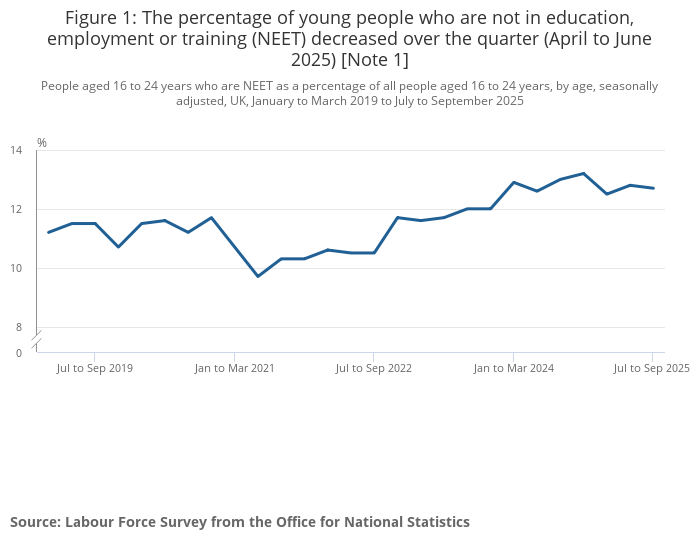
- 12.7% NEET rate, down 0.1 percentage points on quarter, down 0.5 points year-on-year
- Gender reversal emerges, young men up 15,000 on quarter, young women down 16,000
- Male NEET rate at 13.4% compared to 11.9% for women
- 18-24 age group at 15.1%, 880,000 young adults NEET
- Male unemployment rising, up 14,000 on quarter to 238,000
NEET Numbers Edge Down to 946,000
The latest figures released today by the Office for National Statistics (ONS) show 946,000 young people aged 16-24 were not in education, employment, or training (NEET) in July to September 2025, down from 948,000 in April to June 2025. This represents 12.7% of all young people, down 0.1 percentage points on the quarter and 0.5 percentage points year-on-year from 13.2%.
Notably, the absolute number of 946,000 matches the figure from the same period a year ago (July to September 2024), though the improved rate reflects changes in the overall youth population.
Gender Gap Narrows
The data shows a reversal of recent gender patterns. Young men increased by 15,000 on the quarter to reach 512,000 (13.4%), while young women decreased by 16,000 to 434,000 (11.9%). The male NEET rate rose 0.3 percentage points on the quarter, while the female rate fell 0.5 percentage points.
Year-on-year comparisons reveal significant opposing movements. Young men NEET have decreased by 38,000 from 550,000 in July-September 2024, while young women NEET have increased by 37,000 from 397,000. This marks a substantial narrowing of the gender gap compared to a year ago, when the male NEET rate stood at 15.1% compared to 11.2% for women.
Young Adults Hit Hardest
The 18-24 age group continues to show higher NEET rates, with 880,000 individuals (15.1%) in this category. This is up 7,000 on the previous quarter and represents a 0.1 percentage point increase, though it remains 0.3 percentage points lower than the same period last year.
Breaking Down the Numbers
The NEET population comprises two groups:
Unemployed NEETs: 366,000 (up 1,000 on the quarter, down 38,000 on the year)
- Young men: 238,000 (up 14,000 on quarter)
- Young women: 128,000 (down 12,000 on quarter)
The number of young men NEET who were unemployed increased by 14,000 from April to June 2025, while young women unemployed NEET decreased by 12,000 on the quarter.
Economically Inactive NEETs: 580,000 (down 3,000 on the quarter, up 28,000 on the year)
- Young men: 274,000 (up 1,000 on quarter)
- Young women: 306,000 (down 4,000 on quarter)
Economic inactivity among young women NEET decreased by 4,000 on the quarter, while young men aged 16 to 24 who were NEET and economically inactive increased by 1,000.
Economic Inactivity: A Growing Concern
The year-on-year increase of 28,000 economically inactive NEETs indicates a growing number of young people disconnected from both the education system and the labour market. This contrasts with the 38,000 decrease in unemployed NEETs over the same period.
Data Quality and Context
The ONS notes that Labour Force Survey (LFS) estimates remain subject to increased volatility due to smaller achieved sample sizes. Estimates from January to March 2025 include the full effect of improvements in LFS data collection and sampling methods introduced from January 2024; however, estimates may be subject to the effect of further ongoing improvements.
An increased amount of volatility will remain in the estimates from mid-2023 and throughout 2024, so caution is advised when interpreting change involving those periods. LFS-based labour market statistics will continue to be badged as official statistics in development until further review.
The ONS recommends using NEET statistics alongside other labour market indicators such as Workforce Jobs (WFJ), Claimant Count data, and Pay As You Earn (PAYE) Real Time Information estimates.
Looking Ahead
The next update on NEET statistics is scheduled for February 26, 2026, when there will be better indication of whether the gender trends observed represent a longer-term pattern or statistical fluctuation.
The current data shows that while there has been a marginal decrease from 948,000 to 946,000, nearly one million young people remain disconnected from education and employment, highlighting the need for targeted interventions to support youth participation and labour market transition.
Broader Implications
The data raises questions about the different barriers facing young men and women in accessing education and employment. The quarterly rise in male unemployment alongside year-on-year increases in overall economic inactivity suggests complex challenges requiring targeted policy responses.
For the FE and skills sector, the figures emphasize the importance of provision that addresses the distinct challenges facing young men and women as they transition from education to employment.
Work and Pensions Secretary, Pat McFadden, said:
“The number of young people not in education, employment or training (NEET) has been far too high for too long, which is why we are tackling this crisis of opportunity with new energy and determination.
“Our Youth Guarantee will ensure 18-to-21-year-olds have access to education, training, an apprenticeship – or ultimately guaranteed paid work if they cannot find a job.
“And I have commissioned former Health Secretary Alan Milburn to identify how we can go further to tackle the root causes of youth activity by improving employment support, skills, health and welfare.
“We will leave no stone unturned so every young person has the chance to succeed, no matter where they are from or what their background is.”
Sector Reaction
Stephen Evans, chief executive at Learning and Work Institute (L&W), said:
“The number of young people not in education, employment or training remains worryingly high at 946,000. Each one represents a risk of lost potential so it’s urgent the Government ramps up its efforts to tackle this. Only one in four young people who are NEET is currently getting help from Jobcentre Plus to find work and youth apprenticeships are low by international standards. The Chancellor’s Budget needs to speed up the roll out of a Youth Guarantee across England so all young people have good education and employment opportunities.”
Rebecca Florisson, Principal Analyst, Work Foundation at Lancaster University, said:
“Today’s data shows that the number of young people aged 16-24 not in education, employment, or training remains stubbornly close to one million. With unemployment across the labour market rising and vacancies having declined over the last 12 months, there is a serious risk more young people will slip into long-term worklessness without further Government intervention.
“The UK has had a significant population of NEETs for over 20 years, but the challenge has evolved with fewer of these young people actively looking for work. Currently, 61.3% of NEETs are in economic inactivity – not actively looking for work or studying – but this is far higher for young women (70.4% vs 53.6% men).
“In addition, recent DWP data indicates nearly half of young people not in employment, education or training are now classed as disabled (45.8%) – a rise of 24.3 percentage points since 2013/14. This could have significant implications for the earnings of young people, with the Keep Britain Working Review estimating a 22-year-old who falls out of work for health reasons could be more than £1 million worse off over the course of their lifetime.
“The Government’s Youth Guarantee has the potential to help address these issues, but only if additional support kicks in earlier than the 18 months currently proposed – evidence shows that the longer you spend out of work, the harder it is to return. The Guarantee must also be aligned with improved access to health support for young people, especially relating to mental health, and ensure the jobs on offer are secure, with fair pay and routes to progression.”
Barry Fletcher, CEO at the Youth Futures Foundation said:
“Today’s figures confirm that the number of young people not in education, employment or training remains stubbornly high, with no real shift from previous quarters. This is a long-term problem that continues to negatively shape the lives of too many across the country.
“One in eight are still out of work or learning. Over a third of unemployed young people have been looking for work for over six months. Without decisive action, we risk pushing even more young people further from the labour market and heightening the risk of long-term unemployment.
“We welcome the government’s commitment and action in tackling the challenge, with the Youth Guarantee and post-16 education and skills white paper. Given the scale of the challenge we know more will need to be done to build on these initial steps, to create lasting change that benefits both young people and the wider economy.”
Joe Shalam, Policy Director at the CSJ, said:
“Every single young person outside of mainstream work or training risks becoming a tragedy of wasted potential. The utter dysfunction in the labour market is holding back our economy.
“The Government needs to get on with reforming mental health benefits to expand NHS care and cutting the cost of employing youngsters left on the scrapheap. The Budget must set out a radical response to tackle the crisis facing British young people.”
James Toop, CEO of Teach First, said:
“Today’s figures show that nearly one million young people are not in education, employment or training. It means futures grinding to a halt, with young people from low-income communities hardest hit, not because of a lack of talent but a lack of opportunity.
“With one of the most anticipated Budgets in years just a week away, the Government has a real chance to turn this around. There can be no growth without supporting the next generation: helping young people stay in education, achieve and move into meaningful careers. That’s why any new education investment must be directed towards the communities and schools with the greatest need – where it can make the greatest difference.”
TUC General Secretary Paul Nowak said:
“These figures are a stark reminder of the toxic Tory legacy this government inherited.
“Under the Conservatives, young people were badly let down with hundreds of thousands of young people stuck out of work, education or training.
“This has damaging consequences for young people’s prospects – and for the country as a whole too.
“With the youth guarantee, stronger employment rights, an industrial strategy and apprenticeship reforms, the government has made a positive start in turning this around.
“It’s now vital this translates to a comprehensive, coordinated plan to ensure all young people across the country can access high-quality training and decent, well-paid work as well as timely and effective healthcare.
“That means a jobs guarantee which is ambitious in scale and scope and reaches young people furthest from the labour market – as well as further apprenticeship reforms to improve access and completion rates.”
Susannah Hardyman MBE, CEO of Impetus, said:
“946,000 young people neither earning nor learning is an indefensible figure, costing the UK billions in GDP and even more in lost potential. While we cannot replace what young people lost during Covid, the upcoming budget offers an opportunity to stop the damage from following them for life.
The Government’s Youth Guarantee, providing NEET young people a paid work placement, is a critical step. But to fulfil its promise, it must go further and faster, delivering wraparound support and early intervention. For those facing the highest barriers, the guarantee should offer young people comprehensive support and skills training to help them not only to find a job but to keep it. Likewise, support must be offered at the earliest opportunity, starting in school. By waiting until a young person leaves school unemployed – and certainly by waiting another 18 months for them to qualify for the Guarantee – we’ve missed our best chance to prevent those outcomes.
To make real progress, Government needs a cohesive strategy aligning education and employment policy, targeting the precise barriers young people face. But this requires real commitment and investment from the Treasury. With £20bn lost in GDP, tackling the NEET crisis has become an economic imperative for growth.”
Dan Mayhew, Director of Community and Partnerships, Kingfisher Schools Trust:
“In East Suffolk, the reality is many young people have been left behind because the pathways out of unemployment or inactivity haven’t been visible or accessible to them. In fact, the East of England continues to have a higher-than-average proportion of young people who are NEET compared to the national average.
“However, we are seeing first-hand that large infrastructure, done right, can be a driver of long-term change, develop skills, open up new careers, and create lasting opportunities for young people who have too often been overlooked. The development of Sizewell C has offered our region a once‑in‑a‑generation chance to change its direction. This is the level of ambition needed, not just in energy but in transport, housing, and other industries too. Collectively, we need to show young people that they do not have to leave their hometowns to find a well-paid highly-skilled job.”
Jeanette Wheeler, Chief People Officer at MHR said:
“Today’s ONS figures show an estimated 12.7% of 16 – 24-year-olds in the UK were not in education, employment or training (NEET) in July – September of 2025. That equates to 946,000 young people NEET, a small quarterly fall of 1,000.
“These numbers underline a familiar but urgent challenge – while movement is in the right direction, too many young people remain disconnected from routes into work or learning. However, there’s an opportunity for businesses, and an untapped pool of talent with exactly the digital-first, future-ready skills needed. As AI evolves and reshapes the workplace, the businesses that succeed will be the ones who act on that opportunity. Employers should design entry-level roles, apprenticeships and internships that deliberately channel curiosity about AI into on-the-job learning and take advantage of the new skills young professionals can bring to the workplace.
“The upcoming Budget presents a real chance to scale incentives for employer-led training, apprenticeships and digital reskilling, but policymakers and businesses must act together. Targeted government funding and smart employer investment dedicated to young people could turn today’s modest falls into sustained progress, and prevent a generation being left behind.”
Responses