
Empowering families affected by Fetal Alcohol Spectrum Disorder

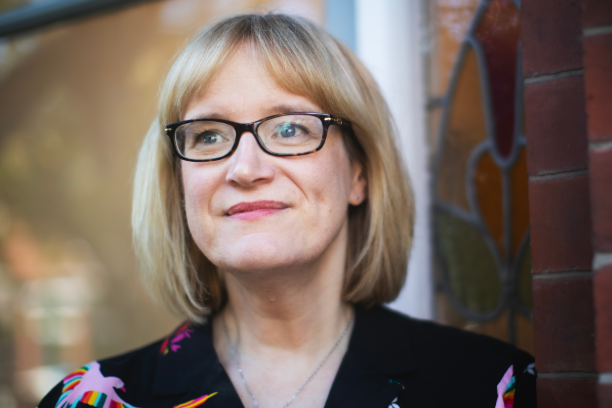
Fetal Alcohol Spectrum Disorder (FASD) is thought to affect thousands of children across the UK, yet it remains widely under-recognised and poorly understood. Anna Webster, from south Manchester, is helping to change that.
Alongside academics at the University of Salford, she is helping to shape pioneering research around the condition. Drawing on her experience of caring for her adopted son with FASD, Anna is working together with our academics to improve awareness and support for families affected by what is often described as a hidden condition.
Anna features in the University’s Heart of the Community exhibition – a series of portraits of people in the community who have collaborated with our researchers. The exhibition captures the difference that can be made when communities and researchers work together to find solutions to some of the world’s most pressing problems.
Fetal Alcohol Spectrum Disorder (FASD) is a common neurodevelopmental disorder caused by prenatal exposure to alcohol. The UK has one of the highest estimated rates of FASD in the world, however it is often missed or misdiagnosed, leaving people with FASD and their families with insufficient support and access to services.
University of Salford is conducting vital research alongside clinicians, researchers and the community to understand various aspects of the cause and impacts of FASD, developing interventions and support to improve lives, help to raise public awareness and provide training for professionals.
In 2019, Anna Webster from south Manchester heard about the University’s research and met Professor Penny Cook and Dr Alan Price for a coffee to talk about their work and how she might be able to get involved.
Anna went on to support the research team in a multitude of ways, using her experience of caring for her adopted son with FASD. She joined a project funded by the Greater Manchester Integrated Care Partnership to establish the prevalence of FASD in Greater Manchester.
The research showed that around 3 to 4 per cent of children in mainstream schools in Greater Manchester may have FASD and this is likely to be similar across the rest of the UK.
Anna explains:
“Fetal Alcohol Spectrum Disorder is a hidden epidemic; it’s so hidden and so common. In reality, it’s actually expected to be quite a bit higher than 3 to 4 per cent. It means it’s more common than autism, which is often estimated at 1 to 2 per cent.
“That’s why the team at Salford are so amazing in doing this research, it is so needed. I know I’m saying all the cheesy phrases, but it genuinely is world leading, trail blazing, path breaking – all those things!”
Anna also supported the University of Salford’s development of the parenting intervention SPECIFiC, funded by the Medical Research Council. It was developed following research by the University that showed there is lack of support for families from service providers and often inappropriate services were being offered.
“So the acronym – there is always a joke that Alan is the only one who remembers the acronym – stands for Salford Parents and carers Education Course for Improvements in FASD outcomes In Children.
“It’s a psychoeducation programme for caregivers of children with FASD. It’s seven group workshops looking at the different aspects of how the brain is affected and how families can be prepared for the specific challenges of FASD, including strategies that can help.
“It helps parents to understand the condition, understand their children more, have greater compassion for themselves and the kids, and employ effective tools for managing the condition.”
Anna and her partner adopted their son when he was nine months old and he’s now 13.
“My son was diagnosed with FASD when he was three. It’s been a roller coaster, an epic roller coaster. There’s a lot of sensory issues and a lot of issues with emotional regulation, which means children can have a lot of meltdowns, get very frustrated very easily.
“Change and uncertainty is hugely threatening, which means children behave in really challenging ways. Unless you see all that through the FASD lens, things would be a lot more difficult. It’s even doubtful that our family would still be together if we hadn’t.”
“The University of Salford team – Penny, Alan and the others – are brilliant at putting people with living experience at the forefront and empowering them to help lead the research.”
Salford secured further funding from the National Institute for Health and Care Research and The Oglesby Charitable Trust to test SPECIFiC in a large-scale feasibility trial. In that project, Anna co-wrote the manual for the intervention, and was one of eight facilitators delivering the programme to families – over 120 in total.
“Some of the feedback we’ve received has highlighted just how massively validating and transformative the SPECIFiC programme is – helping people to see things through that different lens, while also enabling them to have more compassion for themselves and their children.
Anna continues to be involved with University of Salford’s research; she joined the team for the European conference on FASD in Madrid and presented on her experiences. Anna is now supporting the team with a bid for further funding for the project.
“I’ve actually changed careers now. Partly inspired by my work with University of Salford, I did a Masters in Psychology and I’ve now got my own business called Neurowise, which is therapeutic coaching and training – on neurodiversity but specialising in FASD.
“I feel like I’ve developed loads on a personal level through my involvement with Salford. They’ve been extremely supportive of my development and have given me so many opportunities.
“I’ve also been able to be at the heart of this amazing, groundbreaking research team, made up of really lovely people on a personal level.
“And being part of a team that may not all have living experience, but still really understand it and are very compassionate towards people with the condition.
“Overall, it’s been such a positive experience working with the team at University of Salford and I’m feeling really hopeful about what we can achieve in the future for families across the country.”
Responses