
English helps rebuild lives amid record global displacement

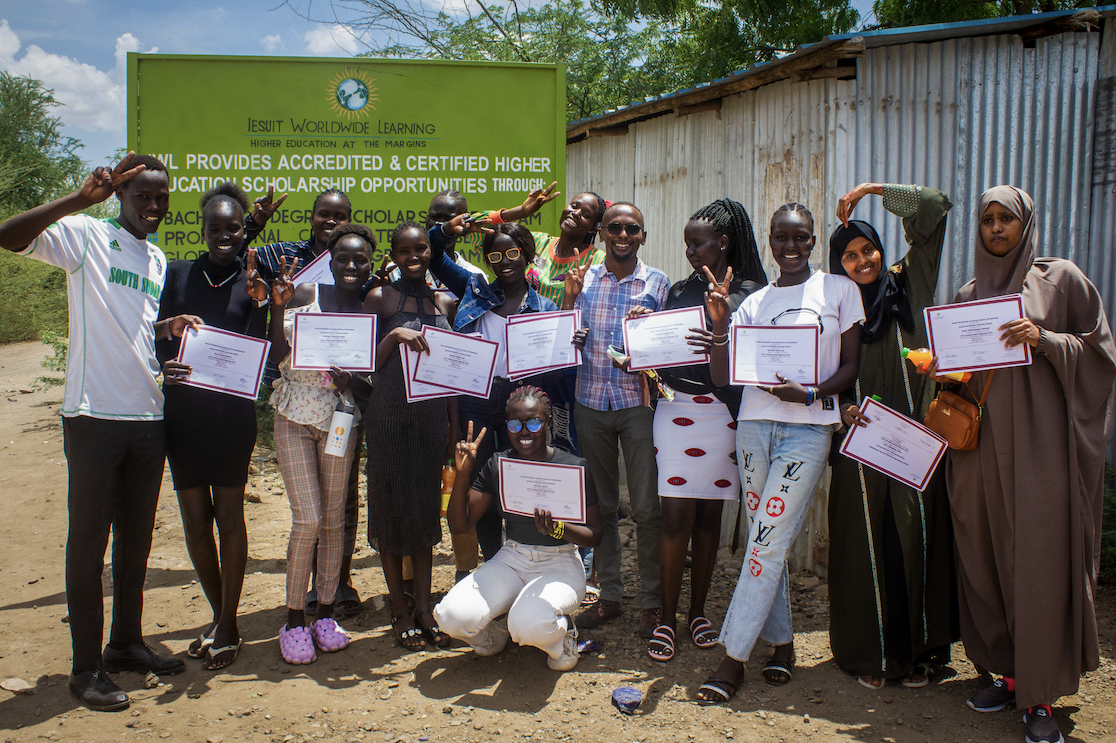
- Over 30,000 displaced and marginalised people learn English
- New five-year impact study discovers surprising benefits
- Majority of learners were women and girls
An English programme taken by thousands of displaced people has helped to improve their lives and prospects, according to a new report published by Cambridge University Press & Assessment.
The report evaluates the Jesuit Worldwide Learning (JWL) Global English Language (GEL) programme between 2019 and 2024, focusing on refugee learners in Kenya and returnee learners in Iraq.
Since its launch in 2017, the GEL programme has reached 32,000 learners across 100 centres in more than 30 countries. Cambridge has supported the programme with teacher training, learning materials and exams, with over 30,000 Cambridge English tests taken to date.
The analysis shows how learning English is helping displaced people rebuild their lives, strengthen communities and create pathways to further study and employment.
This included less obvious benefits, such as providing a common language to help navigate life in camps with diverse populations, and improving access to education for women and girls.
Key findings include:
- Nine in ten students said that learning English had improved their life, with more than half reporting a large positive impact.
- 81% said that learning English had improved the lives of people in their community.
- More than seven in ten learners said courses had helped them improve their employment prospects or professional development.
- 90% of learners said that learning English had increased their confidence to interact with others in English.
- Despite making up 51% of enrolled learners in Kenya, female students were half as likely to complete three GEL courses than male students.
- Based on this finding, JWL is working to expand the GEL programme to girls in high schools and has recruited more female facilitators to improve retention.
The report concludes that English education can be a bridge between displacement and opportunity.
Dr Brigita Séguis, Head of Impact Evaluation at Cambridge University Press & Assessment, said:
“While conducting this research something that stayed with me was the extraordinary lengths people went to, and the risks they took, simply to attend an English class. Participants described walking for hours in extreme heat, hitching rides or trekking through mountains, often at real danger to themselves.
“Despite this, many said they would do it all again because of the opportunities English offers. While basic needs like food, water and safety will always come first, learners also told us that education mattered because it helped them prepare for what comes next.”
The need for education in emergency settings has never been greater, with a sharp rise in the number of people displaced by conflict and instability from around 38 million in 2000 to over 117 million in 2025.
Francesca Woodward, Global Managing Director for English at Cambridge University Press & Assessment, added:
“We are seeing a shocking increase in disruption to education as a result of conflict and instability. Supporting displaced people with their education should be a global priority.
“The resilience and determination of these English language learners in such challenging circumstances is inspirational. Learning English is about far more than language. It is about opportunity, connection, and the ability to shape one’s future. Everyone deserves that opportunity. It is a privilege for Cambridge to support and help in this critical area.”
Susanna Ablewhite, Global English Language Programme Director at Jesuit Worldwide Learning, said:
“In the current global context, strong partnerships are more essential than ever to provide high-quality education for all, not just the privileged few. For displaced learners, and in particular women, JWL’s Global English Language programme is a real lifeline, offering hope and the prospect of a brighter future. We are immensely grateful to Cambridge University Press & Assessment for their vital contribution in amplifying the voices of the excluded and helping to build a more just world.”
Below, a student and a facilitator of the GEL programme in Kenya and a GEL student in Iraq share their experience of how displaced students are rewriting their futures.
Panique’s story: a shared language helps build community in Kenya
The impact of the English programme is visible in refugee camps such as Kakuma in north west Kenya – home to more than 300,000 people from multiple nationalities – where learners use English not only to access education and services, but to help live alongside one another peacefully.
Panique fled conflict and arrived in Kakuma after being separated from his family and loved ones, forced to abandon his college education and traditional village. Language was one of the first barriers he encountered.
“At first it was difficult for me to integrate and communicate in Kakuma,” he said. “We had people from Rwanda, Sudan, South Sudan, Somalia, Ethiopia and many other countries.”
In Kakuma, Panique quickly realised that without a shared language it was harder to resolve misunderstandings, build relationships and even navigate daily life. This echoed findings from the report, in which 90% of learners said learning English increased their confidence to interact with others.
Once enrolled on a GEL course, Panique said the programme’s interactive, student centred approach helped him improve his English – and begin to look to the future again.
“I believe English language can help people to heal and recover from past traumatic events,” he said. “By sharing what somebody went through, people can empathise with and support each other. It can have a huge impact on somebody’s life.”
Learners across the programme echoed this sentiment. Feedback from the report indicates that learning English in group settings supported healing and rebuilding, helped to reduce tensions between ethnic and religious groups, and contributed to peaceful coexistence within camps.
Today, Panique is studying for a Bachelor of Arts in General Studies at Saint Louis University via distance learning, alongside his life in Kakuma. He is also an example of the leadership the GEL programme can facilitate, in his role as community volunteer for the Wings to Fly Initiative, a refugee led organisation supporting education within the camp.
The report also highlights the role English education plays in supporting livelihoods. More than seven in ten learners said GEL courses had improved their employment prospects or professional development, with some going on to work with NGOs or in community leadership roles.
“For me, Kakuma represents a place of struggle, with a lot of pressures, but at the same time it is a place of hope.”
Sarah’s story: removing barriers to education for women and girls
The report also highlights barriers that need to be overcome, particularly for women and girls in Kenya.
Women and girls made up 51% of GEL learners in Kenya between 2019 and 2024, but retention was challenging. In that period, only 5% of female learners completed three or more GEL levels, compared to 12% of male learners.
For Sarah, also living in Kakuma with her two children, the challenges were both practical and cultural.
“When we fled from home, we were running for safety and there was no time to bring things we might need, such as academic certificates,” she said. “This made it harder to find work at first.”
Her experience reflects a common issue identified in the report, with displaced learners often lacking documentation needed to continue education or access employment. Sarah eventually retrieved digital copies of her results from Uganda’s examination board, allowing her to resume her studies.
But another hurdle proved harder to overcome.
“Looking for employment is challenging, particularly for women. There are many women out there who are single mothers, like I am. Where I’m from people think that mothers are not supposed to go to school. You’re only supposed to stay home and take care of your children. But to build a better life, I needed to do both.”
The report finds that where supportive conditions are in place, English language education can have a transformative effect on female learners, boosting confidence, employability and social participation. Sarah’s journey illustrates that potential.
She later became a GEL programme facilitator, one of only two women in the role in Kakuma. Learners told evaluators that seeing women in leadership positions helped inspire and retain other women and girls. Overall, 72% of students in Kenya and Iraq said they aspired to become GEL facilitators, and 10% had already gone on to teach.
Based on recommendations from the report, JWL is now working to expand the GEL programme to other high schools in Kakuma camp and Kalobeyei settlement, many of whose students will be female. Sarah is lined up to coordinate this project.
“The impact of the GEL programme has been great,” Sarah said. “Many students have found jobs because of it, many with NGOs. They are able to provide for their families and inspire others to get an education.”
Dalwaz’s story: building a future after fleeing the Yazidi genocide
The evaluation also foregrounded voices from the Yazidi community in northern Iraq.
In a context marked by genocide and displacement, learners described English not only as a tool for education and employment, but as a means to engage directly with international audiences.
For many Yazidi participants, gaining the language to explain what happened to their communities – in their own words – was a powerful step towards justice, recognition and healing.
Now aged 18, Dalwaz was six years old when ISIS attacked her community in Sinjar, Iraq.
“We lost our homes, our safety, and thousands of people were killed, kidnapped. Many women and children were sold and raped.”
Dalwaz and her family were forced to flee the village they’d lived in and seek refuge in the Sinjar mountains.
She recalls first discovering new cultures and people from different countries. She wanted to share her story and listen to their stories, but didn’t have the language to do so.
“I remember the moment when I wanted to share my ideas and thoughts, but I couldn’t because my English was not that good. I felt that it made me silent, like I had a voice to speak but couldn’t.”
Dalwaz had begun learning English independently, using music and YouTube videos, when she was introduced to the GEL programme by a friend.
“Even a small amount of progress made me feel proud and motivated to continue,” she said.
This safe and supportive environment is particularly important to students who identify as Yazidi. The evaluation reported that facilitators purposefully created safe learning spaces where the community could come together to heal and recover.
Dalwaz is now in an upper intermediate (B2) level class. One of her biggest dreams is to receive a scholarship to study abroad, explore new educational opportunities, and build a successful future. With her new language skills, she sees a world that is open to her and a chance to improve her own prospects and the lives of people in her community – a sentiment echoed by 81% of participants.
“I wanted people to know that even in difficult times, we still can have hopes and dreams and the power to continue,” she said. “I want to use my experience to help others and make a positive impact on the world.”
Responses