
July 2026 ONS Labour Market Data. Youth Unemployment Reaches An 11 Year High

So we have had the latest ONS Labour Market Data released today (March to May 2026). This is a day after we have had Andy Burnham become Prime Minister, who is promising Educational change to get more young people into work and has just completed his Cabinet Reshuffle. Work Foundation have calculated that youth unemployment has reached an 11-year high.
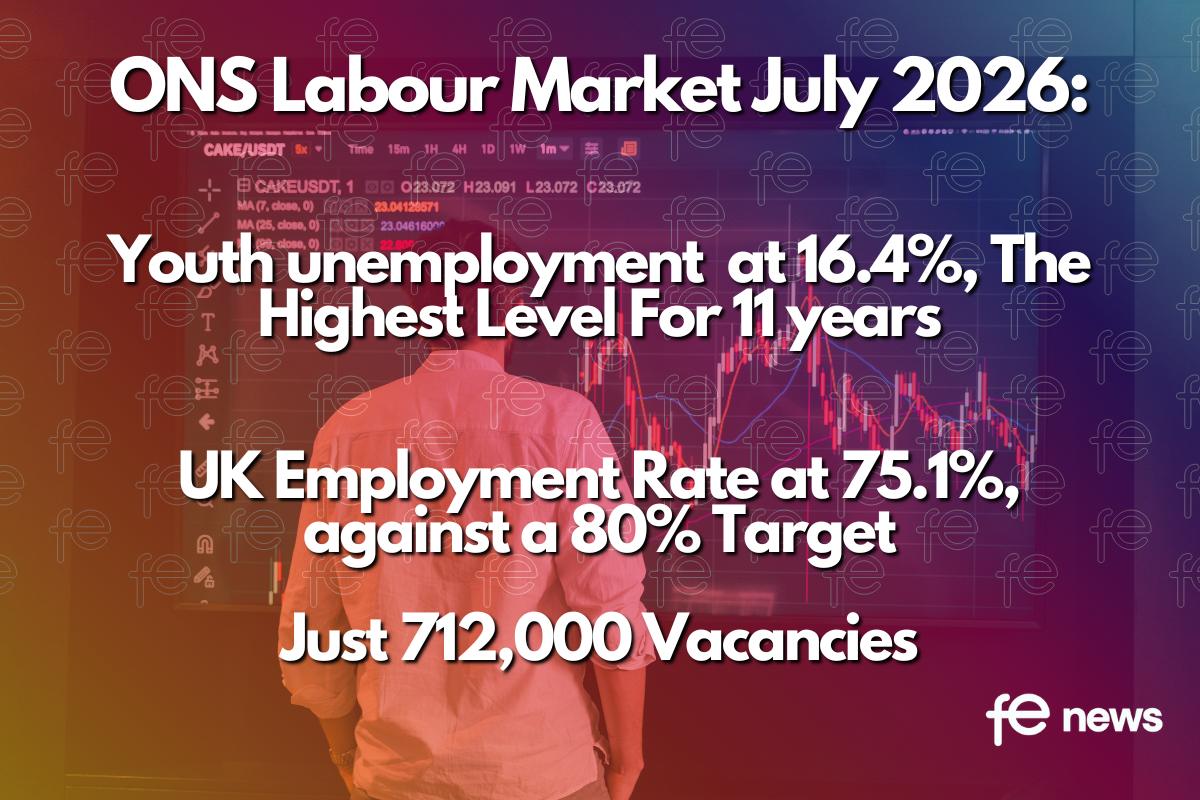
The UK employment rate, based on the Labour Force Survey (LFS) data for people aged 16 to 64 years was estimated at 75.1% in March to May 2026. This is down 0.1 percentage point on the year but up 0.1 percentage points on the latest quarter. This is against a 80% employment rate target.
Estimates for payrolled employees in the UK fell by 85,000 (0.3%) between May 2025 and May 2026. However, it was largely unchanged on the month, increasing by 3,000 (0.0%) between April and May 2026.
The UK unemployment rate for people aged 16 years and over was estimated at 4.9% in March to May 2026. This is up 0.2 percentage points on the year but down 0.1 percentage points on the latest quarter.
Youth unemployment now stands at 16.4%, its highest level for 11 years, with around one in six young people seeking work.
UK economic inactivity rate is at 20.9%
The UK economic inactivity rate for people aged 16 to 64 years was estimated at 20.9% in March to May 2026. This is down 0.1 percentage points on the year and down 0.1 percentage points on the latest quarter.
The UK Claimant Count for June 2026 increased on the month but decreased on the year to an estimated 1.689 million.
Just 712,000 vacancies
The estimated number of vacancies in the UK decreased in the latest quarter. Early estimates for April to June 2026 suggest a decrease of 7,000 (0.9%) to 712,000, compared with January to March 2026. This is a quarterly drop of 7,000 vacancies, but an annual drop of 18,000 vacancies!
Sector Reaction:
Responding to the latest ONS figures, Stephen Evans, chief executive at Learning and Work Institute (L&W), said:
“The labour market remains relatively flat, although wider survey evidence suggests stabilisation or modest improvement in future months. The data, though, highlight the twin challenges Andy Burnham faces as he takes office. First, the Government is off track for its 80% employment rate ambition, needing another 2.1 million people in work, with a worrying one million young people not in education, employment or training. Second, real average weekly earnings are more than £260 lower than on pre-financial crisis trends, highlighting the deep and persistent cost of living challenges.”
Aman Navani, Senior Research and Policy Analyst (he/him), Work Foundation at Lancaster University, a leading think tank for improving working lives in the UK, on the latest ONS labour market statistics:
“Today’s figures expose the scale of the labour market challenge facing the new Prime Minister, as private sector pay falls in real terms and youth unemployment reaches an 11-year high.
Private sector employees under pressure as real wages fall
“Pay growth across the economy continues to slow but living standards are coming under renewed pressure for private sector employees. Since October 2025, private sector wages have failed to keep pace with rising prices and average real weekly earnings are £1.75 lower (in constant 2026 prices) than a year earlier. Work Foundation analysis suggests just one in five businesses are planning inflation-beating pay rises in 2026, indicating cost of living pressures could intensify in the months ahead.
“The Government’s announcement to remove VAT from household electricity bills is a good first step to provide vital breathing space for workers struggling to make ends meet. But with inflation expected to rise in the coming months, Ministers must go further to support low-income households that are likely to be hit hardest and short-term interventions must be matched by a credible plan to deliver secure, well-paid work and stronger growth in every part of the country.
Young people being left behind
“While unemployment has remained unchanged at 4.9%, the labour market is proving particularly unforgiving for young people aged 16 to 24. Youth unemployment now stands at 16.4%, its highest level for 11 years, with around one in six young people seeking work. Young jobseekers face an acute shortage of opportunities, with starter job vacancies down by almost half over the past decade. This shortage is especially significant in the North East and East Midlands, underlining how a young person’s prospects can depend heavily on where they live.
“While the Government is right to focus on making the education system work better, it must also focus on the demand side. Improving education and employment support will only go so far without concerted action to create more good-quality jobs and give young people a clear route into secure and sustainable work.”
Sharon Steiner CHRO & Chief Freelance Officer at Fiverr said:
“Today’s figures show that the UK labour market is not just cooling or stabilising; it is being redesigned. The live political debate is focused on job creation, from reindustrialisation to the future of retail employment. But for HR leaders, the bigger question is how to build a workforce that can flex with demand, absorb new technologies and close skills gaps quickly.
“Many businesses are solving this by turning to freelancers with specialist skills – often instead of full-time hires, particularly in newer fields such as AI. Our latest Business Trends Index shows demand for specialist AI skills rose 107% in the UK over the past six months as UK businesses try to compete to be fastest and most efficient with AI.
“Younger workers are already adapting faster to this change than many employers. Our research shows that more than half of Gen Z believe traditional employment models are becoming obsolete, while many are already freelancing or planning to. The smartest people are building ‘portfolio careers’ and offering more specialist AI skills because they understand that security now comes from adaptability, not just one employer.”
Jeanette Wheeler, Chief People Officer at MHR said:
“The latest ONS figures point to a labour market holding steady on the surface, but with signs of strain underneath. Employment remains broadly unchanged at 75.1% and unemployment has edged down to 4.9% this quarter. For people who’ve faced a long squeeze on their finances, that steadiness will be welcome
“The number of vacancies tells a more considered story from businesses, as they fell to 7,000 to 712,000, though that’s a far gentler decline than we’ve seen in recent months. Employers remain wary about taking on new staff, especially as they consider the impact Andy Burnham will have on the labour market as lays out his new plans for the country.
“With the Bank of England’s next call on interest rates in focus at the end of the month, many employers will be hoping for firmer ground ahead. The risk is that businesses get stuck in a holding pattern, waiting for conditions to improve rather than investing for growth.
“The labour market is proving more resilient than many predicted at the start of the year, and the slowing fall in vacancies is a positive sign. Business leaders should take confidence from that, while remembering that future growth depends on investing in people now, by upskilling their existing workforce and creating opportunities for new talent.”
Jack Kennedy, Senior Economist at Indeed
“Today’s figures suggest little change in the health of the UK labour market, though caution is advisable given the latest data quality hiccup afflicting the Labour Force Survey.
“The broader picture is one of persistent employer hesitancy. Businesses continue to face cost pressures and are operating in an uncertain environment, now awaiting clarity on the economic direction under new prime minister Andy Burnham. That uncertainty is weighing most heavily on entry-level and junior hiring, with youth unemployment having climbed to 16.4%, its highest since late-2014.
“Relatively benign wage growth within a fragile labour market eases near-term pressure on the Bank of England to tighten monetary policy, even as renewed tensions in Iran put upward pressure on global oil prices.
“The government is active on the policy front, with incoming employment rights provisions and newly announced plans for greater salary transparency. But the most powerful lever for the labour market right now is not regulation but confidence. Employers need reasons to invest in their workforce, and that starts with assurance in the broader economic outlook.”
Anthony Salcito, Senior VP for Enterprise, Coursera
“The latest figures show that the UK labour market is once again struggling to overcome sustained stagnation, with employers and workers continuing to navigate a turbulent economic environment marked by uncertainty and changing workforce demands.
“As the new government sets out its strategy for education and skills, and with A-level results next month placing the spotlight back on young people’s futures, there is an urgent imperative to rethink how we prepare graduates for an AI-driven economy.
“Investment in AI literacy, job-relevant skills, and lifelong learning will be essential to ensure young people leave education capable of thriving in the workforce.
“Our latest research shows 60% of UK employers would choose a less experienced candidate with a GenAI credential over a more experienced candidate without one. These employer signals highlight the increasing focus on skills over credentials alone: as AI reshapes the labour market, graduates who can demonstrate practical, industry-relevant skills alongside their degrees will be best-placed to succeed.”
“The move to skills-first, AI-focused hiring also creates alternative pathways towards economic opportunity for Brits who have chosen not to pursue traditional higher education.”
Chris Goulden, Deputy CEO at Youth Futures Foundation, comments:
“Today’s ONS Labour Market statistics reveal that around 1 in 7 economically active young people not in full-time education (14.3%, around 469,000) are unemployed. A further 1 in 5 young people not in full-time education (20.9%, around 869,000) are economically inactive. Compared to a year ago, the latest figures show an increase in both unemployment and economic inactivity, with 57,000 more young people unemployed and 67,000 more economically inactive.
“As the interim Young People and Work report outlined, the scale and complexity of the challenge facing young people who are NEET remains significant. Today’s figures highlight the importance of looking at both unemployment and economic inactivity to understand youth worklessness.
“The Government’s growing focus through the expanded Youth Guarantee and recent apprenticeship reforms is positive and welcomed; however, it must go further and faster with wider system reform if we are to turn the tide. This must include better integration of employment and health services to help young people who are economically inactive because of long-term ill health, tailored support for those facing the most barriers and more apprenticeship opportunities.
“By prioritising this issue, the new government has a real opportunity to transform the life chances of a generation of young people. Alongside the clear moral imperative, there is a compelling social and economic case for action. Matching the youth participation rates achieved in the Netherlands, the OECD leader, could deliver an estimated £86bn long-term boost to the UK economy.”
Michelle Ovens CBE, CEO & Founder of Small Business Britain, said:
“It’s encouraging to see today’s unemployment figures show a slight improvement. However, following Andy Burnham’s pledge yesterday to reform the education system to help more young people into work, we need to see that ambition translate into action. We urge the Government to introduce a National Business Skills Guarantee, ensuring every young person has access to business skills, role models, and entrepreneurial pathways before leaving education.
“The UK has the third-highest employment rate in the G7, yet too many young people still face barriers when entering the workforce. They need confidence, skills, and experience to prepare them for the world of work. Our work through the Maple Review found that equipping young people with practical business skills is essential not only for driving economic growth, but also widening access to opportunity. With 14.3 million people currently living in poverty across the UK, giving young people the confidence and skills to pursue employment or entrepreneurship has never been more important.”
Kajetan Slonina, Managing Director, Randstad UK, said:
“The latest ONS figures show some signs of resilience in the labour market, with the employment rate edging up and unemployment falling slightly over the latest quarter, despite continued caution in hiring. While employers remain measured in their approach to permanent hiring, demand for critical skills has not gone away.
“We’re seeing organisations become more selective in how they recruit, with many using temporary and contract talent to remain flexible and access the expertise they need. This is helping businesses respond to changing demand, while creating opportunities for people across the labour market.
“Looking ahead, demand across skilled trades, engineering and specialist technical occupations is expected to remain resilient. As confidence improves, permanent hiring should recover, with flexible working continuing to play an important role for both employers and talent.”
Neil Carberry, Chief Executive of the Recruitment and Employment Confederation (REC), said:
“The new Prime Minister inherits a labour market showing tentative signs of improvement, with a resilient employment rate and moderating wage growth providing a platform for further progress. To build on that momentum, policymakers should focus on reducing the cost of doing business, which is a critical component of the rising cost of living. That is especially important for young people, where youth unemployment remains close to 15%, even before inactivity is taken into account.
“Inserting real pragmatism into regulatory interventions in the labour market, like the unworkable proposals for guaranteed hours in the Employment Rights Act, would help immeasurably. Combined with higher National Insurance costs, inflation-busting National Minimum Wage rises and a lack of effective skills reform, these measures risk undermining employers’ confidence to hire and holding back this nascent jobs recovery.
“Business is the solution to the issues the country faces, it is time to stop treating it as the problem. Firms can help clear the obstacles facing Andy Burnham across jobs, investment and growth if his new government replaces misguided paternalism with pragmatism and partnership.”
Responses