
Prime Minister To Transform Further and Higher Education and Invest Nearly £800M Extra Funding For 16–19 Year Olds Next Year

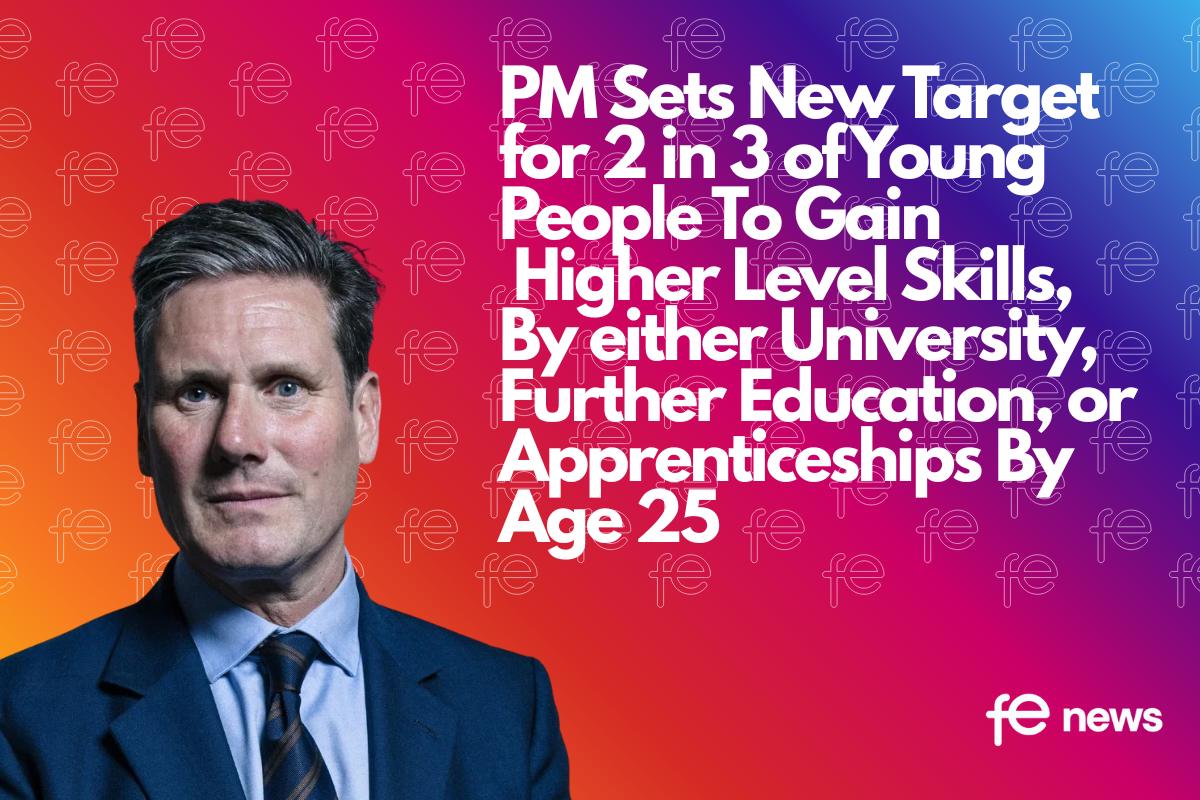
- New target for two thirds of young people to get higher level skills, either through University, Further Education, or Apprenticeship by age 25
- The Prime Minister set out his plan to build a world-class Further Education system that will unlock opportunity across the UK
- Part of Labour’s Plan for Change, government will invest nearly £800m extra into funding for 16–19-year-olds next year, supporting an additional 20,000 students and unlocking opportunity for all
Young people across the UK are set to gain the cutting-edge skills needed to succeed in tomorrow’s workforce, as the Prime Minister today announced a landmark package of reforms aimed at boosting technical education and placing it on equal footing with university degrees.
Speaking at the Labour Party’s Annual Conference, the Prime Minister set out his plan to build a world-class Further Education system that will unlock opportunity across the UK.
Two-thirds of young people to get higher skills, either through university, further education or taking on a gold standard apprenticeship
At the heart of the Prime Minister’s reforms is a decision to scrap the ambition for fifty percent of young people to go to university. Starmer replaced this with a new target: for two-thirds of young people to get higher skills, either through university, further education or taking on a gold standard apprenticeship. This target will include at least ten percent of young people pursuing higher technical education or apprenticeships that the economy needs by 2040, a near doubling of today’s figure.
In his speech, the Prime Minister highlighted how these changes will not only help to build a Britain fit for the future, but will mean that technical qualifications, undervalued and overlooked by previous Conservative governments, are afforded the same respect as university degrees.
Prime Minister Keir Starmer said:
“While you will never hear me denigrate the aspiration to go to university, I don’t think the way we currently measure success in education – that ambition to get 50% of kids to uni – I don’t think that’s right for our times.
“Because if you are a kid or a parent of a kid who chooses an apprenticeship, what does it say to you? Do we genuinely, as a country – afford them the same respect?
“Today I can announce, we will scrap that target and we will replace it with a new ambition that two thirds of our children should go either to university or take on a gold standard Apprenticeship.”
14 new Technical Excellence Colleges
Forming part of the government’s programme of national renewal, these changes will be underpinned by a drive to raise standards. There will be higher quality teaching in colleges and 14 new Technical Excellence Colleges to equip young people with the technical qualifications or apprenticeships that our economy needs.
£800m extra into funding for 16–19-year-olds next year (2026-7).
To support these reforms, the government will also invest nearly £800m extra into funding for 16–19-year-olds next year (2026-7). Coming from the existing Spending Review settlement, this funding will support an additional 20,000 students and make our Further Education system world-class.
This announcement comes on the penultimate day of the Labour Party’s annual conference, where the government has set out how it will be pushing ahead with delivering on the Prime Minister’s promise of national renewal to make working people better off.
It follows on from plans announced by Chancellor Rachel Reeves to create a new Youth Guarantee, which offers every young person on Universal Credit who has been out of work or education for 18 months guaranteed paid work.
14 new Technical Excellence Colleges in Advanced Manufacturing, Clean Energy and Digital
The Prime Minister also announced 14 new Technical Excellence Colleges, focused on high-growth sectors such as advanced manufacturing, clean energy, and digital, giving young people more choice over where and what they study. This builds on the 10 Technical Excellence Colleges already announced for construction (CTECs) and five for defence (DTECs).
Further detail will be set out in the upcoming Post-16 Skills White Paper.
Sector Reaction
Stephen Phipson, Chief Executive of Make UK, said:
“For far too long quality Apprenticeships have been undervalued and not as comparable in esteem to a degree, As such, industry will give a strong welcome to the Prime Minister’s emphasis on their importance, the advanced skill levels they involve and the fact we now have a target of equal value to University that we have long advocated for. This also includes Degree Apprenticeships which provide a valuable, alternative pathway and are strongly supported by manufacturers. Manufacturers will also welcome an endorsement from the highest office of the importance of the sector to our economy at national and regional level, our security and national resilience.”
David Hughes, Chief Executive, Association of Colleges said:
“It is great to see a prime minister speak so passionately about the power of further education and skills and to back those words with actions that can truly make a difference.
“The new target that puts high level skills, attained either through an apprenticeship or attending college, on a par with a university degree will help drive a step change in the skills and education landscape. For too long the 50% target has washed ambitions on technical education and apprenticeships, so I am delighted to see that change.
“For decades, I have been fighting to place further education at the heart of economic growth and inclusion and I am personally pleased the prime minister has pledged his personal commitment to that.
“Every college leader will be as delighted as I am because delivering high quality technical education and apprenticeships and higher education are what they have been delivering day in, day out – despite the years of funding cuts they have suffered. To build on the 147,000 people currently on apprenticeship provision in colleges, we now need to see the investment match the ambition.
“We know there is demand from workers and employers in key sectors from green skills to engineering and construction skills to childcare and the NHS. Colleges can help employers be more productive and give people the opportunity to secure the jobs for a better life.
“With nine out 10 colleges judged good or outstanding for overall effectiveness at their most recent inspection by Ofsted, the commitment to Technical Excellence Colleges and improving the quality of teaching can only strengthen a sector that is delivering so much already.”
Dr Katerina Kolyva, CEO of the Education Training Foundation said:
“ETF is delighted to hear Prime Minister Keir Starmer champion the further education and skills sector and its workforce in his Labour Party Conference speech today.
“He pledged to make further education ‘a defining cause of this Labour government’ – promising higher standards in colleges, raised teaching quality, more apprenticeships and technical excellence colleges, and qualifications rooted in jobs and communities.
“This matters. To match this ambition, we need a bold, long-term workforce strategy and ETF stands ready to work with government and sector partners to turn today’s commitment into action.”
Pepe Di’Iasio, General Secretary of the Association of School and College Leaders, said:
“For far too long our colleges have been the forgotten heroes of the education system – underfunded and unsung – while providing vital skills and training to hundreds of thousands of young people.
“We therefore welcome the Prime Minister’s decision to place them at the centre of national renewal and to incorporate skills education and apprenticeships into his new target for higher level education and training.
“We welcome also the funding commitment made today for 14 new technical excellence colleges and look forward to seeing more detail about exactly how the 16-19 sector will be supported to deliver these vital policy ambitions.”
Ben Rowland, AELP CEO said:
“The Prime Minister’s announcement today resets what young people, parents and crucially teachers will view as aspirational. It reflects what AELP and its members have been saying for decades – that the FE and skills sector are at least the equal part of creating the productive workforce of the future.
“This announcement and reset are a necessary, not sufficient step. Now we need to make it happen. That means reengaging employers, starting with spending all of the money raised through the levy on the kind of programmes the Prime Minister wants.
“It also means making sure that investment in Technical Excellence Colleges is designed so that the whole sector can contribute including ITPs who are the engine of employer and learner engagement currently delivering 2/3rds of apprenticeships.”
Paul Whiteman general secretary at school leaders union NAHT, said:
“We have long argued that while university education is of course a great option for many students, it isn’t the only route to a fulfilling career for young people.
“For some, training, apprenticeships or employment better suit their needs and ambitions. Yet for too long, these career paths have not been prioritised, so we welcome the prime minister’s ambition to address this.
“However, it is important that this is supported not only by funding, but also by changes to ensure our school curriculum and assessment landscape works for all students.
“The offer from schools has been warped by government policies including the publication of narrow, high-stakes performance measures, and the exclusion of creative and cultural subjects from the EBacc has led to a reduction in pupils taking these subjects. Not only does the EBacc have the effect of narrowing the curriculum in Years 10 and 11, but the effects can be seen in sixth form and college choices too.
“These policies have created an implicit lack of value in the achievements of many young people, who are not ‘academic,’ reinforced from an early age with a pass or fail approach to tests and exams. Broadening the curriculum and valuing all subjects and skills, will help to improve the outcomes for all young people.
“The ongoing curriculum and assessment review is a chance for the government to reform the system and deliver learning that is relevant, reflects society’s diversity and gives all students access to meaningful qualifications across a broader range of vocational, academic and arts subjects, using varied assessment methods.”
Robbie Cruikshanks, Senior Researcher (Higher Education) at the Education Policy Institute, said:
“We welcome the government’s commitment to a more unified higher and further education system, with a long awaited focus on Higher Technical Qualifications.
“The government is right to acknowledge that meeting these new targets require investment in further education to raise quality. The plans for expanded professional development for FE teachers is a welcome announcement as our own research has highlighted the workforce quality gap and the important role of continuous training in improving learner outcomes and narrowing disparities.
“This is an important opportunity to make sure additional funding in the FE sector is targeted to disadvantaged students. A dedicated 16–19 student premium, which we have called for, would help ensure that additional resources reach the young people who need them most.”
Responses