
The Freelance Education Alliance – A Collective Voice For Future Freelancers Goes Live

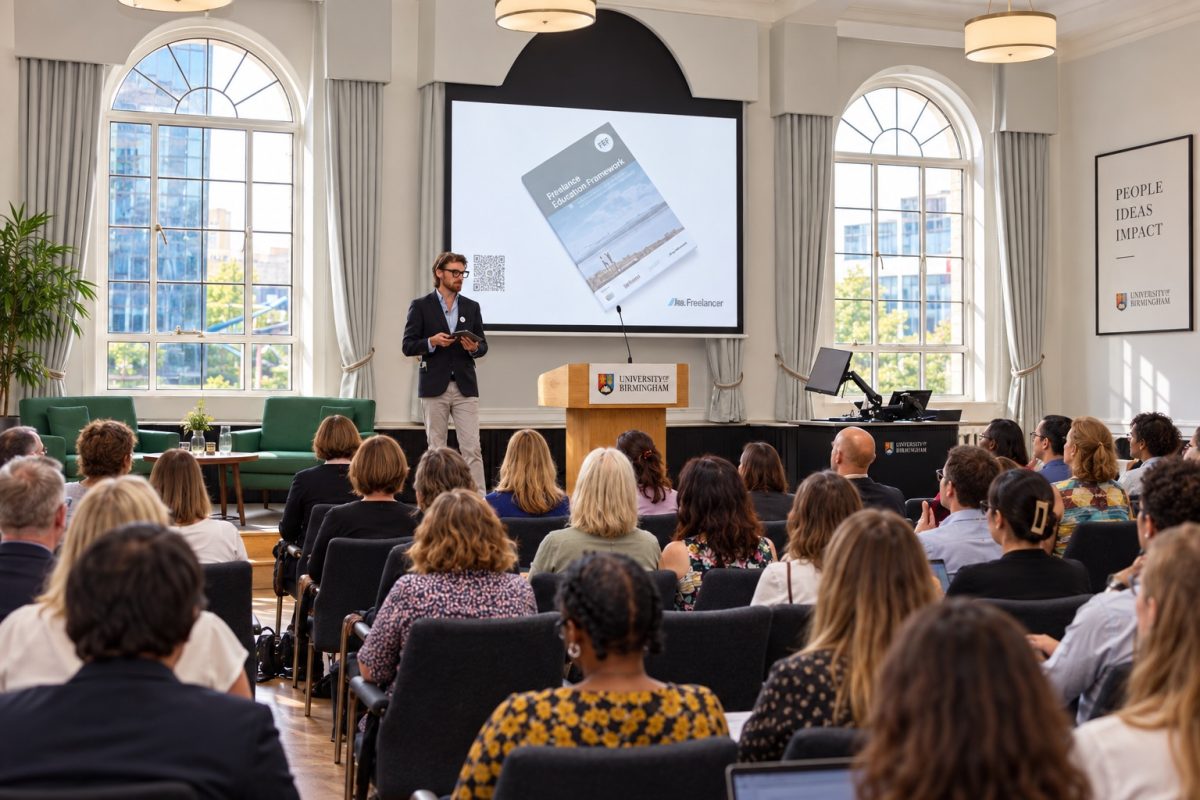
The Freelance Education Framework established a shared standard for preparing students for freelance careers. Now comes the tricky second album: producing real impact.
Earlier this year, a collection of FE, HE, policymakers and industry leaders launched the Framework with the ambition of giving education a more consistent and structured way of preparing students for freelance careers. A fairly uncontroversial proposition, you might think, given millions of people now make a living outside the reassuring bosom of conventional employment.
And while the Framework continues to gather momentum, it does so thanks to inspirational people doing extraordinary work in freelance education.
Over the years, we’ve had the great pleasure of meeting many of them. Teachers cramming coaching sessions with aspiring student freelancers into spare corners of their diaries, educators constructing entire programmes from scratch and enterprise teams helping students develop the essential skills for independent work.
The deeper we travelled down the rabbit hole, the more we discovered an entire ecosystem of freelance champions working beyond the coalface. Researchers attempting to understand a labour market that appears to mutate every six minutes, Senior Leaders embedding freelance pathways into their strategies, and policymakers confronting the possibility that measuring graduate success exclusively through traditional employment might not paint the most accurate picture.
So, what’s the problem? For starters, many of these people barely know the others exist and most are running their initiatives with one had tied behind their back.
At the Freelance Education Framework launch, we heard from several individuals already building impressive freelance initiatives within their institutions: Alison Kent on Farnborough College’s extensive freelance programme designed for a young audience of side hustlers; Anneliese Paul on New Wave, UWE’s agency for student freelancers – driving equity in professional practice; Catherine Dormor on Zone29, the University of Westminster’s new home for careers and enterprise; and Jo Living on Anglia Ruskin University’s Freelance Fast-Start programme.
Across the country, talented individuals are independently solving remarkably similar challenges, often with limited resources, recognition or institutional support. It’s an archipelago of good intentions: hundreds of people furiously reinventing the same wheel while sitting in separate Teams meetings discussing collaboration.
So today we officially launch the Freelance Education Alliance (FEA): a community-led action group designed to connect these champions, amplify their collective influence and, together, tackle some of the problems none of us can realistically solve alone.
Now that freelancing is largely treated as a legitimate career path, the people fighting for it probably ought to be in the same room.
From good intentions comes a movement
There is power in numbers. There’s also power in organisational structure – it just doesn’t trip of the tongue as well. To truly make an impact, we need a collective voice with enough status and influence to change how freelance careers are understood, taught and supported. We also need diverse groups of passionate people to tackle some of the most pressing challenges in freelance education head on.
And, believe me, there are some fundamental problems that need solving. Educators need practical ways to support students who want – or, increasingly, need – to turn their skills into viable side hustles and freelance businesses, rather than simply releasing them into the wild armed with a certificate and a LinkedIn profile.
There’s a conversation to be had about the way we measure freelance outcomes. What should good freelance education actually contain? How do we support people beyond graduation? Why can’t international students run freelance businesses in the UK? How do we ensure opportunities are accessible and fair? And how do we make freelancing visible alongside employment and entrepreneurship, rather than treating it as that ‘bit in the middle’.
None of these questions has a neat answer. And repeatedly asking individual educators and institutions to solve them alone seems an inefficient way of finding one.
Enter, the FEA. Designed to give us somewhere to tackle them collectively – pooling expertise, challenging what isn’t working and turning good intentions into something genuinely useful.
A little less conversation
Education is not exactly suffering from a shortage of networks, panels, committees and working groups. There are enough roundtables in the sector to furnish a conference centre, many dedicated to discussing problems that everyone agreed were problems several meetings ago.
The Alliance is deliberately action-led. Members will identify the most pressing challenges facing freelance education, form Action Groups around them and spend focused periods turning collective expertise into something tangible: resources, research, campaigns, partnerships, policy recommendations or practical approaches that institutions can actually use.
It’s other function is as a super-connector. One of the things we’ve noticed repeatedly over the years is what happens when two freelance champions from different institutions discover they’re wrestling with exactly the same problem. Within minutes they’re comparing approaches, swapping resources and wondering why on earth they’ve both spent the past six months trying to solve it independently. We wanted to leverage that existing sharing culture for the betterment of the sector. A rising tide lifts all boats.
The FEA gives those conversations a home, connects the people doing the work and provides a route from “someone really ought to do something about this” to actually doing something about it.
The big picture
Ultimately, however, this more than improving freelance education, it’s about recognising a fundamental shift in the way people work.
Freelancing, self-employment and portfolio careers are an essential part of our economy, yet the systems surrounding education and early careers still overwhelmingly point young people towards a traditional employment model.
Employment should absolutely remain one of those routes. But it shouldn’t be the only one we prepare people for. That recognition is fundamental to change.
A student entering education today should be able to graduate understanding how to get a job, start something of their own, sell their skills independently or combine several of those things over the course of their career.
For that to happen, freelancing needs to become more formalised within education. It needs language, standards, research, infrastructure and, importantly, people prepared to champion it.
That’s the bigger ambition behind the Freelance Education Alliance.
To elevate freelancing. To give the people working in this area a stronger collective voice. And, most importantly, to improve the experience of the next generation entering a workforce that looks very different from the one our education and careers systems were originally designed for.
Responses