
Behind the Numbers: A Million Individual Stories

The Milburn Report landed with the force of a statistic that should stop us all in our tracks. Over one million young people in England are currently not in employment, education or training. Without concerted and immediate action, that figure could reach 1.25 million within five years. 1.25 million young people, a number that exceeds the entire population of Birmingham.
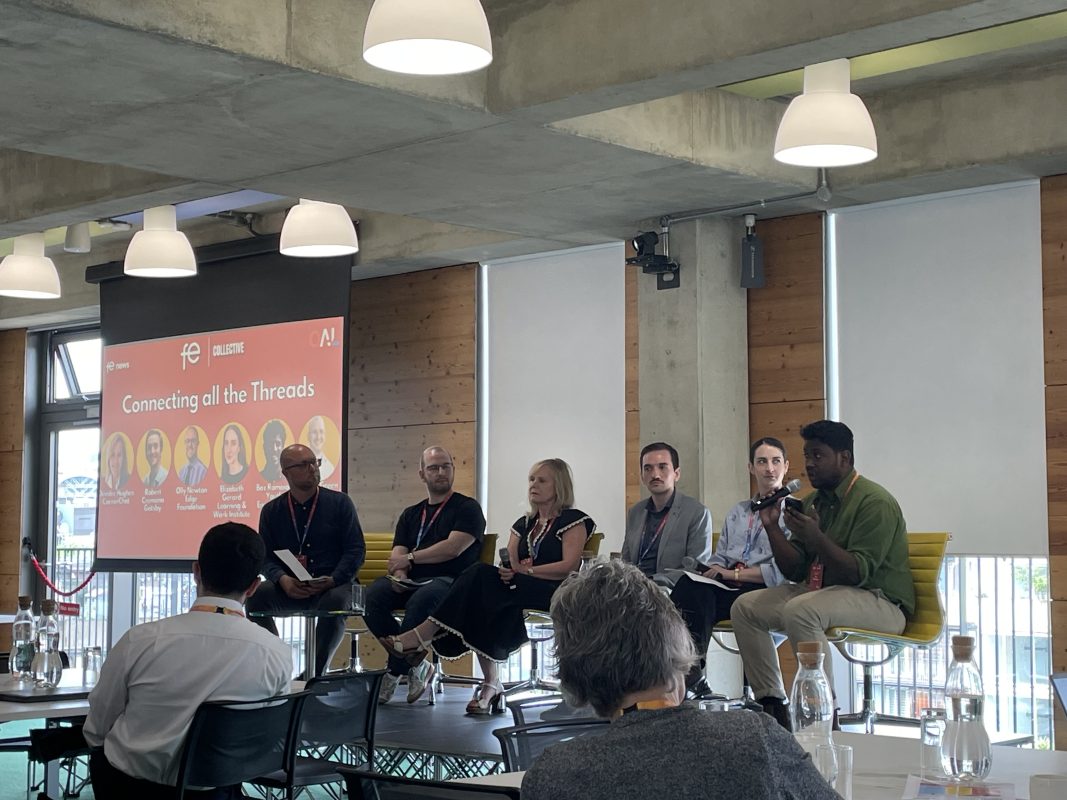
I was at the FE News’ Breaking Barriers Collective on Tuesday, a few days after the report dropped, and the timing felt significant. The room brought together voices from Skills England, the DfE, DWP, Gatsby, the Federation of Awarding Bodies and, most powerfully, young people currently living the reality of being NEET. It was a rich, sometimes uncomfortable, and genuinely important day.
One observation stayed with me above all others. As someone in the room pointed out, the one million figure only captures those who are on the system. The real number is likely higher. These are the visible ones. There are others we simply aren’t counting.
What I loved about the Breaking Barriers Collective is that it wasn’t designed simply to discuss and go over and over the problem. The intent was to move the conversation forward: to bring the right people into the same room, to share what is working as well as what isn’t, and to start building towards answers rather than simply restating the scale of the challenge. That feels important. We have no shortage of reports, statistics and summits that describe the crisis. What we need more of is the kind of honest, cross-sector conversation that Tuesday represented, one that moves from describing the problem to working on the solutions.
The problem with a number
NEET is, as several speakers acknowledged, a deeply unhelpful term, particularly if you happen to be one (someone called it an ‘ugly’ term). It reduces a human being to an administrative category. It defines people by what they are not, rather than by who they are or what they could become.
Behind that million-plus figure are individuals. Each with a different story, a different set of circumstances, a different combination of barriers, some structural, some personal, some the product of a system that wasn’t built with them in mind. If we are serious about addressing this crisis, we have to hold both things at once: the policy ambition at scale, and the individual in front of us who needs someone in their corner.
That tension, between systemic response and individual support, felt like the defining challenge of the day.
The structural shifts we can’t ignore
Technology is reshaping the labour market in ways that are directly relevant to young people entering work for the first time. Retail is a sector I know well. The workforce has contracted from 3.2 million to 2.9 million in recent years, driven by self-service technology, the growth of online channels, and changing consumer behaviour. That trend is unlikely to reverse. The entry-level jobs that once provided a foothold into the world of work are quietly disappearing from the sectors where young people have traditionally found them. This is just one sector example; many others are changing. But many remain the same, but off the radars of young people, for whatever reason.
The death of the weekend job came up repeatedly during the day, and rightly so. For generations, a Saturday shift in a shop or a café wasn’t just pocket money, it was the first experience of turning up, of navigating a workplace, of learning that resilience and conversation are skills as much as any qualification. That informal on-ramp into employment readiness has eroded significantly, and we haven’t adequately replaced it.
What we keep coming back to
Some of Tuesday’s themes were familiar, we have been having versions of these conversations for decades. Careers advice and guidance that is genuinely effective, rather than a tick-box exercise. Employability skills, interpersonal confidence, resilience, the ability to hold a conversation, built into education from an early age, not bolted on at the end. A recognition that education is not only about academic knowledge but about workplace readiness.
But, there are some things that I think we sometimes skirt around.
The first is employability behaviours, and I mean the basics. Turning up on time. Making eye contact. Being able to hold a conversation with someone you’ve never met. Accepting feedback without crumbling. Persisting when something is hard. These sound obvious, but not if nobody has ever shown you, and if the informal routes through which previous generations absorbed them, the Saturday job, the family business, the community organisation, are no longer there. We need to be much more deliberate about building these behaviours into education and early experience, because right now we’re assuming young people will pick them up somewhere. Many aren’t.
The second is harder to say, but I think it needs saying. Somewhere in the system there need to be honest, compassionate conversations with young people about realistic pathways. I’m not talking about crushing ambition; ambition is valuable and should be encouraged. But genuine careers guidance has to include a grounded conversation about probability and alternatives. The creative industries, professional sport, and performance are real careers for a small number of extraordinarily talented and fortunate people. I know this personally; I had my own rock star ambitions and dreams once, and then I found myself working in the skills sector for 30 years (which I love, but I’m always available if the Rolling Stones come knocking).
The role of employers came up too, and it’s a genuinely difficult conversation. Businesses are being asked to do more, to offer work experience, to engage with schools, to support young people into their first roles, take on apprentices, at a time when many are under significant financial pressure themselves. In some sectors, asking employers to take on more feels like adding weight to a structure that is already straining. We need to be honest about that, rather than simply asserting that business must, and can, do better.
Solving one problem, creating another
One point raised during the day has stayed with me in particular. If we focus policy energy entirely on reducing the NEET figure for under-25s, we need to be careful that we don’t simply displace the problem, pushing young people into education or training that doesn’t lead anywhere, or into employment pathways that run out at 25 and deposit them into a different set of unemployment statistics.
The goal isn’t to move people off a register. It is to build genuine, sustainable pathways into work, into further learning, into lives where their potential is recognised and developed. That is a more complex and more expensive ambition than a headline target. But it is the right one.
Who wants this most?
One of the most thought-provoking moments of the day, and I’ll be honest, one I’m still turning over in my mind, was a challenge posed about agency and ownership. Who actually wants this problem solved? Us, sitting in a conference room in London, or the young people we’re talking about?
It sounds like a provocative question. But I think it’s a serious one. So much of the policy conversation around NEETs positions young people as the recipients of solutions designed by others, interventions delivered to them, pathways laid out for them, support offered at them. And yet the evidence suggests that the most effective approaches are those where young people have genuine agency in shaping their own route forward. Not being processed through a system, but actively participating in designing it.
I’m not entirely sure where I land on this. There are young people in very difficult circumstances who genuinely need structure, support and direction, and empowerment without scaffolding can be its own form of abandonment. But the question stays with me: are we building solutions that young people would actually choose? And if not, why not, and what does that tell us? If we want this more than they do, we may be trying to solve the wrong problem…
What needs to happen now
The Milburn Report, the Breaking Barriers Collective, and the broader policy conversations all point in the same direction, but pointing isn’t enough. If I were to distil Tuesday’s conversations into what actually needs to change, I would start here.
First, careers advice and guidance needs to be properly funded, genuinely independent, and treated as a statutory entitlement, not a postcode lottery delivered by whoever happens to be available. The evidence on what good guidance does for young people is clear.
Second, business incentives need to reflect the real cost and real risk of taking on young people with limited experience. Asking businesses to do more while squeezing their margins and adding regulatory burden is wishful thinking. If we want businesses to be part of the solution, we need to make it genuinely viable for them to be so.
None of this is new thinking. That is precisely the problem. We know what works. The question is whether we will finally resource it, sustain it, and resist the temptation to reorganise it before it has had time to bed in.
But above all, it requires us to remember that we are talking about people. Over a million of them. Each one deserving of someone who sees them, believes in them, and helps them find their way forward.
By James Stockdale, Chair of the OCN London Board of Trustees
Responses