
The Milburn Review. Part 1: The Moment to Grasp the Nettle


I’ve been waiting for the dust to settle after the publication of the Milburn Review.
There’s been so much commentary, so much analysis and so much conjecture. What I want to do is separate the signal from the noise.
So what is this ‘moment’ which Milburn referred to? Where are we in the bigger scheme of things? And what actually needs to change?
Speaking to Laura Kuenssberg on the BBC the weekend before publication, Alan Milburn was asked whether his report would end up on a shelf like so many before it. His answer was that this is ‘a moment in time’, not a time for half measures, and that we have to ‘grasp the nettle’. His final report puts it the same way: ‘This is a moment of choice for the country.’ I agree with him. However, before we can grasp the nettle, we need to be clear what this moment actually is.
This is a Four-Part Series
This is the first of four articles, each one asks different questions:
- The moment. Where are we in the grand scheme, why now, and who is Alan Milburn? Is he the right person to be making these calls?
- How did we get ? What is the system we’ve built, what did Milburn find, and what is he proposing?
- Will it work? What does the available evidence suggest, and what can we learn from other countries, especially the Netherlands?
- What comes next? With careers fast-changing and some disappearing, what should we be preparing for, including the question of a universal basic income?
By the end, I hope we’ll have a clearer view of what really matters in all of this, and what each of us can do about it.
Almost a Million Statistics
Let’s start with the numbers, because they are pretty bleak.
At the end of 2025, 957,000 young people aged 16 to 24 were not in education, employment or training. That’s 12.8% of the age group, roughly one in eight. Behind every one of those statistics is a real young person, and usually a family, trying to work out what to do and comes next.
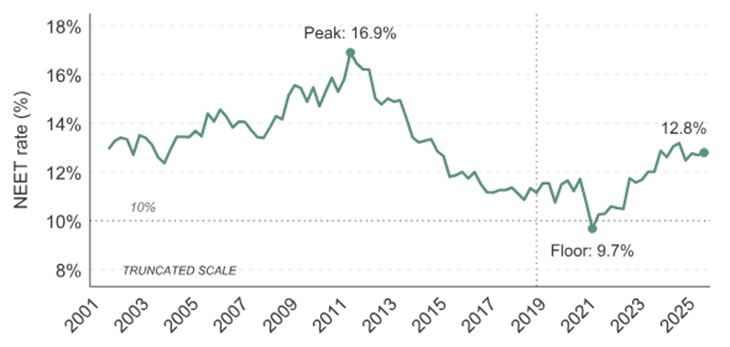
This isn’t a new phenomenon. As the graph shows, the rate has been this high before, and higher. It peaked at 16.9% in the years after the financial crash, and in the last 25 years it has fallen below 10% only once, during the pandemic. Go back further still and some older teachers will remember 1981, when UB40, a Birmingham band who named themselves after the card you were handed when you signed on the dole, had a hit with ‘One in Ten’, a song about being reduced to a number in the unemployment figures. Ali Campbell told the BBC a couple of weekends ago that the whole band was on the dole when they started out. Forty-five years on, for young people, the number is worse than one in ten.
What is new is the direction of travel. Numbers have climbed since the pandemic, passing a million early this year for the first time since 2013. The final report warns that without change the rate could reach 16.3% by 2031. That would equate to around 1.27 million young people.
The cost is very hard to ignore. The Milburn Review puts it at £125 billion a year. Around £8.1 billion goes on key benefits for 16- to 24-year-olds, and less than half of that comes with any support to help them into work or learning. For every £1 we spend helping young people into work, we spend around £25 on benefits.
The headline figure hides as much as it shows. NEET is not one group of young people who don’t want to work. Almost three quarters of them say they want to work, learn or train. It could be a young person with special educational needs, and so around 80% more likely to be NEET than average. It could be a teenager whose family had no one in work when they were 14, where the rate is almost 30%. It could be a graduate who can’t get a foot in the door through ever-diminishing graduate schemes. Increasingly, it could be a young person who is unwell. In 2025, 44% of NEET young people reported a health condition which limits the work they can do, up from 26% in 2015. Among disabled young people who are NEET, mental health is now the main condition for more than four in ten, up from under a quarter in 2011.
Where you grow up still matters far too much. It’s a postcode lottery. Eight of the ten local authority areas in England where young people are most likely to be NEET are in the North and the Midlands. One University of Manchester study found around 18% of young people in the North East are NEET, against around 10% in the South East. And background matters just as much as place. Young people from lower working-class backgrounds have a NEET rate of 22%, compared with those from higher professional backgrounds, where it’s 9%.
The Scars Don’t Fade
The part which worries me most is what is going to happen next.
Being out of work or learning at 18 isn’t just a gap on a CV. The longer it lasts, the harder it is to recover. Six in ten NEET young people have never had a job, up from four in ten in 2005. The review estimates that 45% of today’s 24-year-old NEETs have never worked. Even those who do find work could lose up to £300,000 in earnings over their lifetime. Pat McFadden, the Work and Pensions Secretary, put it starkly on the same BBC programme: a 20-year-old who signs on to long-term sickness benefit is more likely to still be on it at 30 than to have held down a steady job in between.
At the Manchester SEET Network recently (the S stands for seeking), Anthony Turner from Manchester City Council made the same point: if you’re NEET, you’re more likely to stay NEET, and for longer. The first years after leaving education set the pattern for working life, and that pattern is hard to break.
Then there’s what it does to people. In focus groups run for Education Development Trust in the North East, young people described applying for job after job and hearing nothing back. Owen, 22, from Sunderland, had sent around 100 applications and talked about how each rejection eroded his pride and motivation. In Great Yarmouth, the Sunday Times Magazine met Connor Fox, 20, who keeps a list of every job he’s applied for: 172 since January 2025. Every knock-back chips away at their confidence, health, income and, for many, a sense of where they belong. There’s a lot at stake.
The Fast-Changing World of Work
All of this is happening against a backdrop of rapid change, in how we live and how we work.
There are far fewer starter jobs than there used to be. Some of the bottom rungs on the ladder have gone, and the ones which are left are further apart. Milburn points out that there are 1.6 million fewer low and medium-skilled jobs than there were 25 years ago. The Saturday job, the paper round, the checkout shift. These were the places many of us first learned to turn up on time, talk to customers and take responsibility. And these are the very components of employability. Fewer young people get those opportunities now. It isn’t only school leavers. James Reed, of the recruitment firm Reed, says graduate jobs listed on his site are down by about three quarters.
At the same time, technology is reshaping the whole careers landscape. The World Economic Forum’s Future of Jobs report expects 170 million new jobs to be created by 2030 and 92 million to be displaced. On paper that looks like a net gain, but in practice, many young people are being prepared for jobs which won’t exist, and not for the ones which will.
This raises a harder question. If fewer young people find a way into work, more will depend on the state. Is this the beginning of the road to a universal basic income? Should we be preparing for that? I’ll come back to it in Part 4.
Who Is Alan Milburn?
So, who has been asked to make sense of all this?
Alan Milburn was raised by his mother on a council estate in County Durham. He went to Stokesley Comprehensive in North Yorkshire and was the first in his family to go to university. He was MP for Darlington from 1992 to 2010 and served in Tony Blair’s governments as Chief Secretary to the Treasury, Health Secretary from 1999 to 2003 and Chancellor of the Duchy of Lancaster. He has impressive political credentials and connections.
Since leaving Parliament, much of his work has been about opportunity. In 2009 he chaired the Panel on Fair Access to the Professions. From 2012 he chaired the government’s social mobility commission, stepping down in 2017. More recently he sat on Barnsley Council’s Pathways to Work Commission, looking at why so many people in the borough were out of work. He’s been at the coalface.
In late 2025 the Department for Work and Pensions asked him to lead an independent investigation into the rising number of young people not in education, employment or training: why it’s happening, how young people deal with the health, welfare, skills and employment systems, and what needs to change. The interim report came out in May, and the final report last week.
Is He the Right Person to Do the Review?
It’s a fair question, and there are good arguments on both sides.
In the ‘for’ camp. Few people have spent longer thinking about social mobility. He has run a major government department and knows how the machinery works. He has the political weight to get a hearing in Downing Street. And he knows from his own life how education can raise the aspirations of a young person from a council estate.
Against, or at least worth asking. He’s a former Labour cabinet minister reviewing a problem for a Labour government. He holds other roles, including at the Department of Health and Social Care, at a time when health is at the centre of the NEET story. And he has been here before. He sat in the government which brought in the New Deal for young people, and he now says schemes like it were only ever temporary. The social mobility commission produced report after report, and he stepped down saying progress was too slow. Some will ask what will be different this time.
For me, the bigger question isn’t who wrote the review. It’s what happens next. We’ve had plenty of good reports in the past which ended up gathering dust. As David Blunkett said at the RSA this month, this one can’t just sit on a shelf. The investment has to come now and the impact soon.
So, What Is This Moment?
Look at the graph above and you could ask with reason: why now? The rate was this high, or higher, for most of the decade before 2014. So, what’s different? I think three forces have collided.
First, it’s gone on too long and reached too far. We’ve had generations living with this, and it’s no longer confined to the poorest places. Graduates can’t get onto the careers ladder, and parents who never expected to worry about this are worrying. Milburn says the reaction from families has been visceral. Andy Burnham has called the review a ‘watershed moment’, though he stopped short of promising to implement it in full.
Second, a change in how we see the problem. After the crash, most young people out of work were looking for jobs which weren’t there, and many came back as the economy recovered. Today far more are out because they’re unwell. The message at the Manchester SEET Network was clear: it’s not the young person’s fault. It’s the system. The question has moved from ‘what’s wrong with young people?’ to ‘what’s wrong with the way we support them?’
Third, the ground is shifting. Entry-level jobs are thinning out, technology is changing what work looks like, and the numbers are rising without a crash to blame. That’s not a downturn. It’s structural.
That’s why this really matters. The conditions for real change may finally be in place. Milburn has set a target of bringing the NEET rate down to around 5% by 2036, which would mean around 440,000 more young people in work. Whether we get there is up to all of us: government, councils, schools, colleges, employers and young people themselves. So here’s the question for those of us in schools and colleges: if this is the moment, what are we going to do with it?
When he took on the review, Milburn said: ‘We cannot stand by and let a generation of young people be consigned to a life without employment or prospects.’ When Eli, 17, spoke to researchers in the North East, he put it more simply: ‘I just wish someone would take the chance.’
I’d like to hear what you’re seeing in your school, college or community.
In Part 2, I’ll look at how we got here, what Milburn found, and what he’s proposing to do about it.
By Neil Wolstenholme, Chairman at Kloodle
Responses