
Summer Hiring Slows in Another Blow to Young Workers, Indeed Data Shows


Summer job postings are tracking below prior years, spelling yet fewer avenues for British youth in a tough labour market.
London, 10th June 2026: New data from Indeed suggests the UK labour market has continued to soften. Overall job postings on Indeed have remained subdued, declining 10.6% on 2025. As of 22 May, postings stood 29% below their 1 February 2020, pre-pandemic baseline. The latest official figures meanwhile show vacancies dropping to a five-year low, payrolled employment falling and unemployment rising.
A particular concern is youth unemployment, raised recently in the Milburn Review. Young people not in employment, education or training has reached its highest level in more than a decade, as opportunities to step on to the career ladder close up. Indeed has found that one of the first steps young people take into the workforce, summer jobs, are also tracking below previous years.
Summer jobs are trending below previous years
Summer job postings throughout 2026 have run consistently below their 2025 levels and, as of 22 May 2026, were down 31% from a year earlier. This continues a downward trend that began after 2023: summer postings in late May 2026 are 71% below their 2023 peak, suggesting another soft summer labour market for British youth.
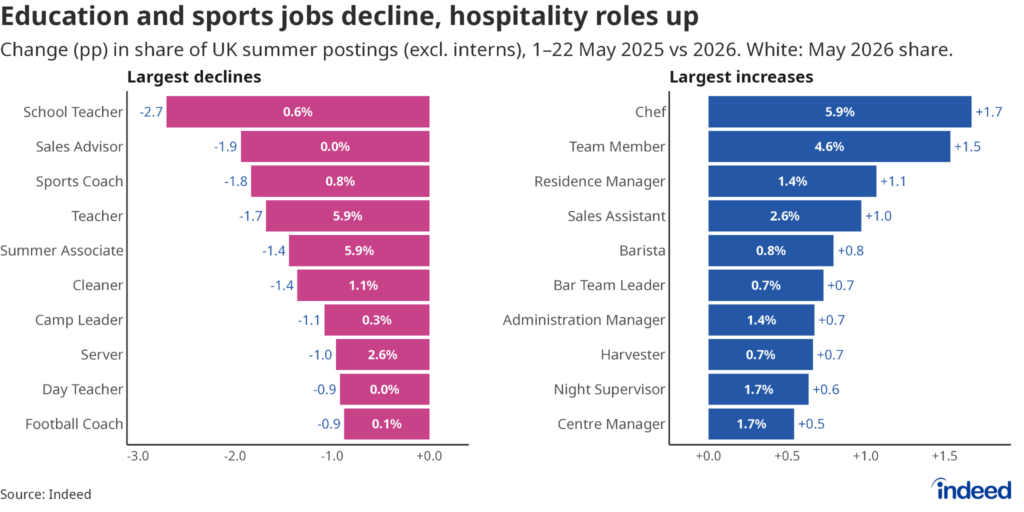
The composition of summer postings is also shifting. Comparing the first three weeks of May 2025 with the same period in 2026, roles in education and sports coaching have decreased. School teachers fell by 2.7 percentage points of the summer-postings mix (a substantial share of UK “summer teacher” demand comes from residential English-language summer schools). Sports coaches (-1.8 pp), teachers more broadly (-1.7 pp), day teachers (-0.9 pp), camp leaders and football coaches also saw falls.
The titles gaining share sit squarely in hospitality and customer-facing services. Chefs (+1.7 pp), team members (+1.5 pp), residence managers (+1.1 pp), sales assistants (+1.0 pp), baristas, bar team leaders, night supervisors and harvesters are all accounting for a larger slice of summer postings than they did a year ago.
Jack Kennedy, Senior Economist at Indeed Hiring Lab, commented:
“The challenges facing young people in the labour market highlighted by the Milburn report have only intensified recently. Employers are navigating a difficult environment and they’re responding by pulling back on junior hiring in particular. This makes it harder for younger workers to get that crucial first foot on the career ladder.
Additionally, the slow start to the summer hiring season suggests employers are cautious about adding seasonal headcount, an unwelcome development given how much summer employment matters to particular groups of workers. For the youngest jobseekers, a first summer job is often more than a source of income – it’s an introduction to the world of work and can help build foundational skills.
The government’s commitment to 300,000 new work experience and training placements is a welcome recognition of the experience gap holding many young people back. The key test will be whether these placements are aligned with employer demand and provide a credible route into sustained work.
What’s needed is a genuinely joined-up response across education, industry and government – one that prioritises early career support and real-world experience at precisely the moment market forces are working against it. The risk is stark: a tough jobs market today becomes a permanent setback for the generation entering the workforce tomorrow.”
Methodology
Data on seasonally adjusted Indeed job postings is an index of the number of seasonally adjusted job postings on a given day, using a seven-day trailing average. Feb. 1, 2020, is our pre-pandemic baseline, so the index is set to 100 on that day.
To calculate the average rate of wage growth, we follow an approach similar to the Atlanta Fed US Wage Growth Tracker, but we track jobs, not individuals. We begin by calculating the median posted wage for each country, month, job title, region and salary type (hourly, monthly or annual). Within each country, we then calculate year-on-year wage growth for each job title-region-salary type combination, generating a monthly distribution. Our monthly measure of wage growth for the country is the median of that distribution.
We track summer hiring appetite by tallying UK job postings on Indeed that include the term “summer” in the job title, excluding postings whose titles also reference internships, work placements, apprenticeships or graduate programmes (e.g. “intern”, “internship”, “placement”, “apprentice”, “graduate”). We track internship postings separately, tallying postings whose job titles contain “intern” or “internship”. This method doesn’t capture the full extent of seasonal demand but provides a gauge of recent trends and how summer postings compare to prior years. All posting data presented reflects 7-day trailing moving averages.
The number of job postings on Indeed.com, whether related to paid or unpaid job solicitations, is not indicative of potential revenue or earnings of Indeed, which comprises a significant percentage of the HR Technology segment of its parent company, Recruit Holdings Co., Ltd. Job posting numbers are provided for information purposes only and should not be viewed as an indicator of performance of Indeed or Recruit. Please refer to the Recruit Holdings investor relations website and regulatory filings in Japan for more detailed information on revenue generation by Recruit’s HR Technology segment.
Responses