
Rewiring Research


Further education (FE) and skills generates knowledge every day. Teachers, trainers, leaders and support staff investigate what works, adapt practice and draw on evidence to improve outcomes for learners. Practitioner research, college-based inquiry and collaborative networks already produce valuable insights and innovations across the sector. The question is not whether FE and skills researches; it does. The more important question is whether our research system is designed around how knowledge is actually created, and whether it is fit for a sector responding at pace to technological change, evolving employer demand, curriculum reform and increasingly complex learner needs.
Consider a curriculum team noticing that learners who attend practical sessions regularly are nevertheless struggling to explain and apply what they have learned in assessments. The team reviews learner feedback, compares assessment evidence, discusses the issue with learners and tests a different approach to connecting practical activity with theory. They then examine whether the change makes a difference. This may begin as professional reflection and structured inquiry rather than formal academic research, but it generates knowledge that can inform practice. If the approach is documented, evaluated and shared, others can question it, adapt it and test whether it works in their own settings. The starting point is a question arising from practice; the potential value extends well beyond the original team.
Beyond a linear model of research
Research has classically been conceived as a relatively linear process: a question is defined, a methodology designed, data collected and analysed, findings tested and published, and knowledge then disseminated to those who might use it. This architecture has considerable strengths. It protects rigour, enables independent scrutiny and produces robust, cumulative knowledge. But it can also position practitioners as research subjects or end-users rather than as co-creators of knowledge.
There is a long academic tradition that challenges that separation. Stenhouse (1975) positioned teachers as investigators of their own practice. Schön (1983) located reflection within professional action, while Cochran-Smith and Lytle (1999; 2009) argued that practitioners can generate knowledge of practice rather than simply consume knowledge produced elsewhere. Freire’s (1970) concept of praxis similarly connects reflection and action: knowledge develops as people act, examine what happens and use that learning to shape what they do next. For FE and skills, this suggests a different research architecture. Research should not only arrive in practice; it should also be able to begin there. A teacher notices something; a curriculum team identifies a recurring problem; learners describe an experience that headline data does not explain; a provider tests a different approach. Those observations can become structured inquiry, innovation, evaluation and, where appropriate, more formal practitioner, applied or academic research.
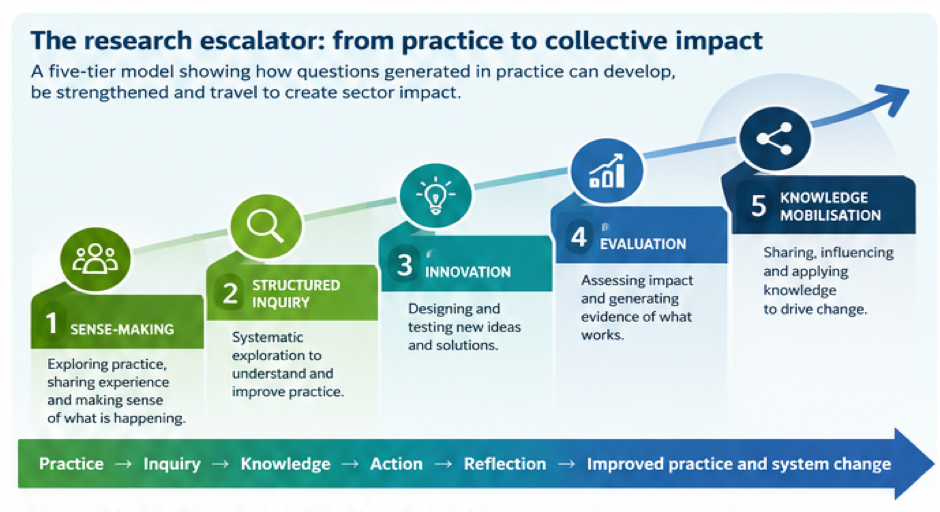
This is not an argument for replacing academic research with practitioner research, nor for sacrificing rigour in the interests of speed. It is about rewiring the connections between different forms of knowledge so that the sector can learn in the moment and during change, not only study change afterwards. Reason and Bradbury (2008) describe action research as an iterative relationship between inquiry and action; that recursive quality is particularly valuable in environments where practice cannot stand still while a multi-year study is completed. The five-tier framework below describes how questions generated in practice can develop: from sense-making, through structured inquiry and innovation, into evaluation and knowledge mobilisation. It is not a hierarchy of worth. Not every professional question needs to become an academic study. Rather, it creates routes through which promising insights can acquire greater evidence, challenge and reach.
Proportionate rigour in an agile system
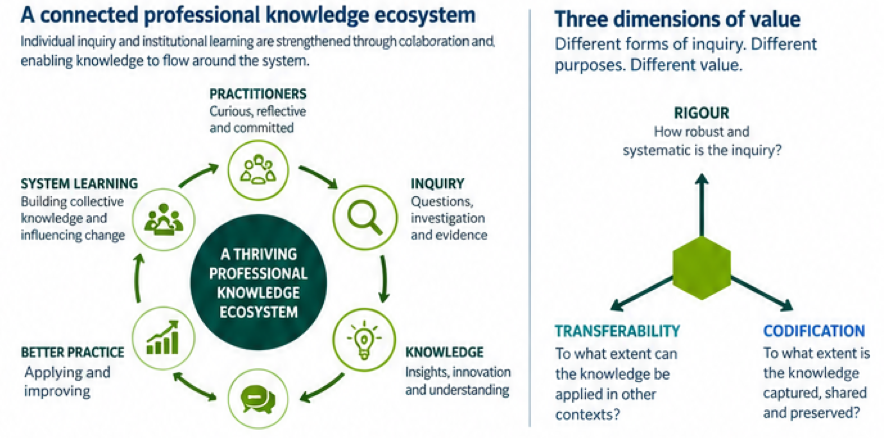
Calls for agility carry an obvious risk: rapid inquiry can become an excuse for weak evidence, small samples can be over-interpreted, and promising practice can too quickly become a claim about what works. The answer is not to slow every form of inquiry to the pace of classical academic research. It is to be explicit about what we know, how confidently we know it and what claims the evidence can support. The framework therefore considers research-related practice through three dimensions: rigour, transferability and codification. Rigour asks how robust and systematic the inquiry is. Transferability asks what others might reasonably learn from it and under what conditions. Codification asks whether the knowledge has been captured sufficiently well to be shared, challenged, taught, retained and developed. These dimensions allow different forms of inquiry to be valued without pretending that they all provide the same kind of evidence. A rapid piece of practitioner inquiry can be rigorous for its purpose while remaining appropriately cautious about causality. If an approach appears promising, it can move into further testing. Similar findings across settings can strengthen understanding of transferability. Academic partners can add theory, methodological expertise, comparison and critical challenge. Networks can enable findings to travel and be tested elsewhere. The result is not rigour versus agility, but proportionate rigour within an agile knowledge system.
From aspiration to conditions
If research is part of practice, the infrastructure that enables it becomes critical. Not everyone needs to become an academic researcher, but more practitioners need meaningful opportunities to ask good questions, interrogate evidence, undertake proportionate inquiry and connect what they learn with others. That requires leadership, capability, networks, research partnerships and, crucially, time. This moves the debate from aspiration to conditions. If practitioner research is to be valued, it cannot depend on individual enthusiasm or work undertaken in practitioners’ own time. Protected time or research remission, access to methodological support and opportunities to participate in research communities all signal that inquiry is part of work rather than an additional activity for the relatively few who can find the capacity to pursue it. Universities also have a role, not simply as producers of research about FE, but as partners able to bring theoretical insight, methodological challenge and research expertise to questions generated through practice. The ambition, therefore, is not simply more research about FE. It is to build a knowledge ecosystem in which practitioner, applied and academic research strengthen one another, knowledge can move at sufficient pace to remain useful, and learning generated through practice has routes through which it can be tested, challenged, codified and mobilised across the sector.
Rewiring the connections
The challenge is not to choose between academic and practitioner research, or between rigour and speed. It is to rewire the connections between them: creating a research system rigorous enough to trust, agile enough to remain relevant, connected enough for knowledge to travel, and close enough to practice to identify the questions worth asking in the first place.
To help build a clearer picture of research engagement across FE and skills, and what would enable it to develop, please share your experience and views through our short survey.
By Dr Vikki Smith, Independent Education & Skills Consultant and Researcher
References
Cochran-Smith, M. and Lytle, S.L. (2009) Inquiry as Stance: Practitioner Research for the Next Generation. New York: Teachers College Press.
Freire, P. (1970) Pedagogy of the Oppressed. New York: Continuum.
Reason, P. and Bradbury, H. (eds.) (2008) The SAGE Handbook of Action Research: Participative Inquiry and Practice. 2nd edn. London: Sage.
Schön, D.A. (1983) The Reflective Practitioner: How Professionals Think in Action. New York: Basic Books.
Stenhouse, L. (1975) An Introduction to Curriculum Research and Development. London: Heinemann.
Smith, V. and Hyde, M (2026) Research as System Infrastructure: An Integrated Framework for Further Education and Skills. Education Training Foundation.
Responses